


x

Handgemaltes Ölgemälde auf Leinwand in Ihrer Wunschgröße und mit Rahmen, auf Bestellung von unseren Künstlern angefertigt. ( Zum Druck wechseln Zum Bild wechseln)





























Wählen Sie aus unseren vordefinierten Formaten, die den ursprünglichen Proportionen des Kunstwerks entsprechen.

Sie können Ihre eigenen Maße eingeben, um einen bestimmten Rahmen oder Platz auszufüllen. Wenn die gewählte Größe nicht den Proportionen des Originalbildes entspricht, werden wir das Kunstwerk entweder beschneiden oder das Gemälde durch zusätzliche, handgemalte Elemente erweitern. Ein digitales Mockup wird Ihnen zur Genehmigung zugesandt, bevor die Produktion beginnt.
Bitte beachten Sie, dass die Bildschirmvorschau nicht die tatsächliche Beschneidung oder Erweiterung widerspiegelt. Nur das Mockup zeigt die endgültige Komposition exakt an.
Obwohl Sondermaße verfügbar sind, empfehlen wir, eine Größe aus der vordefinierten Liste zu wählen, um die ursprünglichen Proportionen beizubehalten.
Weltweiter Versand () in nur 3 bis 4 Wochen statt der üblichen 5 Wochen. (9 August). Keine Kompromisse bei der Qualität.


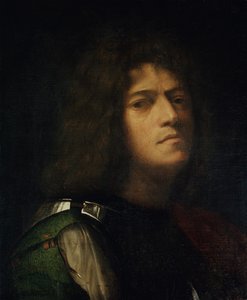
Junge mit Flöte
Format der Reproduktion
Giorgione’s “Junge mit Flöte” – a painting shrouded in mystery and whispered speculation – is more than just a portrait; it's an invitation into the heart of Venetian Renaissance artistry. Completed around 1508, this intimate depiction captures a young woman with luminous blonde hair, her gaze lost in contemplation as she holds a flute delicately in her hand. The scene unfolds within a carefully constructed space, dominated by a dark, almost velvety background that serves to heighten the brilliance and ethereal quality of the subject’s complexion and the light filtering through what appears to be an open window. The painting's power lies not just in its technical mastery but also in the profound sense of melancholy and quiet beauty it evokes – a characteristic that has captivated viewers for centuries.
Giorgio Barbarelli da Castelfranco, better known as Giorgione, remains one of the most enigmatic figures in Renaissance art. Born in 1477 or possibly 1478 in the small town of Castelfranco Veneto near Venice, his life was tragically short, ending around 1510 at the age of thirty-two or thirty-three. Unlike many of his contemporaries, whose lives are meticulously documented, Giorgione’s story is largely pieced together from fragmented historical accounts and the romanticized narratives of Giorgio Vasari. He likely began his artistic training under Giovanni Bellini, Venice's most prominent painter at the time, absorbing the established Venetian traditions before developing a distinctly personal style. His brief but impactful career produced only a handful of paintings – “Boy with Flute” being arguably his most famous – fueling speculation about his methods and motivations. The scarcity of biographical details adds to the allure surrounding this artist; he seems to have deliberately cultivated an aura of mystery, leaving us to interpret his work through its evocative imagery.
“Junge mit Flöte” exemplifies Giorgione’s unique approach to painting. He eschewed the precise detail and dramatic narratives favored by some of his contemporaries, opting instead for a hazy, atmospheric style that prioritizes mood and suggestion over sharp definition. The brushstrokes are incredibly subtle, almost dissolving into the overall tone of the painting – a technique known as *sfumato*, perfected by Leonardo da Vinci. Giorgione masterfully employs light and shadow to create an illusion of depth and volume, particularly evident in the rendering of the woman’s hair and clothing. The muted palette—primarily browns, ochres, and subtle greens—contributes significantly to the painting's dreamlike quality. The composition is remarkably simple yet profoundly effective; the focus remains entirely on the young woman, drawing the viewer into her private world of contemplation.
The symbolism within “Junge mit Flöte” has been a subject of intense debate among art historians. The flute itself is often interpreted as representing harmony, peace, and even the fleeting nature of beauty – themes central to Renaissance thought. Some scholars suggest that the open window symbolizes access to an idealized world, while the dark background could represent mortality or the passage of time. However, Giorgione deliberately avoided providing explicit answers, allowing each viewer to project their own interpretations onto the scene. The young woman’s expression is ambiguous; she appears serene yet melancholic, inviting us to contemplate her inner life and the mysteries of human emotion. Ultimately, “Junge mit Flöte” transcends its status as a simple portrait, becoming a meditation on beauty, loss, and the enduring power of art.
Most-Famous-Paintings offers meticulously crafted reproductions of Giorgione’s “Junge mit Flöte,” ensuring that you can experience the painting's captivating beauty in your own home. Our hand-painted reproductions utilize archival-quality materials and techniques, faithfully recreating the artist’s atmospheric style and subtle nuances. Whether you are an art collector, a design enthusiast, or simply seeking to add a touch of Renaissance elegance to your interior space, our reproduction provides an authentic representation of this iconic masterpiece. Bring the enigmatic beauty of Giorgione's "Junge mit Flöte" into your world – a timeless testament to Venetian artistry and human emotion.

1477 - 1510 , Italien

Entdecken Sie das faszinierende Werk Giorgiones und seinen Einfluss auf die venezianische Renaissance-Malerei. Analysen, Hintergrundinformationen & Meisterwerke – jetzt lesen!
Entdecken Sie die 25 Meisterwerke von Jacopo Tintoretto! Tauchen Sie ein in die dramatische Welt der venezianischen Renaissance. Hochwertige Kunst-Reproduktionen & Inspiration für Ihr Zuhause – jetzt auf Most-Famous-Paintings.com.

Embark on a journey through the Venetian Renaissance. Discover how masters like Giorgione and Titian revolutionized art through luminous color and light. Explore the profound legacy of the Venetian School and its enduring influence on the world of fine art.

Explore the Golden Age of Venetian art (1430–1580). Discover Giorgione, Titian & Tintoretto's techniques, the 'colorito' revolution, and lasting influence. Expert insights for collectors & enthusiasts.

Entdecken Sie die 10 berühmtesten Gemälde, die von düsteren Olivgrüntönen geprägt sind! Von Renaissance bis Impressionismus – erfahren Sie die Geschichten hinter den Meisterwerken und lassen Sie sich von Kunstlegenden wie Monet & Caravaggio inspirieren. Kunstdrucke auf .


Bleiben Sie über die neuesten Kunstnachrichten, exklusive Angebote und Dekorationsideen auf dem Laufenden.
Erzählen Sie uns von Ihrem Projekt, und unsere Kunstexperten erstellen für Sie drei personalisierte Kunstvorschläge.
Wir kuratieren 3 Optionen exklusiv für Sie – kostenlos!


 Vorschau anzeigen
 Versenden
 Teilen
 Details anzeigen

 Herunterladen
 Ähnliche Objekte
 Röntgenaufnahme
 Diashow


 Weiterlesen







 Die Glasoption ist nur für Größen unter 110 cm verfügbar.


