x


 Öl auf TafelEarly Netherlandish Painting
 1467Renaissance
 221.0 x 160.0 cm
 Muzeum Narodowe
Giclée- oder Leinwanddruck in Museumsqualität mit schneller Produktion und flexiblen Veredelungsoptionen. ( Zur handgemalten Reproduktion wechseln Zum Bild wechseln)





























Wählen Sie aus unseren vordefinierten Formaten, die den ursprünglichen Proportionen des Kunstwerks entsprechen.

Sie können Ihre eigenen Maße eingeben, um ein bestimmtes Format oder einen speziellen Platz einzupassen. Wenn das von Ihnen gewählte Format nicht den Proportionen des Originalbildes entspricht, werden wir das Kunstwerk entweder beschneiden oder das Bild mit einem gespiegelten oder einfarbigen Rand erweitern. Ein digitaler Entwurf wird Ihnen zur Genehmigung zugesandt, bevor die Produktion beginnt.
Bitte beachten Sie, dass die Vorschau auf dem Bildschirm nicht den tatsächlichen Zuschnitt oder die Erweiterung widerspiegelt. Nur der Entwurf zeigt die endgültige Komposition präzise an.
Obwohl Sondermaße verfügbar sind, empfehlen wir die Auswahl eines Maßes aus der vordefinierten Liste, um die ursprünglichen Proportionen zu bewahren.
Weltweiter Versand () innerhalb von 2 Wochen statt der üblichen 4/5 Wochen. (4 August)


Das letzte Gericht
Format der Reproduktion
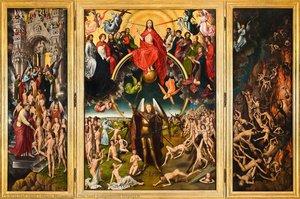
In the quiet corridors of the National Museum in Gdańsk, there exists a window into the divine, a breathtaking spectacle known as Hans Memling’s Last Judgment Triptych. Created between 1467 and 1471, this monumental work is far more than a mere religious relic; it is a symphonic achievement of Early Netherlandish painting that captures the very essence of human anxiety and spiritual hope. As one gazes upon the central panel, the viewer is immediately swept into a cosmic drama where the boundaries between the earthly and the eternal dissolve. The composition is anchored by the majestic presence of Jesus Christ, presiding over the apocalypse with a gravity that commands both awe and introspection. This is not merely a depiction of an event, but an immersive experience designed to stir the soul, making it an incomparable centerpiece for any collection dedicated to the profound depths of classical art.
The technical brilliance of Memling is nothing short of miraculous, showcasing a mastery of the oil medium that was revolutionary for the fifteenth century. Unlike the flatter, more opaque textures of tempera, Memling utilized the translucent properties of oil paint to achieve a luminous, sculptural quality. Each layer of pigment serves to build depth, allowing light to seemingly emanate from within the figures themselves. The drapery of Christ’s robes and the delicate features of the surrounding saints are rendered with such meticulous precision that they possess a tactile, three-dimensional presence. For the discerning collector or interior designer, this level of detail offers a rich visual texture that breathes life into a room, providing a focal point that rewards prolonged contemplation and reveals new nuances with every glance.
Beyond its physical beauty, the triptych serves as a complex theological map, woven with the intricate symbolism characteristic of the Burgundian Netherlands. The central panel acts as the fulcrum of existence, where St. Michael the Archangel performs the solemn task of weighing souls. This act of divine measurement introduces a palpable tension to the work; on one side, the promise of salvation beckons, while on the other, the terrifying descent into the abyss looms. The presence of figures like Tommaso Portinari, a prominent banker, embedded within the sacred narrative, bridges the gap between the contemporary world of the artist and the eternal realm of the divine. This fusion of the personal and the universal creates an emotional resonance that transcends centuries, inviting viewers to reflect on their own place within the grand tapestry of time.
The triptych’s structure—comprising the central scene of judgment, the left wing depicting the ascent to Heaven, and the right wing portraying the descent into Hell—offers a complete narrative arc of the human condition. The movement from the serene, light-filled heavens to the chaotic, shadowed depths of the underworld creates a dramatic chiaroscuro effect that is both visually arresting and emotionally taxing. For those seeking to incorporate art into a sophisticated living space, a high-quality reproduction of this work brings with it an atmosphere of profound dignity and intellectual depth. It is a piece that does not merely decorate a wall but transforms an environment, turning a room into a sanctuary of historical significance and spiritual beauty.
Deutschland

Entdecken Sie die 10 prägendsten Meisterwerke der Frühniederländischen Malerei! Von Jan van Eyck bis Rogier van der Weyden – erleben Sie Kunstgeschichte hautnah. Hochwertige Reproduktionen & Inspiration für Ihr Interieur auf Most-Famous-Paintings.com.

Entdecken Sie die 25 Meisterwerke von Claude Monet! Tauchen Sie ein in die Welt des Impressionismus, erleben Sie Seerosen, Sonnenaufgänge & Kathedralen. Hochwertige Reproduktionen für Ihr Zuhause – exklusiv auf Most-Famous-Paintings.com.
Entdecken Sie die 10 berühmtesten Gemälde, dominiert von grauen Tönen! Von Monet bis Hopper – erfahren Sie die Geschichten hinter den Meisterwerken und lassen Sie sich für Ihre Wohnideen inspirieren. Hochwertige Reproduktionen auf
Entdecken Sie die 25 faszinierendsten Meisterwerke von Hieronymus Bosch! Tauchen Sie ein in die düstere Schönheit niederländischer Malerei, religiöse Symbolik und fantastische Welten. Hochwertige Kunstdrucke & Inspiration für Ihr Zuhause auf Most-Famous-Paintings.com.

Entdecken Sie die 25 Meisterwerke von Francis Bacon! Erleben Sie existenzielle Schmerz, expressive Porträts & dunkle Farben. Kunstreproduktionen in Museumsqualiät auf Most-Famous-Paintings.com – für Ihre Wanddekoration.


Bleiben Sie über die neuesten Kunstnachrichten, exklusive Angebote und Dekorationsideen auf dem Laufenden.
Erzählen Sie uns von Ihrem Projekt, und unsere Kunstexperten erstellen für Sie drei personalisierte Kunstvorschläge.
Wir kuratieren 3 Optionen exklusiv für Sie – kostenlos!


 In echtem Maßstab anzeigen
 Versenden
 Teilen
 Details anzeigen

 Herunterladen
 Ähnliche Objekte
 Röntgenaufnahme
 Diashow starten
 Mehr anzeigen







 Die Glasoption ist nur in Größen unter 110 cm verfügbar.