


x


 Preview
 Druck bestellen Gemälde kaufen
 Versenden
 Details anzeigen
 Zu Favoriten hinzufügen
 Herunterladen
 Ähnliche Objekte
 Röntgenaufnahme
 Diashow anzeigen
Erwerben Sie ein hochauflösendes, optimiertes digitales Bild, das der Online-Vorschau weit überlegen ist.
Jede Datei wird von unseren hauseigenen Spezialisten mit modernsten Werkzeugen und fachmännischer manueller Retusche sorgfältig vorbereitet. Wir stellen sicher, dass jedes Bild eine außergewöhnliche Klarheit, präzise Farbgenauigkeit und feinste Details aufweist.
Die endgültige Datei wird innerhalb von 72 Stunden per E-Mail zugestellt und ist für den sofortigen Einsatz in professionellen, redaktionellen und Druckumgebungen optimiert. Es handelt sich um dieselbe Qualität, der führende Designstudios, Verlage und Galerien vertrauen.
Laden Sie eine hochauflösende Datei für die persönliche Präsentation, den Druck und kreative Projekte herunter.
Wenn Sie sich für Most-Famous-Paintings.com entscheiden, erhalten Sie nicht nur ein Bild – Sie erhalten ein professionell aufbereitetes digitales Kunstwerk, das mit höchster Präzision erstellt und durch eine Zufriedenheitsgarantie abgesichert wird. Hier ist alles, was automatisch mit Ihrer Bestellung geliefert wird:

Ihre hochauflösende digitale Bilddatei wird Ihnen innerhalb von 72 Stunden nach der Bestellung per E-Mail zugestellt – bereit zur sofortigen Verwendung.

Ihre Kunstwerke werden professionell mithilfe fortschrittlicher KI-Tools und manueller Bearbeitung optimiert, um maximale Detailtreue, Klarheit und Farbgenauigkeit zu gewährleisten.

Datei versehentlich gelöscht oder verloren? Keine Sorge – wir senden sie Ihnen jederzeit kostenlos erneut zu.

Genießen Sie Ihr Kunstwerk sofort ohne Zollgebühren, Einfuhrabgaben oder Versandkosten – digitale Downloads sind immer steuerfrei.

Wir garantieren, dass Ihr digitales Bild die Originalfarben mithilfe professioneller Werkzeuge und Farbmanagement so präzise wie möglich wiedergibt.

Sollten Sie mit Ihrem digitalen Bild nicht zufrieden sein, werden wir es überarbeiten oder Ihnen innerhalb von 60 Tagen 100% erstatten – ohne Wenn und Aber.

Nicht zufrieden? Erhalten Sie innerhalb von 60 Tagen nach Erhalt Ihrer digitalen Datei eine vollständige Rückerstattung – ohne Angabe von Gründen.

3 Bilder kaufen, 10% sparen – 5 Bilder kaufen, 15% sparen – Ab 10 Bildern 20% sparen. Ideal für kreative Projekte, Galerien und Agenturen.
Piet Mondrian’s “Composition,” produced around 1925, stands as a cornerstone of Neo-Plasticism—a movement that fundamentally reshaped the landscape of early twentieth-century art. More than just aesthetically pleasing, it embodies a profound philosophical assertion: that abstraction represents a more truthful reflection of reality than representational imagery.
As Dr Stephanie Chadwick eloquently explains in Smarthistory (Smarthistory), Mondrian believed that pure abstract art emancipated itself from the constraints of naturalistic depiction, liberating it to explore universal harmonies and principles.
Considered alongside references like *The Red Mill*, Mondrian’s formative landscapes reveal a young artist diligently studying nature—a meticulous process aimed at mastering technique. Yet, even amidst this careful observation, he harbored an insistent desire for simplification. He wasn't merely replicating what he saw; he sought to distill its essence into its purest form.
The painting itself is deceptively simple. A grid of horizontal and vertical lines dominates the canvas—a deliberate rejection of curvilinear forms favored by Impressionism and Cubism. Within this geometric framework reside squares of primary colors – red, blue, and yellow – interspersed with rectangles of black and white.
The meticulous execution is characteristic of Mondrian’s approach. Each square is precisely delineated, its edges sharply defined, conveying a sense of stability and order. The color palette—though restrained—is carefully considered; the hues are chosen to create visual balance and contribute to the overall meditative atmosphere.
“Composition” emerged during a period of intense intellectual ferment in Europe, fueled by breakthroughs in physics (Einstein’s theory of relativity) and psychology. Artists like Mondrian were grappling with questions about perception and representation, rejecting traditional artistic conventions in favor of new expressive languages.
The painting aligns perfectly with the tenets of Neo-Plasticism—a movement championed by artists including Kazimir Malevich and Theo van Doesburg. These pioneers sought to create a universal aesthetic language based on geometric abstraction, mirroring the underlying structure of the cosmos.
Mondrian’s use of color isn't arbitrary; it carries symbolic significance rooted in his spiritual beliefs. He drew inspiration from Zendavesta—the Zoroastrian sacred text—which posits that the universe is comprised of four elemental forces: fire, air, water, and earth.
The squares represent these elements, while the horizontal and vertical lines symbolize the opposing forces of heaven and earth. By eliminating extraneous details and reducing forms to their fundamental geometric shapes, Mondrian aimed to transcend subjective experience and capture a glimpse of objective reality—a quest for spiritual harmony expressed through visual language.
Despite its austere appearance, “Composition” possesses an undeniable emotional resonance. The balanced grid and harmonious color scheme evoke feelings of serenity and contemplation. It invites viewers to engage in a dialogue with the artwork itself—to consider its underlying principles and appreciate its subtle beauty.
As showcased at The Metropolitan Museum of Art (The Metropolitan Museum of Art), this piece exemplifies the movement’s ambition to communicate profound ideas through visual form, demonstrating how Mondrian successfully translated philosophical concepts into a powerfully evocative aesthetic experience.

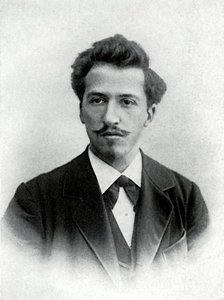
1872 - 1944 , Niederlande


Bleiben Sie über die neuesten Kunstnachrichten, exklusive Angebote und Dekorationsideen auf dem Laufenden.
Erzählen Sie uns von Ihrem Projekt und unsere Kunstexperten erstellen für Sie 3 personalisierte Kunstvorschläge.
Wir kuratieren 3 Optionen exklusiv für Sie – kostenlos!


 Teilen


 Weiterlesen


