x


Handgemaltes Ölgemälde auf Leinwand in Ihrer Wunschgröße und mit Rahmen, auf Bestellung von unseren Künstlern angefertigt. ( Switch to Print Switch to Image)





























Wählen Sie aus unseren vordefinierten Größen, die den ursprünglichen Proportionen des Kunstwerks entsprechen.

Sie können Ihre eigenen Maße eingeben, um einen bestimmten Rahmen oder Platz auszufüllen. Wenn die gewählte Größe nicht den Proportionen des Originalbildes entspricht, werden wir das Kunstwerk entweder beschneiden oder das Gemälde durch zusätzliche, handgemalte Elemente erweitern. Ein digitales Mockup wird Ihnen zur Genehmigung zugesandt, bevor die Produktion beginnt.
Bitte beachten Sie, dass die Bildschirmvorschau nicht die tatsächliche Beschneidung oder Erweiterung widerspiegelt. Nur das Mockup zeigt die endgültige Komposition exakt an.
Obwohl Sondermaße verfügbar sind, empfehlen wir, eine Größe aus der vordefinierten Liste zu wählen, um die ursprünglichen Proportionen beizubehalten.
Weltweiter Versand () in nur 3 bis 4 Wochen statt der üblichen 5 Wochen. (30 Juli). Keine Kompromisse bei der Qualität.


The secunder
Größe der Reproduktion
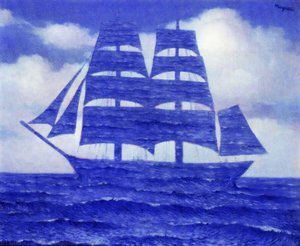
René Magritte’s “The Secunder” isn't merely a depiction of a ship on the ocean; it’s an invitation to question the very nature of reality and representation. Painted in 1928, during his intensely productive period exploring the boundaries of surrealism, this work embodies Magritte’s signature style – a deliberate disruption of familiar imagery designed to unsettle the viewer's assumptions. The painting presents a blue vessel sailing across a seemingly limitless expanse of water, beneath a sky punctuated by indistinct clouds. While superficially resembling a traditional pirate ship, its details are subtly off-kilter, hinting at an unreality that lies just beneath the surface. Notice the lack of detail in the ship’s construction; it feels almost constructed from fragments, as if assembled from memory rather than direct observation.
Magritte's fascination with the mechanics of perception is central to “The Secunder.” He wasn’t interested in simply replicating what he saw; instead, he aimed to expose the gap between our conscious experience and the underlying processes that shape it. The ship itself becomes a symbol of this disconnect – a recognizable form rendered ambiguous through its simplified features and the unsettling stillness of the scene. This deliberate ambiguity is further reinforced by the muted color palette, dominated by blues and greys, contributing to an atmosphere of quiet contemplation and subtle unease.
Understanding Magritte’s artistic journey requires acknowledging the profound impact of his early life. Born in Lessines, Belgium, in 1898, he experienced a deeply formative event at the age of thirteen – the suicide of his mother. The image of her body being recovered from the River Sambre, with her dress obscuring her face, became a recurring motif throughout his work, representing loss, mystery, and the hidden aspects of human experience. This trauma instilled within him a lifelong preoccupation with what remains unseen, concealed, or deliberately obscured – a theme powerfully realized in “The Secunder.” The veiled faces, the simplified forms, all contribute to this sense of something being withheld from direct comprehension.
This early experience isn’t simply a biographical detail; it fundamentally shaped Magritte's artistic approach. He wasn’t interested in creating beautiful or easily digestible images. Instead, he sought to provoke thought and challenge the viewer’s expectations, mirroring the unsettling nature of his own memories. His exploration of perception can be seen as an attempt to grapple with the unresolved grief and questions surrounding his mother’s death – a subconscious desire to bring something hidden into view.
Magritte's technique in “The Secunder” is characterized by meticulous detail combined with a calculated disregard for realism. He employed oil paints on canvas, building up layers of color and texture to create the illusion of depth and atmosphere. However, he deliberately avoided creating a convincing representation of space or light. The horizon line is flat, the clouds are amorphous, and the ship lacks any sense of dynamism. This deliberate disruption of traditional artistic conventions serves to further emphasize the painting’s surreal quality.
The composition itself is carefully balanced, with the ship positioned slightly off-center, drawing the viewer's eye across the canvas. The vastness of the ocean and sky creates a sense of isolation and loneliness, while the subtle details – such as the faint reflection on the water’s surface – add to the painting’s complexity. Magritte’s control over his materials is evident in every brushstroke, yet it's precisely this control that contributes to the work’s unsettling effect.
“The Secunder” resists easy interpretation, inviting viewers to project their own meanings onto the scene. The ship itself can be seen as a symbol of exploration, adventure, or even oblivion – a vessel adrift in an unknown sea. The obscured faces suggest a loss of identity, a questioning of selfhood, and perhaps a yearning for something beyond the visible world. The painting’s emotional impact is one of quiet contemplation, tinged with melancholy and a sense of mystery.
Ultimately, “The Secunder” isn't about providing answers; it’s about raising questions. It’s a testament to Magritte’s genius – his ability to create images that are both familiar and profoundly unsettling, prompting us to reconsider our assumptions about the world around us. A hand-painted reproduction of this iconic work offers a unique opportunity to experience the depth and complexity of Magritte's vision, bringing this enigmatic mariner into your home or studio.

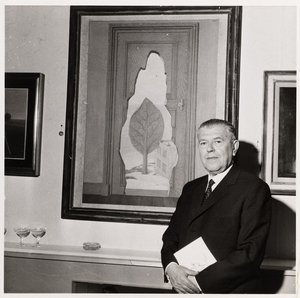
1898 - 1967 , Belgien
Entdecken Sie die 25 bedeutendsten Kunstwerke von Max Ernst! Tauchen Sie ein in die Welt des Surrealismus, Dada und abstrakter Malerei. Hochwertige Kunstreproduktionen & Inspiration für Ihr Zuhause bei Most-Famous-Paintings.com.

Entdecken Sie das faszinierende Leben und Werk von Frida Kahlo! Unsere Expertenanalyse beleuchtet ihren einzigartigen Stil, die tiefgründigen Selbstporträts und den bleibenden Einfluss der mexikanischen Künstlerin auf die Kunstgeschichte.

Entdecken Sie die 10 schönsten Bootsgemälde der Kunstgeschichte! Von Monet bis Van Gogh – erfahren Sie die Geschichten hinter ikonischen Werken, Techniken & Marinemalerei. Hochwertige Reproduktionen auf Most-Famous-Paintings.com.

Explore the rich history of ocean art! Discover Romantic seascapes, renowned artists like Aivazovsky & Harris, and expert guidance for collectors at Most-Famous-Paintings.com.

Entdecken Sie die Top 10 Gemälde in faszinierenden 'Slate Blue' Tönen! Von Monet bis Manet – erleben Sie Kunstgeschichte und lassen Sie sich von Meisterwerken inspirieren. Hochwertige Kunstdrucke auf


Bleiben Sie über die neuesten Kunstnachrichten, exklusive Angebote und Dekorationsideen auf dem Laufenden.
Erzählen Sie uns von Ihrem Projekt und unsere Kunstexperten erstellen für Sie 3 personalisierte Kunstvorschläge.
Wir kuratieren 3 Optionen exklusiv für Sie – kostenlos!


 Preview
 Versenden
 Teilen
 Details anzeigen

 Herunterladen
 Ähnliche Objekte
 Röntgenaufnahme
 Diashow anzeigen
 Weiterlesen







 Die Glasoption ist nur in Größen unter 110 cm verfügbar.