


x

Handgemaltes Ölgemälde auf Leinwand in Ihrer Wunschgröße und mit Rahmen, auf Bestellung von unseren Künstlern angefertigt. ( Zum Druck bestellen Zum Bild wechseln)
Wählen Sie aus unseren vordefinierten Formaten, die den ursprünglichen Proportionen des Kunstwerks entsprechen.

Sie können Ihre eigenen Maße eingeben, um einen bestimmten Rahmen oder Platz auszufüllen. Wenn die gewählte Größe nicht den Proportionen des Originalbildes entspricht, werden wir das Kunstwerk entweder beschneiden oder das Gemälde durch zusätzliche, handgemalte Elemente erweitern. Ein digitales Mockup wird Ihnen zur Genehmigung zugesandt, bevor die Produktion beginnt.
Bitte beachten Sie, dass die Bildschirmvorschau nicht die tatsächliche Beschneidung oder Erweiterung widerspiegelt. Nur das Mockup zeigt die endgültige Komposition exakt an.
Obwohl Sondermaße verfügbar sind, empfehlen wir, eine Größe aus der vordefinierten Liste zu wählen, um die ursprünglichen Proportionen beizubehalten.
Weltweiter Versand () in nur 3 bis 4 Wochen statt der üblichen 5 Wochen. (6 August). Keine Kompromisse bei der Qualität.


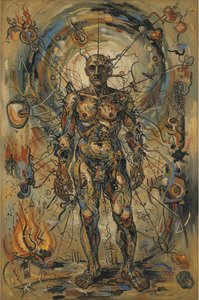
William Blake: Unbetitelte Zeichnung (Untitled Drawing)
Format der Reproduktion
William Blake's "The Ghost of Cadmus," painted in 1798, is not merely a depiction of a mythological figure; it’s a profound exploration of the human psyche grappling with prophecy, guilt, and the haunting power of the past. This intensely colored, almost hallucinatory image, rendered in tempera on paper, embodies Blake's unique vision – a synthesis of classical mythology, visionary experience, and deeply personal symbolism. The painting immediately arrests the viewer with its dramatic use of color: a swirling vortex of crimson, ochre, and deep blues dominates the composition, creating an atmosphere of intense emotional turbulence.
The subject is Cadmus, the Phoenician king who, according to Greek legend, founded Thebes by following a serpent’s guidance. Blake reimagines this story not as a triumphant founding myth, but as a descent into madness and despair. Cadmus, depicted as a spectral figure with a gaunt face and hollow eyes, stands amidst a desolate landscape – a barren field strewn with skulls and bones. He is surrounded by a swirling vortex of light and shadow, suggesting the chaotic forces that have driven him to this state. The painting’s power lies in its ability to evoke a sense of profound unease and psychological distress, far removed from the heroic narratives typically associated with classical mythology.
Blake's technique is characterized by an extraordinary intensity and dynamism. He employed tempera on paper, a medium that allowed for rich colors and immediate layering—a crucial element in conveying the painting’s turbulent atmosphere. The brushstrokes are loose and expressive, creating a sense of movement and urgency. Notice how he uses hatching and cross-hatching to build up form and texture, particularly in Cadmus's face and the surrounding landscape. This technique is reminiscent of both classical engraving and Blake’s own innovative printmaking style.
The painting exemplifies the Romantic aesthetic—a reaction against Enlightenment rationalism—with its emphasis on emotion, imagination, and the sublime. However, it transcends simple Romantic tropes through Blake's intensely personal symbolism. The use of color is particularly significant; crimson represents passion and violence, ochre symbolizes decay and death, while blues evoke a sense of melancholy and spiritual darkness. Blake’s style can be seen as a bridge between the classical tradition he studied and his own unique visionary approach.
“The Ghost of Cadmus” is replete with symbolic elements, inviting multiple interpretations. The serpent, central to the myth, represents both divine guidance and destructive temptation. Here, it’s depicted as a shadowy presence, suggesting that even the most seemingly benevolent forces can lead to ruin. Cadmus's gaunt appearance and hollow eyes symbolize his spiritual emptiness and psychological torment. The skulls scattered across the landscape represent the consequences of his actions—the victims of his ambition and madness.
The desolate setting itself is symbolic, representing a wasteland of the soul. It’s not merely a physical location but a metaphor for Cadmus's internal state – a realm of guilt, regret, and despair. The swirling vortex of light and shadow can be interpreted as the chaotic forces of fate or the destructive power of the imagination. Blake frequently used mythological figures to explore universal themes—the struggle between good and evil, the nature of consciousness, and the relationship between humanity and the divine – and “The Ghost of Cadmus” is a prime example of this approach.
“The Ghost of Cadmus” remains a powerfully evocative work of art. It doesn’t offer easy answers or comforting resolutions; instead, it confronts the viewer with the unsettling realities of human existence—the burden of guilt, the fragility of sanity, and the enduring power of the past. The painting's intensity and psychological depth continue to resonate with audiences today, cementing Blake’s place as one of the most significant figures in Western art.
Reproductions of this masterpiece offer a unique opportunity to experience Blake’s visionary world firsthand. Whether displayed in a private collection or incorporated into an interior design scheme, “The Ghost of Cadmus” serves as a potent reminder of the enduring power of art to explore the complexities of the human condition and challenge our perceptions of reality.

1757 - 1827 , Vereinigtes Königreich

Entdecken Sie das faszinierende Werk von Sir William Blake Richmond – ein Pionier des Ästhetizismus und Symbolismus. Erfahren Sie mehr über seine Mosaiken in St. Paul’s Cathedral, seinen Einfluss auf die Arts and Crafts Bewegung und sein Vermächtnis als Slade Professor.
Entdecken Sie das faszinierende Werk André Massons! Wir beleuchten seine Rolle im Surrealismus, die Technik des Automatismus und seinen Einfluss auf die moderne Kunstgeschichte. Expertenwissen & tiefe Einblicke.

Entdecken Sie den Abstrakten Expressionismus! Expertenratgeber für Sammler: Rothko, Pollock & Hofmann verstehen, wertvolle Kunst auswählen und Ihre emotionale Verbindung finden. Jetzt lesen!

Explore the captivating world of graphite drawing! Discover its rich history, master essential techniques like chiaroscuro, and learn how artists evoke emotion through this timeless medium. Expert insights for art enthusiasts.

Explore the captivating world of monochrome painting! Discover its rich history, from Renaissance chiaroscuro to contemporary minimalism. Uncover the emotional power and artistic techniques behind this enduring art form.


Bleiben Sie über die neuesten Kunstnachrichten, exklusive Angebote und Dekorationsideen auf dem Laufenden.
Erzählen Sie uns von Ihrem Projekt, und unsere Kunstexperten erstellen für Sie drei personalisierte Kunstvorschläge.
Wir kuratieren 3 Optionen exklusiv für Sie – kostenlos!


 Versenden
 Teilen
 Details anzeigen

 Herunterladen
 Ähnliche Objekte
 Diashow starten

 Mehr anzeigen




































 Die Glasoption ist nur in Größen unter 110 cm verfügbar.


