x

Handgemaltes Ölgemälde auf Leinwand in Ihrer Wunschgröße und mit Rahmen, auf Bestellung von unseren Künstlern angefertigt. ( Zum Druck wechseln Zum Bild wechseln)





























Wählen Sie aus unseren vordefinierten Formaten, die den ursprünglichen Proportionen des Kunstwerks entsprechen.

Sie können Ihre eigenen Maße eingeben, um einen bestimmten Rahmen oder Platz auszufüllen. Wenn die gewählte Größe nicht den Proportionen des Originalbildes entspricht, werden wir das Kunstwerk entweder beschneiden oder das Gemälde durch zusätzliche, handgemalte Elemente erweitern. Ein digitales Mockup wird Ihnen zur Genehmigung zugesandt, bevor die Produktion beginnt.
Bitte beachten Sie, dass die Bildschirmvorschau nicht die tatsächliche Beschneidung oder Erweiterung widerspiegelt. Nur das Mockup zeigt die endgültige Komposition exakt an.
Obwohl Sondermaße verfügbar sind, empfehlen wir, eine Größe aus der vordefinierten Liste zu wählen, um die ursprünglichen Proportionen beizubehalten.
Weltweiter Versand () in nur 3 bis 4 Wochen statt der üblichen 5 Wochen. (9 August). Keine Kompromisse bei der Qualität.


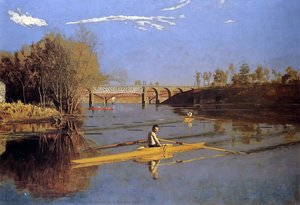
John Biglin in a Single Scull
Format der Reproduktion
Thomas Cowperthwait Eakins, born in Philadelphia on July 25, 1844, stands as a monumental figure in American art—a painter of unflinching realism who dedicated his life to capturing the essence of human experience. He wasn’t merely interested in *representing* the world; he sought to dissect it, understand its anatomy, both physical and psychological, and then reconstruct it on canvas with an honesty that often bordered on provocation. Eakins's path was not one of immediate acclaim, but rather a slow burn of dedication, controversy, and ultimately, enduring recognition as perhaps the most profound realist in 19th and early 20th-century American art. His Philadelphia wasn’t a city of grand landscapes or romantic ideals; it was a world of doctors, rowers, hunters, and everyday individuals—and these were his subjects, rendered with an almost scientific precision.
“John Biglin in a Single Scull,” completed in 1873, exemplifies Eakins’s distinctive approach. This watercolor, now housed at Yale University Art Gallery, isn't simply a depiction of rowing; it’s a meticulously observed study of human movement and perception under challenging conditions. Eakins painstakingly analyzed the physics of rowing—the angle of oars, the ripple effect on the water surface, the strain on muscles—translating these scientific principles into visual form.
Style and Technique: The painting’s style leans heavily toward Impressionism, albeit filtered through Eakins's rigorously analytical gaze. Unlike Impressionists who prioritized capturing fleeting moments of light and color, Eakins focused on conveying the solidity and physicality of his subject matter. He employed a technique characterized by smooth brushstrokes and subtle gradations of tone—a deliberate effort to mimic the way light interacts with surfaces. The watercolor medium itself lends an ethereal quality to the scene, enhancing the sense of atmosphere and mirroring the reflections shimmering on the water.
Historical Context: Rowing was a popular pastime in Victorian America, symbolizing strength, discipline, and social status. Eakins’s depiction captures this cultural preoccupation with physical prowess and competitive spirit. Furthermore, the painting reflects the burgeoning interest in scientific observation during the era—Eakins's meticulous anatomical studies informed his artistic process.
Symbolism and Emotional Impact: Beyond its technical merits, “John Biglin in a Single Scull” speaks to themes of concentration, perseverance, and the pursuit of excellence. The rower’s focused gaze and posture convey an unwavering determination—a testament to Eakins's belief that art should strive for accuracy and emotional resonance simultaneously. The muted palette contributes to a mood of quiet contemplation, inviting viewers to consider not just what is seen but also how it feels.
Conclusion: “John Biglin in a Single Scull” remains a cornerstone of Eakins’s oeuvre and a remarkable achievement in realist painting. It stands as a powerful reminder that true artistic brilliance lies in confronting reality head-on—analyzing its complexities, translating its essence into visual form, and conveying its profound emotional impact.


1844 - 1916 , Vereinigte Staaten von Amerika
Entdecken Sie die 10 Meisterwerke des Amerikanischen Realismus! Von Edward Hopper bis Winslow Homer – erleben Sie die Geschichten, Techniken & zeitlose Schönheit. Hochwertige Kunstdrucke auf Most-Famous-Paintings.com.

Discover the captivating world of Thomas Edwin Mostyn (1864-1930), a Victorian artist renowned for his romantic garden scenes and evocative portraits. Explore his artistic journey, legacy & find high-quality reproductions at Most-Famous-Paintings.

Entdecken Sie das Werk von Thomas Pollock Anshutz und die Entwicklung des Amerikanischen Realismus. Analysen, Hintergrundinformationen & Einblicke in seine sozialkritische Malerei und seinen Einfluss auf die amerikanische Kunstgeschichte.

Entdecken Sie die 10 legendärsten Akrylmalereien, die Kunstgeschichte schrieben! Von Jackson Pollock bis Gerhard Richter – erfahren Sie die Geschichten hinter den Meisterwerken und finden Sie hochwertige Reproduktionen für Ihr Zuhause. Jetzt bei entdecken!

Entdecken Sie die Welt der Acrylmalerei! Von Techniken & Geschichte bis zu zeitgenössischen Trends – umfassende Informationen, Künstlerporträts und Tipps für Ihre eigene Kunst. Jetzt lesen!


Bleiben Sie über die neuesten Kunstnachrichten, exklusive Angebote und Dekorationsideen auf dem Laufenden.
Erzählen Sie uns von Ihrem Projekt, und unsere Kunstexperten erstellen für Sie drei personalisierte Kunstvorschläge.
Wir kuratieren 3 Optionen exklusiv für Sie – kostenlos!


 Vorschau anzeigen
 Versenden
 Teilen
 Details anzeigen

 Herunterladen
 Ähnliche Objekte
 Röntgenaufnahme
 Diashow


 Weiterlesen







 Die Glasoption ist nur für Größen unter 110 cm verfügbar.