


x

Handgemaltes Ölgemälde auf Leinwand in Ihrer Wunschgröße und mit Rahmen, auf Bestellung von unseren Künstlern angefertigt. ( Switch to Print Switch to Image)





























Wählen Sie aus unseren vordefinierten Größen, die den ursprünglichen Proportionen des Kunstwerks entsprechen.

Sie können Ihre eigenen Maße eingeben, um einen bestimmten Rahmen oder Platz auszufüllen. Wenn die gewählte Größe nicht den Proportionen des Originalbildes entspricht, werden wir das Kunstwerk entweder beschneiden oder das Gemälde durch zusätzliche, handgemalte Elemente erweitern. Ein digitales Mockup wird Ihnen zur Genehmigung zugesandt, bevor die Produktion beginnt.
Bitte beachten Sie, dass die Bildschirmvorschau nicht die tatsächliche Beschneidung oder Erweiterung widerspiegelt. Nur das Mockup zeigt die endgültige Komposition exakt an.
Obwohl Sondermaße verfügbar sind, empfehlen wir, eine Größe aus der vordefinierten Liste zu wählen, um die ursprünglichen Proportionen beizubehalten.
Weltweiter Versand () in nur 3 bis 4 Wochen statt der üblichen 5 Wochen. (30 Juli). Keine Kompromisse bei der Qualität.


Globe
Größe der Reproduktion
Victor Vasarely's "Globe" is more than just a painting; it’s an invitation into the heart of Op Art, a visual exploration of perception and movement that defined a generation. This vibrant composition, dominated by concentric circles of luminous yellow and orange, immediately draws the eye inward, creating a mesmerizing depth that seems to defy the two-dimensional surface. The artwork's genesis lies in Vasarely’s pioneering work with kinetic art and his deep engagement with geometric abstraction – principles he honed during his formative years at the Bauhaus-influenced Műhely workshop.
Born in 1906 in Pécs, Croatia, Vasarely’s artistic trajectory began unexpectedly. Initially pursuing a medical degree, he abandoned this path to embrace the burgeoning world of visual expression, ultimately becoming a key figure in the development of Op Art – Optical Art. This movement, flourishing in the mid-20th century, sought to stimulate optical illusions through precise geometric forms. Vasarely’s approach was revolutionary; he meticulously constructed his paintings using static elements—circles, lines, and squares—to create dynamic visual effects that appeared to shift and move before the viewer's eyes. “Globe” exemplifies this technique perfectly, demonstrating how seemingly simple shapes can generate complex optical experiences.
The execution of "Globe" reveals Vasarely’s mastery of color theory and his deliberate manipulation of visual perception. The use of contrasting yellows and oranges isn't merely decorative; it’s a calculated strategy to heighten the illusion of movement and depth. Each circle is rendered with painstaking precision, creating a series of overlapping planes that trick the eye into perceiving three-dimensional space. Vasarely’s technique involved layering thin washes of paint, allowing each color to subtly interact with its neighbors, further enhancing the artwork's dynamic quality. The meticulous detail suggests a dedication to scientific observation and an understanding of how the human visual system processes information.
"Globe" can be interpreted as a representation of the universe itself – a microcosm reflecting the vastness and complexity of space. The concentric circles evoke notions of orbits, cycles, and interconnectedness, mirroring Vasarely’s fascination with mathematical principles and their application to art. Beyond its symbolic resonance, the artwork possesses a powerful emotional impact. Its vibrant colors and dynamic composition generate a sense of excitement, wonder, and perhaps even a slight disorientation – a testament to Op Art's ability to challenge our perceptions and stimulate our senses. This piece is not simply observed; it’s experienced.
Victor Vasarely (geboren Károly Vaszary) war eine zentrale Figur in der Entwicklung der Op Art und kinetischen Kunst. Seine Arbeit versuchte, die traditionelle Malerei zu überwinden, indem er optische Illusionen erforschte und dynamische visuelle Erfahrungen schuf. Geboren in Pécs, damals Teil Österreich-Ungarns (heute Kroatien), umfassten seine frühen Jahre ein Medizinstudium an der Eötvös Loránd Universität in Budapest, bevor er sich ganz der Kunst widmete.
Vasarelys Beitrag zur Kunstgeschichte ist vielschichtig. Er ging über traditionelle Maltechniken hinaus, um Werke zu schaffen, die die Wahrnehmung des Betrachters aktiv einbeziehen. Sein systematischer Ansatz forderte konventionelle Vorstellungen künstlerischer Kreativität heraus und ebnete den Weg für computergenerierte Kunst und digitales Design. Indem er Reproduzierbarkeit und kommerzielle Anwendungen annahm, verschwamm Vasarely die Grenzen zwischen bildender Kunst und Populärkultur und hinterließ einen bleibenden Eindruck in beiden Bereichen.

1906 - 1997 , Kroatien
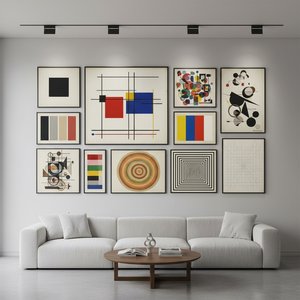
Entdecken Sie die 10 Meisterwerke der geometrischen Abstraktion! Von Kandinsky bis Mondrian – erleben Sie die Geschichte, Farben & Formen dieser revolutionären Kunstrichtung. Hochwertige Kunstreproduktionen auf Most-Famous-Paintings.com

Entdecken Sie das faszinierende Werk von Victor Vasarely, dem Pionier der Op Art! Erfahren Sie mehr über seine künstlerischen Grundlagen, Prinzipien und seinen Einfluss auf die moderne Kunst. Jetzt bei Most-Famous-Paintings!

Explore Orphism, the vibrant abstract art movement pioneered by Robert & Sonia Delaunay. Discover its unique color theory, lasting influence on modern art, and how to bring this 'symphony of color' into your home with Most-Famous-Paintings.

Explore the fascinating relationship between color & emotion in art history. Discover how master artists like Matisse & Gauguin used vibrant hues to evoke feelings and cultural meanings. A deep dive for classic art enthusiasts.

Explore the enduring legacy of geometric abstraction! Discover key artists, historical movements & investment insights for discerning art collectors. Expert guidance from Most-Famous-Paintings.


Bleiben Sie über die neuesten Kunstnachrichten, exklusive Angebote und Dekorationsideen auf dem Laufenden.
Erzählen Sie uns von Ihrem Projekt und unsere Kunstexperten erstellen für Sie 3 personalisierte Kunstvorschläge.
Wir kuratieren 3 Optionen exklusiv für Sie – kostenlos!


 Preview
 Versenden
 Teilen
 Details anzeigen

 Herunterladen
 Ähnliche Objekte
 Röntgenaufnahme
 Diashow anzeigen

 Weiterlesen







 Die Glasoption ist nur in Größen unter 110 cm verfügbar.


