


x
 Preview
 Druck bestellen Bild kaufen
 Versenden
 Details anzeigen
 Zu Favoriten hinzufügen
 Herunterladen
 Ähnliche Objekte
 Röntgenaufnahme
 Diashow anzeigen
Handgemaltes Ölgemälde auf Leinwand in Ihrer Wunschgröße und mit Rahmen, auf Bestellung von unseren Künstlern angefertigt.
Wählen Sie aus unseren vordefinierten Größen, die den ursprünglichen Proportionen des Kunstwerks entsprechen.

Sie können Ihre eigenen Maße eingeben, um einen bestimmten Rahmen oder Platz auszufüllen. Wenn die gewählte Größe nicht den Proportionen des Originalbildes entspricht, werden wir das Kunstwerk entweder beschneiden oder das Gemälde durch zusätzliche, handgemalte Elemente erweitern. Ein digitales Mockup wird Ihnen zur Genehmigung zugesandt, bevor die Produktion beginnt.
Bitte beachten Sie, dass die Bildschirmvorschau nicht die tatsächliche Beschneidung oder Erweiterung widerspiegelt. Nur das Mockup zeigt die endgültige Komposition exakt an.
Obwohl Sondermaße verfügbar sind, empfehlen wir, eine Größe aus der vordefinierten Liste zu wählen, um die ursprünglichen Proportionen beizubehalten.
Weltweiter Versand () in nur 3 bis 4 Wochen statt der üblichen 5 Wochen. (25 Juli). Keine Kompromisse bei der Qualität.


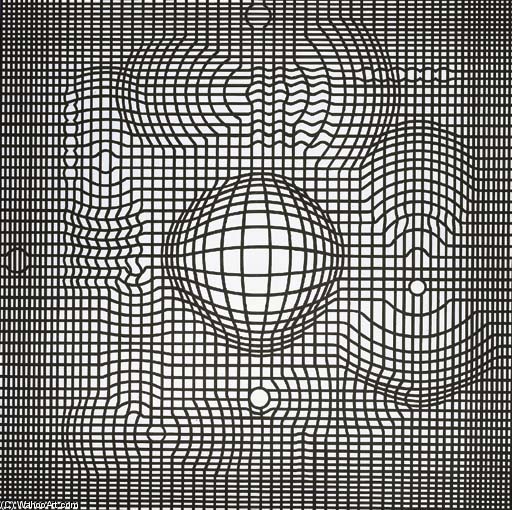
Jong
Größe der Reproduktion
Victor Vasarely's 'Jong,' completed in 1968, is more than just an image; it’s an invitation to question the very nature of reality. This arresting work, a cornerstone of Op Art, immediately captivates with its seemingly impossible optical illusion – a distorted face emerging from a grid of meticulously crafted black and white lines, culminating in a central sphere that appears to both contain and disrupt the composition. Vasarely, born Károly Vaszary in 1906 in Pécs, Croatia, was a visionary who dedicated his life to exploring how our eyes perceive space and form. His journey began with an unexpected detour – initially pursuing medical studies before embracing the world of art in 1927 – a shift profoundly shaped by his education at the Podolini-Volkmann Academy and, crucially, Sándor Bortnyik’s ‘Műhely,’ where he absorbed the revolutionary ideas of the Bauhaus movement. This foundation laid the groundwork for his groundbreaking exploration of geometric abstraction, ultimately leading to the creation of 'Jong' – a testament to his mastery of visual deception.
'Jong’s' power lies in its masterful use of line. A dense grid of parallel lines forms the foundational structure, but these lines are deliberately warped, curved, and distorted – a technique central to Op Art. This manipulation creates an intense sense of movement and visual ambiguity, drawing the viewer into a complex interplay between perception and reality. The sphere at the heart of the composition acts as both a focal point and a destabilizing element, further amplifying the illusion. The stark monochrome palette—a deliberate choice by Vasarely—heightens the impact of this geometric play, stripping away any distractions and focusing solely on the dynamic relationship between form and space.
Beyond its purely visual effect, ‘Jong’ carries a potent symbolic weight. The distorted face, rendered through abstract distortions within the grid, can be interpreted as representing hidden identities or fragmented perceptions – themes frequently explored by Vasarely. The work suggests that what we see isn't necessarily a faithful reflection of reality but rather a subjective interpretation shaped by our own biases and experiences. This resonates with broader philosophical questions about identity, consciousness, and the nature of truth. The implied movement within the composition evokes a sense of dynamism and instability, mirroring the fluid and often contradictory aspects of human experience.
'Jong' is more than just an artwork; it’s a captivating exploration of perception itself. Its enduring appeal lies in its ability to challenge our assumptions about reality and invite us to reconsider how we see the world. Reproduced with meticulous attention to detail, this piece offers a unique opportunity to bring a touch of Op Art's dynamism and intellectual depth into any interior space – a conversation starter, a visual puzzle, and a testament to Victor Vasarely’s visionary genius.
Victor Vasarely (geboren Károly Vaszary) war eine zentrale Figur in der Entwicklung der Op Art und kinetischen Kunst. Seine Arbeit versuchte, die traditionelle Malerei zu überwinden, indem er optische Illusionen erforschte und dynamische visuelle Erfahrungen schuf. Geboren in Pécs, damals Teil Österreich-Ungarns (heute Kroatien), umfassten seine frühen Jahre ein Medizinstudium an der Eötvös Loránd Universität in Budapest, bevor er sich ganz der Kunst widmete.
Vasarelys Beitrag zur Kunstgeschichte ist vielschichtig. Er ging über traditionelle Maltechniken hinaus, um Werke zu schaffen, die die Wahrnehmung des Betrachters aktiv einbeziehen. Sein systematischer Ansatz forderte konventionelle Vorstellungen künstlerischer Kreativität heraus und ebnete den Weg für computergenerierte Kunst und digitales Design. Indem er Reproduzierbarkeit und kommerzielle Anwendungen annahm, verschwamm Vasarely die Grenzen zwischen bildender Kunst und Populärkultur und hinterließ einen bleibenden Eindruck in beiden Bereichen.

1906 - 1997 , Kroatien

Entdecken Sie das faszinierende Werk von Victor Vasarely, dem Pionier der Op Art! Erfahren Sie mehr über seine künstlerischen Grundlagen, Prinzipien und seinen Einfluss auf die moderne Kunst. Jetzt bei Most-Famous-Paintings!

Entdecken Sie die Top 10 minimalistischer Kunstwerke von Rothko bis Mondrian! Erfahren Sie die Geschichten hinter diesen ikonischen Gemälden & finden Sie Inspiration für ruhige Interieurs. Museum-Qualität bei Most-Famous-Paintings.

Entdecken Sie die düsteren Schönheiten der Kunst! Unsere Top 10 Gemälde dominieren durch Elfenbeinschwarz – von Rembrandt bis Goya. Erfahren Sie mehr über Künstler, Techniken & Bedeutung. Hochwertige Reproduktionen auf
Entdecken Sie die Top 10 Gemälde, die von tiefem Schwarz und dramatischer Atmosphäre geprägt sind. Von Caravaggio bis Manet – Kunstgeschichte erleben & hochwertige Reproduktionen auf finden! Jetzt entdecken.

Entdecken Sie die Top 10 berühmter Gemälde, dominiert von Weiß! Von Malewitsch bis Rothko – erfahren Sie Geschichten hinter ikonischen Kunstwerke und lassen Sie sich für Ihre Wohnraumgestaltung inspirieren. Kunstreproduktionen in Museumsqualiät auf


Bleiben Sie über die neuesten Kunstnachrichten, exklusive Angebote und Dekorationsideen auf dem Laufenden.
Erzählen Sie uns von Ihrem Projekt und unsere Kunstexperten erstellen für Sie 3 personalisierte Kunstvorschläge.
Wir kuratieren 3 Optionen exklusiv für Sie – kostenlos!


 Teilen


 Weiterlesen




































 Die Glasoption ist nur in Größen unter 110 cm verfügbar.


