


x

 Druck bestellen Bild kaufen
 Versenden
 Details anzeigen
 Zu Favoriten hinzufügen
 Herunterladen
 Ähnliche Objekte
 Röntgenaufnahme
 Diashow anzeigen
Handgemaltes Ölgemälde auf Leinwand in Ihrer Wunschgröße und mit Rahmen, auf Bestellung von unseren Künstlern angefertigt.





























Wählen Sie aus unseren vordefinierten Größen, die den ursprünglichen Proportionen des Kunstwerks entsprechen.

Sie können Ihre eigenen Maße eingeben, um einen bestimmten Rahmen oder Platz auszufüllen. Wenn die gewählte Größe nicht den Proportionen des Originalbildes entspricht, werden wir das Kunstwerk entweder beschneiden oder das Gemälde durch zusätzliche, handgemalte Elemente erweitern. Ein digitales Mockup wird Ihnen zur Genehmigung zugesandt, bevor die Produktion beginnt.
Bitte beachten Sie, dass die Bildschirmvorschau nicht die tatsächliche Beschneidung oder Erweiterung widerspiegelt. Nur das Mockup zeigt die endgültige Komposition exakt an.
Obwohl Sondermaße verfügbar sind, empfehlen wir, eine Größe aus der vordefinierten Liste zu wählen, um die ursprünglichen Proportionen beizubehalten.
Weltweiter Versand () in nur 3 bis 4 Wochen statt der üblichen 5 Wochen. (21 Juli). Keine Kompromisse bei der Qualität.


SIR-RIS
Größe der Reproduktion
Victor Vasarely’s ‘SIR-RIS,’ a captivating sculpture rendered in meticulous black and white, stands as a cornerstone of Op Art – a movement that fundamentally challenged our understanding of visual perception. This isn't merely a representation of form; it’s an invitation to actively participate in the illusion, a testament to Vasarely’s mastery of manipulating space and light through geometric precision. The photograph captures ‘SIR-RIS’ in all its arresting complexity: a stylized cube, seemingly fractured by intersecting lines that generate a dynamic, almost dizzying effect. The stark contrast between the sculpture's intricate pattern and the clean white pedestal immediately draws the eye, emphasizing the artwork’s deliberate disruption of conventional visual experience.
Vasarely’s approach was rooted in a rigorous exploration of mathematical principles and their application to artistic creation. ‘SIR-RIS’ exemplifies this perfectly. The sculpture's design relies heavily on parallel lines that curve and intersect, creating a powerful sense of movement and distortion. These aren’t random arrangements; they are precisely calculated to exploit the way our eyes perceive depth and distance. The use of black and white amplifies this effect, eliminating color as a distraction and forcing the viewer to focus solely on the interplay of lines and shapes. The polished metal surface, likely chosen for its reflective qualities, further enhances this illusion, creating an almost three-dimensional experience within the two-dimensional image.
Born in 1906 in Pécs, Croatia (then part of Austria-Hungary), Victor Vasarely’s journey began far from the world of abstract art. Initially studying medicine, he was drawn to visual expression, a path solidified by his enrollment in Sándor Bortnyik's workshop – a hub for Bauhaus-influenced design. This formative experience instilled within him a fascination with functional geometry and its potential to create dynamic visual experiences. ‘SIR-RIS’ is a direct descendant of this lineage, echoing the principles of Op Art—a movement that sought to stimulate the eye through optical illusions. Vasarely's work anticipated many developments in kinetic art and influenced generations of designers and artists who explored the relationship between perception and form. The sculpture’s creation involved careful planning and execution, likely utilizing templates or precise tools to ensure the accuracy of the repeating pattern – a testament to the artist’s dedication to his craft.
Beyond its purely visual impact, ‘SIR-RIS’ reflects Vasarely's broader vision for the future. His work often explored themes of urban development and technological advancement, envisioning a world shaped by geometric order and rational design. The sculpture can be interpreted as a representation of a structured, yet dynamic, cityscape – a “city of tomorrow” where form and function are inextricably linked. The deliberate fragmentation and distortion suggest a critical engagement with the complexities of modern life, prompting viewers to question their own perceptions and assumptions about reality. Vasarely’s legacy extends beyond artistic innovation; it represents a profound exploration of how we experience and interpret the world around us.
Victor Vasarely (geboren Károly Vaszary) war eine zentrale Figur in der Entwicklung der Op Art und kinetischen Kunst. Seine Arbeit versuchte, die traditionelle Malerei zu überwinden, indem er optische Illusionen erforschte und dynamische visuelle Erfahrungen schuf. Geboren in Pécs, damals Teil Österreich-Ungarns (heute Kroatien), umfassten seine frühen Jahre ein Medizinstudium an der Eötvös Loránd Universität in Budapest, bevor er sich ganz der Kunst widmete.
Vasarelys Beitrag zur Kunstgeschichte ist vielschichtig. Er ging über traditionelle Maltechniken hinaus, um Werke zu schaffen, die die Wahrnehmung des Betrachters aktiv einbeziehen. Sein systematischer Ansatz forderte konventionelle Vorstellungen künstlerischer Kreativität heraus und ebnete den Weg für computergenerierte Kunst und digitales Design. Indem er Reproduzierbarkeit und kommerzielle Anwendungen annahm, verschwamm Vasarely die Grenzen zwischen bildender Kunst und Populärkultur und hinterließ einen bleibenden Eindruck in beiden Bereichen.

1906 - 1997 , Kroatien
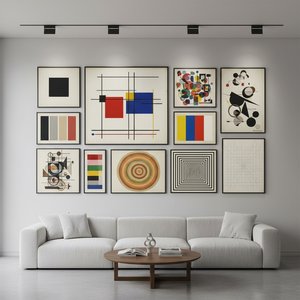
Entdecken Sie die 10 Meisterwerke der geometrischen Abstraktion! Von Kandinsky bis Mondrian – erleben Sie die Geschichte, Farben & Formen dieser revolutionären Kunstrichtung. Hochwertige Kunstreproduktionen auf Most-Famous-Paintings.com

Explore the evolution of geometric abstraction from Cubism to contemporary art. Discover key artists like Malevich & Mondrian, investment insights, and expert collecting advice at Most-Famous-Paintings.

Explore the captivating world of geometric abstraction! Discover its origins, key artists like Kandinsky & Mondrian, and why this movement remains highly valued by art collectors today. Expert insights at Most-Famous-Paintings.

Entdecken Sie das faszinierende Werk von Victor Vasarely, dem Pionier der Op Art! Erfahren Sie mehr über seine künstlerischen Grundlagen, Prinzipien und seinen Einfluss auf die moderne Kunst. Jetzt bei Most-Famous-Paintings!
Entdecken Sie die faszinierende Welt monochromer Innenräume! Expertenwissen zu Farbpsychologie, Lichtgestaltung & Materialwahl für elegante, zeitlose Designs. Inspiration & Fallstudien.


Bleiben Sie über die neuesten Kunstnachrichten, exklusive Angebote und Dekorationsideen auf dem Laufenden.
Erzählen Sie uns von Ihrem Projekt und unsere Kunstexperten erstellen für Sie 3 personalisierte Kunstvorschläge.
Wir kuratieren 3 Optionen exklusiv für Sie – kostenlos!


 Teilen


 Weiterlesen







 Die Glasoption ist nur in Größen unter 110 cm verfügbar.


