x

Hand-painted oil on canvas in your size and frame, made to order by our artists. ( Buy Print Buy Image)





























Pick from our preset sizes that match the artwork's original proportions.

You may enter your own dimensions to fit a specific frame or space. If your selected size does not match the original image's proportions, we will either crop the artwork or extend the painting with additional hand-painted elements. A digital mockup will be sent for your approval before production begins.
Please note that the on-screen preview does not reflect the actual cropping or extension. Only the mockup will accurately show the final composition.
While custom sizes are available, we recommend selecting a dimension from the predefined list to preserve the original proportions.
Worldwide Delivery () in 3/4 weeks instead of standard 5 weeks. (15 August). No compromise on quality.


Ignudo (24)
Reproduction Size
Within the awe-inspiring confines of the Cappella Sistina, nestled amongst the monumental narratives of creation and judgment, resides a deceptively simple yet profoundly resonant fresco – *Ignudo (24)*. Created by the unparalleled genius of Michelangelo Buonarroti in 1509, this intimate depiction of a nude youth offers a rare glimpse into the artist’s profound understanding of human anatomy, his masterful command of light and shadow, and his ability to imbue even the most elemental form with an extraordinary sense of presence. More than just a representation of a young man, *Ignudo* is a meditation on beauty, vulnerability, and the very essence of the human condition – a cornerstone of High Renaissance art that continues to captivate viewers centuries later.
The fresco’s title, “ignudo,” meaning “naked” in Italian, immediately establishes its subject matter. Michelangelo chose to portray a young man seated on a ledge or wall, his gaze directed directly at the viewer with an expression of quiet curiosity. This direct engagement is crucial; it's not a detached observation but a palpable connection, as if the figure is acknowledging our presence within the sacred space of the Sistine Chapel. The pose itself – relaxed yet alert – suggests a moment of contemplation, inviting us to share in his silent awareness.
Michelangelo’s technique in *Ignudo* is nothing short of breathtaking. Executed with the fresco medium—pigments mixed with water and applied to wet plaster—the image possesses a remarkable luminosity and depth. Notice how he renders the musculature, not as idealized perfection but with a palpable sense of underlying strength and vulnerability. The subtle variations in tone create an illusion of volume, while the delicate rendering of the skin reveals the artist’s meticulous attention to detail. The curls of his hair are particularly striking – sculpted with an almost sculptural quality, they add to the figure's youthful vitality.
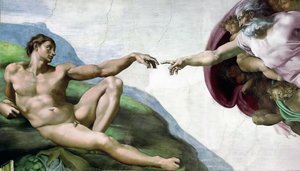
To fully appreciate *Ignudo*, it’s essential to understand its place within the larger context of the Sistine Chapel ceiling. Commissioned by Pope Julius II, this ambitious project aimed to transform the chapel into a visual encyclopedia of biblical narratives. Michelangelo was initially tasked with painting the entire ceiling, but he soon realized that his true passion lay in sculpting – and he famously resisted painting, insisting on executing the fresco himself. The result is a breathtaking panorama of scenes from Genesis, culminating in the iconic *Creation of Adam*. *Ignudo*, situated amongst these grand narratives, serves as a poignant counterpoint—a moment of quiet contemplation amidst the drama of divine creation.
Interestingly, the chapel’s decoration wasn't solely Michelangelo’s. Before his monumental undertaking, artists like Botticelli, Ghirlandaio, and Perugino had contributed to the walls, establishing a rich artistic tradition within the space. Raphael later added magnificent tapestries, further enriching the visual tapestry of the Sistine Chapel.
*Ignudo* is more than just a beautiful image; it’s laden with symbolism. The nude figure represents the innocence and vulnerability of youth, while his direct gaze invites us to contemplate our own mortality and place in the universe. The inclusion of minor details – the bird in the upper left corner, the vase at the bottom right – adds layers of meaning, suggesting a connection to earthly pleasures and the cyclical nature of life. The fresco’s enduring legacy lies not only in its artistic merit but also in its ability to provoke contemplation and inspire awe. It remains a testament to Michelangelo's genius and a powerful symbol of the Renaissance ideal of human beauty and potential.
For those seeking a high-quality reproduction, Most-Famous-Paintings offers meticulously crafted hand-painted reproductions that capture the essence of this iconic masterpiece. Explore our collection today and bring a piece of art history into your home.


1475 - 1564 , Italy
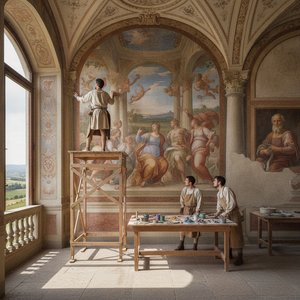
Explore the profound history and technical mastery of fresco painting. From ancient Roman murals to Michelangelo's Sistine Chapel, discover the enduring chemistry and artistry behind this timeless wall painting technique used by the world's greatest masters.

Explore the profound genius of the Renaissance Trinity. Delve into a comparative study of Leonardo da Vinci, Michelangelo, and Raphael, uncovering their unique contributions to art history, technique, and the enduring legacy of Italian High Renaissance mastery.


Stay updated with the latest art news, exclusive offers, and decoration ideas.
Tell us about your project and our art experts will provide you with 3 personalized art suggestions.
Let Us Curate 3 Options Just for You - Free!


 Preview
 Send
Send Share
Share
 Details

 Download
 Similars
 X-Ray
X-Ray Diaporama


 Read More







 Glass option is only available in size under 110 CM