x

Hand-painted oil on canvas in your size and frame, made to order by our artists. ( Buy Print Buy Image)





























Pick from our preset sizes that match the artwork's original proportions.

You may enter your own dimensions to fit a specific frame or space. If your selected size does not match the original image's proportions, we will either crop the artwork or extend the painting with additional hand-painted elements. A digital mockup will be sent for your approval before production begins.
Please note that the on-screen preview does not reflect the actual cropping or extension. Only the mockup will accurately show the final composition.
While custom sizes are available, we recommend selecting a dimension from the predefined list to preserve the original proportions.
Worldwide Delivery () in 3/4 weeks instead of standard 5 weeks. (12 August). No compromise on quality.


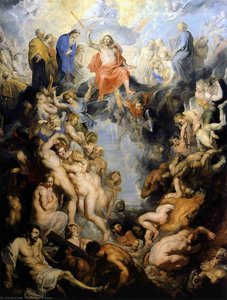
Apotheose of Louis XIV
Reproduction Size
Charles Le Brun’s “Apotheose of Louis XIV,” painted in 1677, isn't merely a portrait; it’s a meticulously crafted declaration of royal authority, a visual embodiment of the Sun King’s absolute power. Commissioned during a pivotal moment in French history – following the scandalous arrest of his predecessor, Nicolas Fouquet – this monumental work served as both a celebration of Louis XIV and a strategic assertion of the monarchy's legitimacy. Le Brun, already a favored court painter, was tasked with creating an image that transcended simple representation, aiming instead to elevate the king to a position of divine status within the grand narrative of French history.
The painting depicts Louis XIV seated upon a colossal throne, not in a traditional military setting, but amidst a fantastical landscape teeming with allegorical figures. He is flanked by his queen, Anne of Austria, and their children, each rendered with exquisite detail and imbued with symbolic meaning. To the left, Mars, god of war, bestows upon Louis XIV a laurel wreath – a potent symbol of victory and imperial glory. On the right, Neptune, ruler of the seas, offers him a trident, representing his dominion over France’s maritime power. The entire scene is bathed in rich, opulent colors—deep reds, golds, and blues—characteristic of the Baroque style, creating an atmosphere of dramatic intensity and regal splendor.
Le Brun's mastery of technique is immediately apparent in “Apotheose of Louis XIV.” He employed a complex layering of glazes – thin, translucent layers of paint applied over dried underpaintings—to achieve an astonishing level of luminosity and depth. This technique, known as *sfumato*, creates a hazy, atmospheric effect that softens the forms and imbues the scene with a sense of ethereal beauty. The meticulous rendering of fabrics, jewels, and armor demonstrates Le Brun’s unparalleled skill in capturing texture and detail. Notably, he utilized a pyramidal composition, drawing the viewer's eye directly to Louis XIV at the apex, reinforcing his central importance within the artwork.
The painting also showcases Le Brun’s innovative approach to perspective. He skillfully manipulated space and depth to create an illusion of vastness, suggesting that Louis XIV’s power extends far beyond the confines of the royal court. The use of aerial perspective—where distant objects appear paler and less distinct—further enhances this effect, transporting the viewer into a world of grandeur and majesty.
Beyond its technical brilliance, “Apotheose of Louis XIV” is laden with symbolism designed to reinforce the king’s divine right to rule. The allegorical figures surrounding Louis XIV are not merely decorative; they represent key aspects of his reign – military strength, maritime dominance, and the prosperity of France. The inclusion of the royal family underscores the importance of lineage and succession, solidifying the legitimacy of the monarchy. Furthermore, the painting’s scale—a monumental canvas measuring approximately 10 feet by 13 feet—served to impress upon viewers the sheer magnitude of Louis XIV's power and influence.
Considering the context of Fouquet’s downfall, the commission itself was a deliberate act of propaganda. Le Brun sought to erase any lingering doubts about the king’s competence and legitimacy, presenting him as an almost god-like figure presiding over a flourishing empire. The painting served as a powerful visual statement—a declaration that Louis XIV was not merely a ruler but a divinely appointed sovereign destined to guide France into an era of unprecedented glory.
“Apotheose of Louis XIV” remains a testament to Charles Le Brun’s artistic genius and his pivotal role in shaping the visual language of the French Baroque. It is a masterpiece that continues to captivate viewers with its dramatic intensity, exquisite detail, and profound symbolism. Reproductions of this iconic work offer an opportunity to experience the grandeur of Louis XIV's reign and appreciate the enduring legacy of one of France’s greatest artists. Its rich colors and dynamic composition make it a striking addition to any interior space, evoking a sense of power, majesty, and timeless elegance.


1619 - 1690 , France

Explore the profound elegance of Baroque Classicism. Discover how 17th-century masters synthesized dramatic emotion with classical order through the lens of the Counter-Reformation and the works of legends like Carlo Maratta and Andrea Sacchi.

Explore the dramatic power of Baroque art through an expert guide to light, shadow, and emotion. Discover how the Counter-Reformation shaped 17th-century masterpieces and learn about the profound techniques used by the Old Masters to inspire awe.

Explore the dramatic evolution from Mannerist distortion to Baroque grandeur. Discover how light, shadow, and emotion redefined art history through a masterclass in technical mastery and religious fervor.

Explore the profound differences between Baroque drama and Rococo elegance. Our expert guide delves into art history, chiaroscuro, and the evolution of European masterpieces for collectors and enthusiasts seeking deep historical context.

Explore the dramatic world of Baroque portraiture. Discover how masters used chiaroscuro and light to evoke profound emotion during the Counter-Reformation. A definitive guide for art enthusiasts seeking to understand the power of 17th-century masterpieces.


Stay updated with the latest art news, exclusive offers, and decoration ideas.
Tell us about your project and our art experts will provide you with 3 personalized art suggestions.
Let Us Curate 3 Options Just for You - Free!


 Preview
 Send
Send Share
Share
 Details

 Download
 Similars
 X-Ray
X-Ray Diaporama


 Read More







 Glass option is only available in size under 110 CM