


x
 Acrylic On CanvasWallArtItalian Mannerism
 1570
1570 89.0 x 72.0 cm
 National Gallery
Hand-painted oil on canvas in your size and frame, made to order by our artists. ( Switch to Print Switch to Image)





























Pick from our preset sizes that match the artwork's original proportions.

You may enter your own dimensions to fit a specific frame or space. If your selected size does not match the original image's proportions, we will either crop the artwork or extend the painting with additional hand-painted elements. A digital mockup will be sent for your approval before production begins.
Please note that the on-screen preview does not reflect the actual cropping or extension. Only the mockup will accurately show the final composition.
While custom sizes are available, we recommend selecting a dimension from the predefined list to preserve the original proportions.
Worldwide Delivery () in 3/4 weeks instead of standard 5 weeks. (11 August). No compromise on quality.


Portrait of a Man holding a Letter (
Reproduction Size
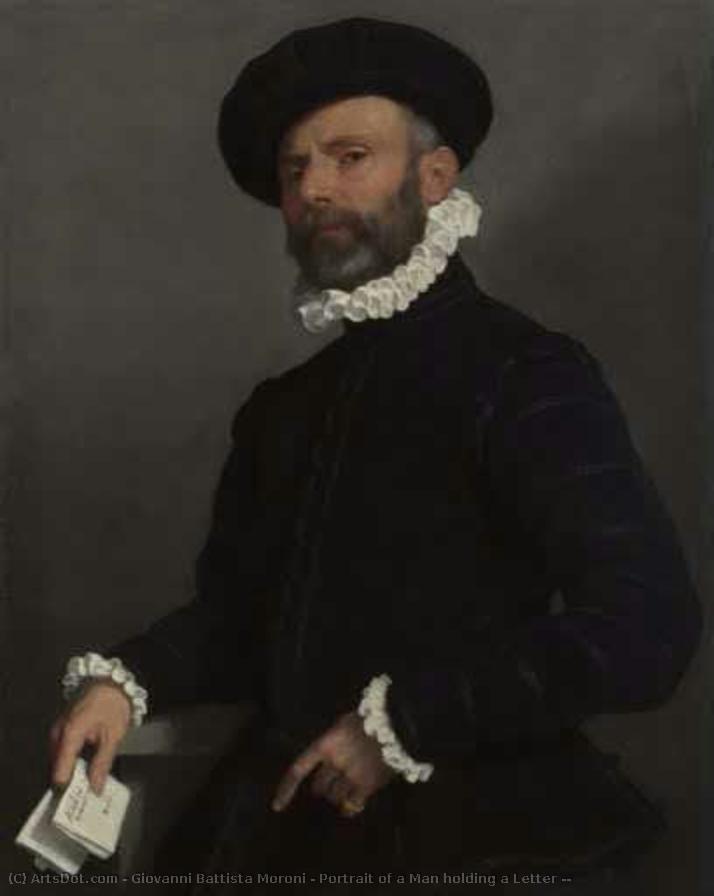
Giovanni Battista Moroni’s “Portrait of a Man Holding a Letter,” painted circa 1570, stands as a testament to the enduring power of Renaissance portraiture. Executed during Moroni's prolific period in Trento – where he collaborated closely with Titian and Cristoforo Madruzzo – this artwork embodies the refined Mannerist style that dominated Venetian art circles at the time.
The painting depicts a man of considerable stature, dressed impeccably in a black suit adorned with white ruffles. His gaze is direct, conveying confidence and composure. The inclusion of a letter grasped firmly in his hand speaks volumes about his profession – likely a diplomat or administrator – subtly layering social commentary onto the formal portrait genre.
Moroni skillfully employs Venetian painting techniques honed under Titian’s tutelage. The muted gray background serves as an ideal canvas for highlighting the man's features, allowing Moroni to achieve a luminous effect characteristic of Venetian art. Careful blending of pigments creates subtle gradations of color, capturing the nuances of light and shadow with remarkable precision. This meticulous attention to detail underscores Moroni’s mastery of chiaroscuro – the dramatic interplay between light and dark – a cornerstone of Mannerist aesthetics.
“Portrait of a Man Holding a Letter” emerged from Trento's influential Madruzzo circle, spearheaded by Cristoforo Madruzzo, Bishop of Trento. This artistic milieu fostered experimentation with innovative compositional strategies and psychological depth. Moroni’s work reflects the broader humanist concerns prevalent during the Reformation era, emphasizing human dignity and intellectual contemplation – values deeply rooted in Renaissance ideals.
Beyond its technical brilliance, the portrait resonates with symbolic significance. The man's gesture—grasping the letter—represents communication and engagement with the outside world. Simultaneously, his facial expression conveys a profound sense of thoughtfulness and introspection. Moroni’s masterful depiction captures not merely physical likeness but also psychological character, elevating the portrait beyond mere representation into an exploration of human emotion.
“Portrait of a Man Holding a Letter” transcends time, offering viewers a glimpse into the spirit of Renaissance Italy. Its understated elegance invites contemplation on themes of status, intellect, and human connection. Today, reproductions of this artwork continue to inspire interior designers seeking sophisticated pieces that embody timeless beauty and intellectual curiosity.

Giovanni Battista Moroni (also known as Giambattista Moroni) was born in Albino, near Bergamo, Italy, in 1520. His father, Andrea Moroni, was an architect, providing a formative environment for artistic development. He received his initial training under Alessandro Bonvicino (known as Moretto) in Brescia. This early apprenticeship laid the foundation for his technical skills and understanding of Renaissance painting techniques.
Moroni’s artistic journey took him through various Italian cities, including Trento and Bergamo. A pivotal moment occurred during his stay in Trento where he encountered Titian and the Count-Bishop Cristoforo Madruzzo. Titian's influence is evident in Moroni’s use of color and sophisticated handling of light. While initially influenced by earlier Renaissance styles, Moroni gradually developed a distinctive Mannerist approach characterized by elegance and realism.
Among Moroni’s most renowned paintings are:
Giovanni Battista Moroni’s work holds a significant place in Italian art history. He bridged the gap between High Renaissance ideals and the emerging Mannerist style, creating portraits that were both elegant and psychologically compelling. His influence extended to later artists such as Fra' Galgario and Pietro Longhi, who admired his ability to capture the essence of his subjects. Today, Moroni’s paintings are displayed in prestigious museums like the Uffizi Gallery and the National Gallery, continuing to inspire art lovers and scholars alike.
Moroni's legacy rests on his ability to elevate portraiture beyond mere representation. He infused his works with a sense of humanity and psychological depth that continues to resonate with audiences centuries later. His paintings offer a unique glimpse into the lives and personalities of 16th-century Italy, solidifying his position as a master of the Cinquecento era.

1520 - 1578 , Italy

Explore the luminous mastery of the Venetian Renaissance. Discover how masters like Titian and Giorgione revolutionized art through colorito, light, and atmosphere. An expert guide to the golden age of Italian painting for collectors and enthusiasts.


Stay updated with the latest art news, exclusive offers, and decoration ideas.
Tell us about your project and our art experts will provide you with 3 personalized art suggestions.
Let Us Curate 3 Options Just for You - Free!


 Preview
 Send
Send Share
Share
 Details

 Download
 Similars
 X-Ray
X-Ray Diaporama
 Read More







 Glass option is only available in size under 110 CM


