


x

Hand-painted oil on canvas in your size and frame, made to order by our artists. ( Switch to Print Switch to Image)
Pick from our preset sizes that match the artwork's original proportions.

You may enter your own dimensions to fit a specific frame or space. If your selected size does not match the original image's proportions, we will either crop the artwork or extend the painting with additional hand-painted elements. A digital mockup will be sent for your approval before production begins.
Please note that the on-screen preview does not reflect the actual cropping or extension. Only the mockup will accurately show the final composition.
While custom sizes are available, we recommend selecting a dimension from the predefined list to preserve the original proportions.
Worldwide Delivery () in 3/4 weeks instead of standard 5 weeks. (6 August). No compromise on quality.


The Insignia of the City of London
Reproduction Size

Born on April 21, 1630, in Haarlem, Netherlands, Pieter Gerritsz van Roestraten emerged as a prominent figure during the Dutch Golden Age. His father, Gerrit Maertenszoon, may have originated from Leiden. Van Roestraten began his artistic journey by studying under the renowned painter Frans Hals in Haarlem for at least five years starting from 1649. This foundational training significantly shaped his early style and technique.
Following his apprenticeship, Van Roestraten moved to Amsterdam around 1651, residing in the Anthonie Breestraat. He married Adriaentje Hals, a daughter of Frans Hals, six years his senior, in 1654. Around this time, he developed a close working relationship with Flemish genre painter Daniël Boone. Subsequently, Van Roestraten relocated to London, where he would spend the remainder of his career. This move proved pivotal, allowing him access to a wealthy and influential clientele.
Van Roestraten’s time in London was marked by success and patronage from high society. He skillfully navigated the artistic landscape, reportedly introduced to King Charles II by Sir Peter Lely with a stipulation that he refrain from portraiture. This allowed him to focus on his preferred subjects: still lifes and genre scenes. He earned substantial income – forty to fifty pounds sterling per still life – reflecting the demand for his work.
Van Roestraten’s artistic output encompassed several genres, but he is most celebrated for his masterful still lifes. His works are characterized by:
Frans Hals’s influence is evident in Van Roestraten's loose brushwork and realistic portrayal of figures. However, he developed a unique style characterized by meticulous detail, particularly in rendering textures and light effects. His time in London exposed him to different artistic trends, further refining his technique.
Van Roestraten’s legacy lies in his ability to capture the opulence and philosophical undercurrents of the Dutch Golden Age. His still lifes are not merely decorative; they serve as meditations on life, death, and the fleeting nature of material wealth. Surviving the Great Fire of London in 1666 added a layer of resilience to his story. He died on July 10, 1700, and was buried in St. Paul's Cathedral.
Today, Pieter Gerritsz van Roestraten’s works are held in various collections worldwide, offering a valuable window into the artistic and cultural landscape of the 17th century. His paintings continue to be admired for their technical skill, symbolic depth, and historical significance.

1630 - 1700 , Netherlands

Journey into the Dutch Golden Age! Explore 10 iconic paintings by Rembrandt, Vermeer & Hals. Discover the stories behind these Baroque masterpieces and find museum-quality art reproductions to elevate your home decor on .
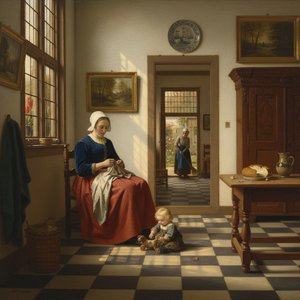
Explore the captivating world of Pieter de Hooch, a master of Dutch Golden Age painting. Discover his innovative use of light, intimate domestic scenes, and lasting influence on art history. Learn more at Most-Famous-Paintings.

Explore the life & legacy of Sir Anthony van Dyck, the leading court painter of his era. Discover his innovative portraiture, Baroque masterpieces, and investment potential for discerning collectors. Learn more at Most-Famous-Paintings.

Explore the captivating world of Dutch Golden Age genre painting! Discover realistic depictions of daily life, masterful artists like Ostade & Metsu, and hidden symbolism. Learn about this influential art movement with Most-Famous-Paintings.

Explore the rich history of still life painting with Most-Famous-Paintings. Discover Dutch Masters, decode vanitas symbolism & learn about collecting timeless art. Expert insights and museum-quality reproductions.


Stay updated with the latest art news, exclusive offers, and decoration ideas.
Tell us about your project and our art experts will provide you with 3 personalized art suggestions.
Let Us Curate 3 Options Just for You - Free!


 Preview
 Send
Send Share
Share
 Details

 Download
 Similars
 X-Ray
X-Ray Diaporama
 Read More




































 Glass option is only available in size under 110 CM


