x

Hand-painted oil on canvas in your size and frame, made to order by our artists. ( Buy Print Buy Image)
Pick from our preset sizes that match the artwork's original proportions.

You may enter your own dimensions to fit a specific frame or space. If your selected size does not match the original image's proportions, we will either crop the artwork or extend the painting with additional hand-painted elements. A digital mockup will be sent for your approval before production begins.
Please note that the on-screen preview does not reflect the actual cropping or extension. Only the mockup will accurately show the final composition.
While custom sizes are available, we recommend selecting a dimension from the predefined list to preserve the original proportions.
Worldwide Delivery () in 3/4 weeks instead of standard 5 weeks. (12 August). No compromise on quality.


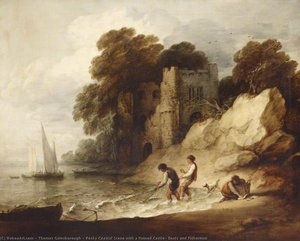
Old hastings, sussex
Reproduction Size

Born in Norwich, England, on May 16th, 1782, John Sell Cotman’s life was inextricably linked to the artistic spirit of his hometown and the burgeoning landscape movement that swept across Britain. The son of a silk merchant and lace dealer, Edmund Cotman, young John initially seemed destined for a business career, but an early and profound passion for art quickly steered him towards a different path. His education at Norwich Grammar School provided a foundation, yet it was his explorations of the surrounding countryside – the rolling hills of North Norfolk, the dramatic coastlines, and the serene rivers – that truly ignited his artistic vision. Cotman’s early career involved sketching trips with influential artists like J.M.W. Turner and Peter de Wint, experiences that profoundly shaped his understanding of light, composition, and the evocative power of nature.
Cotman's artistic style is immediately recognizable for its atmospheric quality and masterful use of light. Unlike the more precise and detailed works of his contemporaries, Cotman favored a looser, more expressive approach. He was particularly adept at capturing the fleeting effects of weather – mist, fog, rain, and sunlight filtering through clouds – creating paintings that seem to breathe with life. His palette tended towards muted tones—greens, browns, grays, and blues—which he skillfully blended to evoke a sense of depth and mood. He wasn’t interested in photographic realism; instead, he sought to convey the *feeling* of a place, its character and spirit.
Cotman’s oeuvre includes numerous paintings that showcase his distinctive style and technical skill. Among his most celebrated works are *A Study of the River Bure* (1809), *The Mill at Walsey Hall* (1810), and *Norfolk Coast* (c. 1835). These paintings, along with many others, demonstrate his ability to capture the beauty and drama of the Norfolk landscape. His work was exhibited regularly at the Royal Academy in London, where it garnered considerable acclaim during his lifetime. Despite a period of relative obscurity in the 1870s, Cotman’s influence on subsequent generations of British landscape painters – particularly J.M.W. Turner and John Constable – is undeniable.
John Sell Cotman continued to paint throughout his life, producing works until his death on July 24th, 1842, in Norwich. He left behind a substantial body of work that reflects his deep connection to the Norfolk landscape and his mastery of capturing its atmospheric beauty. His legacy extends beyond his individual paintings; he helped establish the Norwich School as a significant force in British art history, paving the way for future generations of landscape painters. His dedication to observing and portraying the natural world with sensitivity and skill ensures that John Sell Cotman’s work continues to resonate with viewers today.

1782 - 1853 , United Kingdom

Explore the emotional depth of Romantic landscape painting (18th-19th century). Discover key artists like Friedrich & Cole, and the concepts of the sublime. Expert insights for art lovers & collectors.

Explore the captivating world of Henry Thomas Dawson (1811-1878), a master of Victorian marine painting. Discover his evocative coastal scenes, landscapes & lasting artistic legacy. Learn about collecting Dawson's work and find reproductions at Most-Famous-Paintings.

Explore the captivating world of 19th-century landscape painting! Discover renowned artists like Friedrich & Monet, key movements, and find the perfect artwork to bring nature's serenity into your home. Expert insights at Most-Famous-Paintings.

Explore the captivating world of Romantic Realism! Discover key artists like Courbet & Millet, masterpieces, and the social context behind this influential art movement. Expert insights for collectors at Most-Famous-Paintings.

Explore the captivating world of Fritz von Uhde, a pivotal German painter bridging Realism & Symbolism. Discover his plein-air techniques, religious themes, and influence on modern art. Learn about this fascinating artist at Most-Famous-Paintings.


Stay updated with the latest art news, exclusive offers, and decoration ideas.
Tell us about your project and our art experts will provide you with 3 personalized art suggestions.
Let Us Curate 3 Options Just for You - Free!


 Preview
 Send
Send Share
Share
 Details

 Download
 Similars
 X-Ray
X-Ray Diaporama
 Read More




































 Glass option is only available in size under 110 CM