x


 Oil On CanvasWallArtBaroque
 1622Renaissance
 394.0 x 295.0 cm
 The Louvre
Hand-painted oil on canvas in your size and frame, made to order by our artists.





























Pick from our preset sizes that match the artwork's original proportions.

You may enter your own dimensions to fit a specific frame or space. If your selected size does not match the original image's proportions, we will either crop the artwork or extend the painting with additional hand-painted elements. A digital mockup will be sent for your approval before production begins.
Please note that the on-screen preview does not reflect the actual cropping or extension. Only the mockup will accurately show the final composition.
While custom sizes are available, we recommend selecting a dimension from the predefined list to preserve the original proportions.
Worldwide Delivery () in 3/4 weeks instead of standard 5 weeks. (18 July). No compromise on quality.


The Meeting of Marie de M dicis and Henri IV at Lyon
Reproduction Size
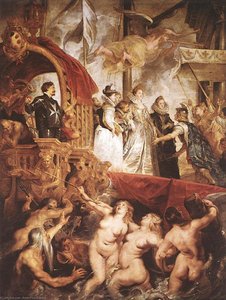
Peter Paul Rubens' "The Meeting of Marie de Médicis and Henri IV at Lyon," painted in 1622, is more than just a historical record; it’s a vibrant explosion of Baroque energy, a testament to the artist’s mastery of color, composition, and the dramatic portrayal of power. Housed within the hallowed halls of the Musée du Louvre, this monumental oil on canvas invites us into a pivotal moment in French history – the carefully orchestrated meeting between the Queen Mother and the young King Henri IV, a union designed to solidify the stability of the realm after years of religious strife.
Rubens, deeply influenced by his time spent absorbing the artistic legacy of Italy, particularly the dramatic realism championed by Caravaggio, infused this scene with an immediate sense of movement and theatricality. The figures aren’t static portraits; they are caught in a dynamic exchange, radiating authority and carefully constructed diplomacy. Henri IV, clad in a commanding red robe – a color traditionally associated with royalty and power – dominates the left side of the composition, his posture exuding confidence and leadership. Opposite him, Marie de Médicis is rendered with a more restrained elegance, her attire suggesting both her regal status and the weight of responsibility she carried as Queen Mother.
The painting’s brilliance lies not only in its subject matter but also in Rubens' masterful technique. He employs a complex layering of colors – rich reds, deep blues, and shimmering golds – to create an astonishingly realistic depiction of texture and light. Note the meticulous detail lavished upon the fabrics, the subtle nuances of expression on the faces, and the way he captures the movement of the horse at the base of the scene, adding a crucial element of dynamism. The use of *tenebrism*, a technique characterized by strong contrasts between light and dark, further intensifies the drama and draws the viewer’s eye to the central figures.
The meeting depicted in “The Meeting of Marie de Médicis and Henri IV at Lyon” was a carefully calculated event. Following decades of religious conflict between Catholics and Protestants, France desperately needed a symbol of unity. Henri IV’s ascension to the throne as a Protestant who had converted to Catholicism – earning him the moniker "Father of his Country" – represented a crucial step towards reconciliation. This painting serves as a visual embodiment of that aspiration, portraying the Queen Mother and King as symbols of a united France, ready to face the challenges ahead.
Beyond the immediate political context, the scene also reflects the broader cultural currents of the era. Rubens was deeply interested in classical mythology and history, and his work frequently drew inspiration from these sources. The composition itself echoes Renaissance depictions of historical gatherings, while the figures’ gestures and expressions are imbued with a sense of formality and dignity reminiscent of courtly portraiture. The inclusion of the horse is particularly significant; it symbolizes power, nobility, and the military strength of the French monarchy.
Rubens masterfully employs symbolism throughout the painting to convey deeper meanings. The red robe worn by Henri IV isn’t merely a signifier of royalty; it also represents his role as a protector of the realm, a warrior defending France from its enemies. Marie de Médicis' more subdued attire suggests her role as a mediator and diplomat, a figure who seeks to bridge divides and foster harmony. The positioning of the figures – Henri IV slightly closer to the viewer – subtly reinforces his authority and importance.
Furthermore, Rubens’ use of perspective creates a sense of depth and spatial complexity. The receding lines of the architecture in the background draw the eye towards the central figures, while the carefully arranged grouping of figures within the foreground establishes a clear hierarchy of importance. The overall composition is meticulously balanced, reflecting the artist's commitment to achieving visual harmony.
“The Meeting of Marie de Médicis and Henri IV at Lyon” stands as a prime example of Peter Paul Rubens’ unparalleled artistic skill and his profound impact on the development of Baroque painting. It is a dynamic, emotionally charged depiction of a pivotal historical event, rendered with breathtaking technical virtuosity. Today, this monumental work continues to captivate viewers with its vibrant colors, dramatic composition, and enduring message of unity and reconciliation. For those seeking to experience the grandeur of the Baroque era firsthand, reproductions of this masterpiece offer a remarkable opportunity to bring this iconic painting into your home – a testament to the power of art to capture history and evoke emotion.
Size: 394 x 295 cm
Date: 1622
Artist: Peter Paul Rubens (1577-1640)

Sir Peter Paul Rubens, a name that resonates with the very essence of Baroque dynamism, was far more than simply a painter. He was a diplomat, a scholar, and a cultural architect who fundamentally reshaped the artistic landscape of 17th-century Europe. Born in Siegen, Germany, in 1577, his early life was marked by displacement—a formative experience that would subtly permeate his later work with an undercurrent of drama and emotional depth. His father, Jan Rubens, a lawyer fleeing religious persecution for his Calvinist beliefs, uprooted the family from their native Antwerp, then under Spanish rule. This initial exile instilled in young Peter Paul a sense of resilience and adaptability, qualities that would serve him well throughout his multifaceted career. Following his father’s death in 1587, the family returned to Antwerp, where he received a humanist education before embarking on his artistic training around 1590, apprenticing under Tobias Verhaecht and Adam van Noort, honing foundational skills in drawing and painting techniques. However, it was his time with Otto van Veen that proved pivotal, exposing him to the rich legacy of Italian Renaissance art—a world he would soon embrace wholeheartedly.
In 1600, Rubens embarked on a transformative journey to Italy, a pilgrimage that irrevocably shaped his artistic vision. For eight years, he immersed himself in the masterpieces of Michelangelo, Raphael, and Titian, absorbing their mastery of form, color, and composition. The influence of these Renaissance giants is readily apparent in his early Italian works, characterized by classical themes and idealized figures. Yet, Rubens didn’t merely imitate; he synthesized these influences with his own innate talent, developing a distinctive style marked by vibrant hues, dynamic compositions, and a sensuous depiction of the human form. He studied anatomy meticulously, resulting in figures that possessed both physical realism and emotional power—robust bodies imbued with life and movement. This period wasn’t solely about artistic development; it was a profound intellectual awakening, fostering a deep appreciation for classical mythology and literature which would become recurring motifs throughout his oeuvre. Upon returning to Antwerp in 1608, Rubens swiftly established himself as the leading artist of his time, receiving a flood of commissions that testified to his burgeoning reputation and solidifying his position at the forefront of Flemish art.
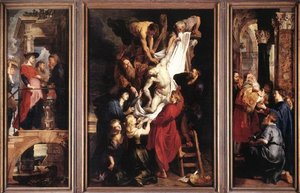
Rubens’s artistic output was astonishingly diverse and prolific. He didn't confine himself to a single genre; instead, he excelled in history paintings, mythological scenes, portraits, landscapes, and religious works—a testament to his versatility and boundless creativity. His large-scale canvases, often intended for churches, palaces, and public spaces, were breathtaking displays of technical virtuosity and dramatic storytelling. The Descent from the Cross (c. 1616-1617) exemplifies his masterful use of light and shadow to create a scene of profound emotional intensity, drawing viewers into the heart of the narrative. The Raising of the Cross (1610-1611), with its swirling figures and dynamic composition, showcases his ability to convey movement and energy—a hallmark of his Baroque style. Even in seemingly static subjects like The Judgement of Paris (c. 1636), Rubens infused a sense of life and vitality through his vibrant color palette and sensual depiction of the human form. His technique was equally remarkable – a masterful command of oil painting, employing impasto to create texture and depth, alongside delicate glazing techniques to achieve luminous effects. He frequently employed allegorical figures and symbolic imagery, layering narratives with complex meanings that invited contemplation and interpretation.
Rubens’s influence extended far beyond the realm of art. His diplomatic skills were highly sought after by the Southern Netherlands (modern-day Belgium), and he undertook numerous missions to England, France, and Spain, negotiating treaties and fostering political alliances—a unique dual role that afforded him a nuanced perspective on European affairs and further enhanced his reputation as a man of intellect and influence. In 1630, he married Hélène Fourment, who became both his muse and frequent subject in his paintings – her youthful beauty gracing many of his later works, embodying the sensuality and vitality that characterized his style. He continued to paint prolifically until his death in Antwerp in 1640, leaving behind a vast legacy that continues to inspire awe and admiration. His impact on subsequent generations of artists is immeasurable; painters like Anthony van Dyck, Jacob Jordaens, and Eugène Delacroix all drew inspiration from his dynamic compositions, vibrant colors, and sensuous figures. Rubens didn’t just define the Baroque style—he elevated painting to a new level of prestige and influence, solidifying Antwerp as a major center of artistic production during the 17th century. He remains, centuries later, a towering figure in the history of art, a testament to the power of human creativity and the enduring allure of Baroque splendor.

1577 - 1640 , Germany
Journey through Henri Matisse's 25 most iconic paintings! Explore Fauvism, vibrant colors & the stories behind masterpieces like 'The Dance'. Find museum-quality art reproductions and curated decor ideas to elevate your space. Discover all masterpieces on Most-Famous-Paintings.com.
Delve into the world of Francisco Goya with Most-Famous-Paintings. Explore 25 iconic paintings – from 'The Third of May' to his haunting Black Paintings. Discover the stories, techniques & emotions behind these Spanish masterpieces. Find museum-quality art reproductions for your home at Most-Famous-Paintings.com!

APS ofrece reproducciones de bellas artes y encargos personalizados desde 2004. Confían en nosotros corporaciones, hoteles y coleccionistas selectos para obras de arte de calidad museística, servicio discreto y soluciones artísticas completas. ¡Póngase en contacto con nosotros para obtener un presupuesto personalizado!

Journey through 25 iconic Claude Monet masterpieces! Explore Impressionism’s beauty, from Water Lilies to Rouen Cathedral. Discover stunning art reproductions & curated decor ideas – explore the full collection online at Most-Famous-Paintings.com.
Explore 10 iconic gray paintings by masters like Rembrandt, Hopper & Whistler. Discover the stories behind these atmospheric artworks and find museum-quality art reproductions for your home decor at . Explore the full collection online.


Stay updated with the latest art news, exclusive offers, and decoration ideas.
Tell us about your project and our art experts will provide you with 3 personalized art suggestions.
Let Us Curate 3 Options Just for You - Free!


 Buy print
 Send
Send Share
Share
 Details

 Download
 Similars
 X-Ray
X-Ray Diaporama
 Read More







 Glass option is only available in size under 110 CM