
Introduction
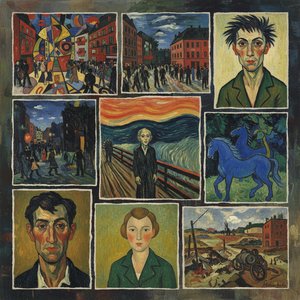
To gaze upon these ten masterpieces is to step into a world ablaze with inner turmoil, raw emotion, and a profound questioning of the human condition. They are not merely paintings; they are visceral cries from a generation grappling with unprecedented change, societal upheaval, and the anxieties of modernity.
Born in the late 19th and early 20th centuries, Expressionism arose as a reaction against both the naturalistic depictions of Impressionism and the industrialization sweeping across Europe. Artists sought to convey not what they *saw*, but what they *felt* – a subjective experience often distorted, exaggerated, and imbued with symbolic weight. The movement flourished in Germany, fueled by a cultural climate marked by rapid urbanization, political tension, and a growing sense of alienation. Think of the bustling streets of Berlin, the philosophical currents of Nietzsche, and the looming shadow of war; these forces coalesced to birth an art that dared to expose the soul.
These works rejected traditional aesthetics in favor of bold colors, jarring compositions, and often unsettling imagery. They weren’t interested in beauty for its own sake, but rather in using artistic form to articulate the deepest recesses of human experience – fear, loneliness, despair, but also moments of ecstatic joy and spiritual awakening. The Scream , The Blue Rider , and others on this list became iconic representations of a world fractured by internal conflict.
But why do these paintings continue to resonate so powerfully today? In an age still grappling with uncertainty, anxiety, and the search for meaning, Expressionism’s unflinching honesty feels remarkably contemporary. These artworks remind us that vulnerability is universal, that emotional intensity is a fundamental part of being human, and that art can be a powerful tool for confronting even the most difficult truths.
Prepare to embark on a journey through ten pivotal works that not only defined an artistic movement but continue to challenge, provoke, and inspire. Each painting holds a story – a glimpse into the mind of its creator and a reflection of a world forever changed.
The Scream - Edvard Munch
 The Scream - Edvard Munch
Imagine a twilight sky bleeding with fiery oranges and bruised purples, reflecting not serenity but a profound inner scream. Edvard Munch’s The Scream , painted in 1893, isn't simply observed; it’s *felt*. This iconic work transcends the boundaries of paint and canvas to become a universal symbol of modern anxiety.
What sets this masterpiece apart is its raw emotional honesty. Munch didn’t aim for photographic realism but sought to depict the overwhelming sensation of existential dread – a feeling that resonates with startling clarity even today. The distorted figure, hands clasped to its face, isn't screaming *at* something; it is the scream itself, an embodiment of inner turmoil.
The swirling lines and vibrant yet unsettling color palette—fiery reds against cool blues—create a visual vortex that draws you into the protagonist’s despair. Broad brushstrokes amplify this visceral quality, lending a textured urgency to the scene. Expressionism , at its core, was about conveying inner experience, and Munch achieved this with unparalleled power.
Bringing a reproduction of The Scream into your space isn’t merely an aesthetic choice; it's an invitation for contemplation. Its presence can spark conversation, inspire introspection, or serve as a poignant reminder that even in moments of isolation, we are connected by the shared human experience of vulnerability. It is a powerful statement piece for those seeking art with depth and emotional resonance—a timeless echo of our deepest fears and anxieties.
Melancholy - Edvard Munch
 Melancholy - Edvard Munch
Picture a cool, grey shoreline stretching into a muted twilight. A solitary figure, shrouded in shadow and contemplation, embodies the very essence of melancholy. Edvard Munch’s Melancholy , painted in 1894, is not merely a depiction of sadness; it's an invitation to feel it—a profound exploration of isolation and the weight of human emotion.
What distinguishes this work is its raw honesty. Munch eschews traditional representation, instead employing distorted forms and a somber palette of blues, purples, and greens to convey inner turmoil. The visible brushstrokes aren’t simply descriptive; they are energetic marks that amplify the painting's emotional intensity—a hallmark of Expressionist technique.
The figure, positioned against the vastness of the landscape, feels both present and profoundly alone. Two indistinct companions hint at lost connection or fragmented aspects of self. The turbulent water mirrors this inner state, while distant ships offer a fleeting suggestion of hope, ultimately overshadowed by their remoteness. This is a painting that doesn’t shy away from darkness.
Bringing Melancholy into your space isn't about creating a somber atmosphere; it’s about acknowledging the full spectrum of human experience. Its presence can be a quiet invitation to introspection, a reminder that even in moments of sadness, there is beauty and resonance—a timeless echo of our shared vulnerability.
The Mocking of Christ - emile nolde
 The Mocking of Christ - emile nolde
A visceral jolt of color and raw emotion—Emil Nolde’s The Mocking of Christ , painted in 1909, is not a comfortable image. It's a plunge into the darker recesses of human experience, a depiction of humiliation and suffering that transcends literal representation.
As a founding member of Die Brücke , Nolde rejected academic traditions, prioritizing subjective feeling over objective reality. This painting exemplifies his signature style: distorted figures, jarring color combinations, and energetic brushwork. Thick impasto layers build texture and immediacy, conveying a sense of urgency that still resonates today.
The palette is deliberately unsettling—earthy tones clash in a symphony of discomfort. Sickly greens and fiery reds amplify the distress, serving as emotional signifiers rather than realistic skin tones. This bold use of color, characteristic of Expressionism , creates a claustrophobic atmosphere that draws you into the scene’s turmoil.
Bringing this powerful work to mind can inspire unexpected design choices—a willingness to embrace imperfection, a celebration of raw texture, and a rejection of conventional beauty. Its legacy lies in its unflinching honesty, reminding us that art at its most potent is not about pleasing the eye but about confronting the depths of the human soul.
Composition VII - Wassily Kandinsky
 Composition VII - Wassily Kandinsky
To stand before Wassily Kandinsky’s Composition VII is to encounter a world born of pure feeling—a monumental expression of “inner necessity” that redefined the possibilities of painting. Completed in 1913, this work isn't simply an abstract arrangement; it’s a swirling vortex of color and form that embodies Kandinsky’s belief in art’s spiritual power.
As his most ambitious compositional statement before returning to Russia, Composition VII marks a pivotal moment in the birth of abstraction. Influenced by music and Theosophy, Kandinsky liberated color from its descriptive role, allowing it to resonate directly with the soul. This painting’s dynamic energy and fragmented structures foreshadowed much of 20th-century art.
The canvas explodes with orange, yellow, red, and deep blues—biomorphic shapes intermingle in a meticulously balanced chaos. Hints of figures emerge from the abstraction, suggesting underlying narratives of creation and destruction. The absence of a single focal point invites you to wander across the surface, experiencing the painting as a holistic sensory event.
Bringing this masterpiece to mind evokes a sense of refined energy—a willingness to embrace complexity and celebrate the power of pure form. Its legacy lies in its enduring influence on modern aesthetics, inspiring generations of artists and designers to explore the boundless possibilities of abstract expressionism.
Madonna - Edvard Munch
 Madonna - Edvard Munch
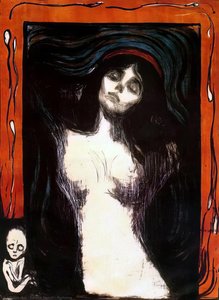
Unveiling Edvard Munch’s Madonna is to encounter a haunting vision—a work that transcends idealized depictions of motherhood to become a visceral exploration of human suffering. Created in 1894, this painting isn't merely observed; it’s *felt*, resonating with an emotional intensity that continues to captivate and disturb.
As a pivotal example of early Expressionism , Madonna eschews traditional artistic conventions in favor of subjective experience. Swirling lines, distorted forms, and a deliberately jarring color palette convey inner turmoil with raw honesty. The skeletal features of the woman and her expression of profound anguish challenge conventional notions of beauty and sanctity.
The composition is framed by darkness—a claustrophobic rectangle within an irregular shape—heightening the sense of isolation. Above, a halo-like form evokes not holiness but chaos. This painting reflects Munch’s personal struggles with loss and mental illness, capturing a sense of existential dread that would become increasingly prevalent in 20th-century art.
Bringing this work to mind invites contemplation—a willingness to confront difficult emotions and acknowledge the complexities of the human condition. Its somber palette and intense emotional charge make it a compelling focal point for any space, speaking to a refined taste that values depth and authenticity.
Woman in a Green Jacket - August Macke
 Woman in a Green Jacket - August Macke
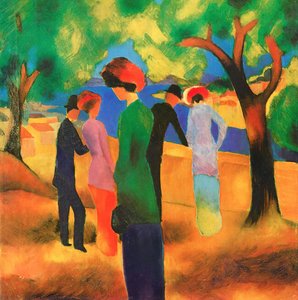
Imagine a sun-drenched afternoon, a gentle breeze rustling through leaves, and figures strolling along a path bathed in vibrant hues. August Macke’s Woman in a Green Jacket , painted in 1913, isn't simply a depiction of leisure; it’s a celebration of modern life—a captivating snapshot of color, form, and the burgeoning spirit of the early 20th century.
As a pivotal member of Der Blaue Reiter , Macke rejected traditional artistic conventions in favor of emotional expression. This painting exemplifies the movement’s core tenets: bold, non-naturalistic color palettes; simplified forms; and a focus on conveying inner experience. The dynamic interplay of shapes and hues reflects his encounter with Robert Delaunay’s Orphic Cubism.
Executed with loose, energetic brushstrokes, the artwork showcases Macke's masterful technique. Figures are rendered from the back or side, creating a sense of anonymity and inviting viewers to project their own narratives onto them. The vibrant colors evoke feelings of joy and vitality, yet the lack of detailed facial expressions introduces an element of mystery.
Bringing this work to mind evokes a sense of calm optimism—a willingness to embrace simplicity and celebrate the beauty of everyday moments. Its legacy lies in its enduring influence on modern aesthetics, inspiring generations of artists and designers to explore the boundless possibilities of color and form.
Portrait of Wally - Egon Schiele
 Portrait of Wally - Egon Schiele
A gaze that pierces the veil of time—Egon Schiele’s Portrait of Wally , painted in 1912, is not merely a depiction of a woman; it's an exploration of the human psyche, rendered with raw emotional intensity and stylistic innovation.
As a pivotal work of Austrian Expressionism , this portrait challenges conventional notions of beauty. Wally Neuzil, Schiele’s lover and muse, confronts the viewer with unsettling directness—a challenge to traditional portraiture that sparked controversy in Vienna's conservative art establishment.
Schiele’s signature style is immediately recognizable in the dynamic brushwork and deliberately distorted forms. He eschews naturalistic coloration, employing a daring palette of greens, yellows, and touches of pink to create skin tones that are both striking and otherworldly. The thick application of paint—impasto—lends a sculptural quality to the surface, heightening its emotional impact.
Bringing this work to mind evokes a sense of quiet contemplation—a willingness to confront vulnerability and embrace imperfection. Its legacy lies in its enduring influence on modern aesthetics, inspiring generations of artists and designers to explore the depths of human emotion with honesty and courage.
Near the bed of death (fever) - Edvard Munch
 Near the bed of death (fever) - Edvard Munch
A silence hangs heavy—Edvard Munch’s Near the Bed of Death (Fever) , painted in 1915, is not merely a depiction of loss; it's an exploration of grief, mortality, and the psychological weight of human suffering. This cornerstone of Expressionist art commands attention not through its size, but through the sheer intensity of feeling conveyed within its brushstrokes.
Painted during a period marked by personal hardship for Munch and widespread societal anxieties stemming from World War I, this work transcends a simple depiction of mourning. Deliberately distorted figures, swirling compositions, and a non-naturalistic color palette convey subjective emotional experience with raw honesty—a hallmark of the Expressionism movement.
The visible brushstrokes, applied with an impasto technique in places, add physicality and rawness to the scene. Flashes of red amidst dominant blues and greens symbolize passion, pain, or a fading life force. The swirling background evokes chaos and disorientation—the internal turmoil experienced during a time of profound grief.
Bringing this work to mind invites contemplation—a willingness to confront vulnerability and embrace the complexities of human emotion. Its legacy lies in its enduring power to evoke empathy and remind us of our shared mortality, inspiring generations of artists and collectors alike.
Landscape with Cows and Camel - August Macke
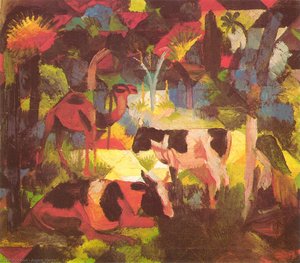 Landscape with Cows and Camel - August Macke
A sun-drenched vision unfolds—August Macke’s Landscape with Cows and Camel , painted in 1914, transports viewers to an exotic landscape brimming with life and color. This captivating artwork is a prime example of his mature Expressionist style, deeply influenced by Fauvism and Orphism.
As a key member of Der Blaue Reiter , Macke sought to move beyond mere representation, prioritizing emotional expression and spiritual resonance. His masterful use of oil paint is immediately apparent in the loose, gestural brushstrokes and unconventional color palette—fiery reds, oranges, yellows, and pinks juxtaposed with blues, greens, and purples.
The colors aren't blended smoothly; instead, they exist as distinct planes, contributing to the painting’s vibrant energy. While seemingly a simple depiction of animals in a landscape, the artwork carries deeper symbolic weight—cattle representing fertility and connection to the land, while the camel introduces an element of exoticism.
This painting is not merely a visual experience; it's an emotional one. Its dynamic composition and bold color choices evoke feelings of warmth and vitality, making it a striking focal point for any interior space—infusing a room with artistic energy and a sense of untamed beauty.
The Self-Seers II (Death and Man) - Egon Schiele
 The Self-Seers II (Death and Man) - Egon Schiele
A haunting stillness emanates from—Egon Schiele’s The Self-Seers II (Death and Man) , painted in 1911, is a cornerstone of early Expressionism . More than just a portrait, it's a visceral exploration of inner turmoil rendered with unflinching honesty.
Schiele’s signature style—distorted forms, angular lines, and raw emotional intensity—breaks from traditional representation. The thick impasto technique creates a tactile surface that amplifies the painting’s unsettling energy, mirroring the fractured psychological state of his subject. The central figure, confronted by a skeletal hand, embodies mortality.
Created in Vienna during societal upheaval, this artwork reflects anxieties of a rapidly changing world. Schiele challenged academic conventions, seeking new ways to express inner experience. Its somber color palette—dominated by browns, ochres, grays, and muted reds—evokes melancholy and isolation.
This painting is not merely observed; it's *felt*. A reproduction of this artwork will introduce a sophisticated air of introspection and dramatic flair to any space, inviting contemplation and serving as a testament to the enduring power of Expressionist art. At , we believe in making such profound works accessible, transforming homes into personal sanctuaries filled with beauty and meaning.
Conclusion
As the echoes of these ten masterpieces fade, we are left not with relics of a distant past, but with living presences that continue to shape our world. The raw emotion laid bare by Munch, Schiele, Kirchner, and their contemporaries wasn’t merely a rebellion against convention; it was an invitation—a courageous opening of the human heart.
These paintings remind us that art isn't confined to galleries or museums; it resides within our own capacity for feeling, for questioning, for seeking beauty even in the face of darkness. They whisper stories of isolation and connection, of joy and despair, mirroring the complexities of life itself—and finding a home within the walls we build around ourselves.
Today, these works continue to inspire not only artists but also those who seek to infuse their surroundings with meaning and emotion. A brushstroke from Nolde can ignite a sense of primal energy in a living room; a haunting gaze from Schiele can spark introspection in a study. They are more than just images—they are portals to another realm, reflections of our own souls.
At , we believe that everyone deserves to experience the transformative power of art firsthand. We invite you to explore our full collection and discover the pieces that resonate with your own unique spirit—to bring a touch of this enduring legacy into your home, and allow these timeless voices to speak for themselves.