Introduction
To gaze upon a Surrealist masterpiece is to step through a looking glass, into a realm where logic dissolves and the subconscious takes flight. These aren’t merely paintings; they are windows into the hidden landscapes of the human mind, born from a desire to liberate thought, emotion, and imagination.
The early 20th century was a period of profound upheaval – the horrors of World War I had shattered established norms, while burgeoning psychological theories, particularly those of Sigmund Freud, revealed the potent forces simmering beneath the surface of conscious experience. From this fertile ground emerged Surrealism, an artistic and literary movement that sought to unlock the power of dreams, irrationality, and the unconscious as a means of revolutionary expression.
Founded by André Breton in 1924 with his “Surrealist Manifesto,” the movement challenged conventional notions of beauty, reason, and reality. Artists embraced automatism – spontaneous creation without conscious control – and explored themes of desire, fantasy, and the uncanny. They drew inspiration from mythology, folklore, and the burgeoning field of psychoanalysis, creating works that were often unsettling, provocative, and deeply personal.
But why do these images, created nearly a century ago, continue to resonate so powerfully today? Perhaps it’s because they tap into something universal – our shared fascination with the mysteries of the self, our anxieties about the world around us, and our enduring longing for meaning beyond the confines of everyday life. They remind us that reality is not fixed, but fluid and subjective, shaped by our individual perceptions and experiences.
Over the following pages, we will embark on a journey through ten iconic works that define the essence of Surrealism. Each painting represents a pivotal moment in the movement’s evolution, showcasing the diverse techniques, themes, and artistic visions that characterized this extraordinary period. Prepare to be captivated by dreamscapes, challenged by symbolism, and invited to explore the boundless depths of the human imagination.
The Disintegration of Persistence of Memory, 1952-54 - Salvador Dalí
 The Disintegration of Persistence of Memory, 1952-54 - Salvador Dalí
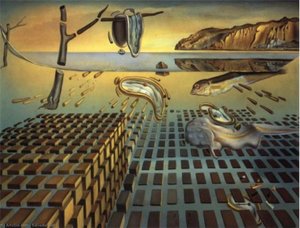
Imagine a sun-drenched shore, yet one steeped not in warmth but in a profound sense of melancholy. Salvador Dalí’s The Disintegration of the Persistence of Memory (1952-54) isn't simply a revisiting of his most famous work; it is its haunting echo, a meditation on time’s relentless erosion and the fragility of all things.
Where “Persistence of Memory” presented melting clocks as novel curiosities, this later piece depicts their very dissolution . The familiar landscape feels fractured, objects dissolving into a grid-like structure that suggests both scientific analysis and utter chaos. Dalí’s meticulous technique – the hyperreal rendering of decaying fish, the smooth surfaces juxtaposed with organic forms – amplifies the unsettling effect.
This painting is deeply rooted in Surrealist principles, exploring the subconscious through dreamlike imagery and illogical juxtapositions. The melting clocks symbolize time's subjectivity, while the ants crawling upon them evoke decay and mortality. The barren landscape speaks to existential loneliness, a feeling many can relate to in our fast-paced modern world.
The muted earthy tones – browns, ochres, and pale blues – contribute to a melancholic atmosphere, inviting quiet contemplation. To encounter this work is to confront the impermanence of existence, but also to find beauty within that disintegration. It’s a piece that could lend an air of sophisticated introspection to any space, prompting reflection on the passage of time and the enduring power of memory – themes central to Surrealism and timeless in their resonance.
Frida Kahlo - `The Two Fridas` - Frida Kahlo
 Frida Kahlo - `The Two Fridas` - Frida Kahlo
To encounter Frida Kahlo’s The Two Fridas (1939) is to gaze directly into a soul laid bare. This double self-portrait, born from the raw aftermath of her divorce from Diego Rivera, transcends mere representation; it's a visceral exploration of identity fractured and resilience forged in pain.
More than just a depiction of heartbreak, this painting embodies the complexities of cultural heritage and personal loss. The two Fridas – one adorned in traditional Tehuana dress, representing her connection to Mexican roots and Rivera’s affection, the other in European attire symbolizing a rejected self – are inextricably linked by a shared artery, pulsing with life yet stained with vulnerability.
Kahlo masterfully blends Surrealism with Mexican folk art traditions, rejecting easy categorization. Her meticulous brushwork and anatomical precision heighten the emotional impact, while bold lines and symbolic imagery—the exposed hearts, the surgical clamp—speak volumes about her inner turmoil. The stormy backdrop mirrors not only her personal tempest but also the anxieties of a world on the brink of war.
“The Two Fridas” is a testament to the enduring human capacity for self-discovery and healing. Its presence in a space invites introspection, prompting reflection on our own identities and the strength we find within vulnerability. It’s a powerful reminder that even amidst fragmentation, wholeness can be reclaimed – a timeless conversation starter for any curated collection.
Time transfixed - René Magritte
 Time transfixed - René Magritte
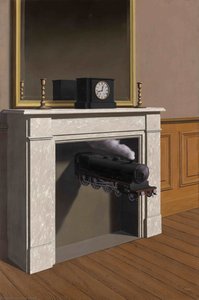
René Magritte’s Time Transfixed (1938) is a quiet disruption, a meticulously rendered paradox that lingers long after you've turned away. Imagine the solidity of a grand fireplace, then picture a full-scale steam locomotive bursting forth from its hearth – an impossible image presented with unwavering realism.
This painting isn’t about shock value; it’s about challenging our fundamental perceptions of reality and domestic tranquility. As a cornerstone of the Surrealism movement, it embodies the exploration of the subconscious through illogical juxtapositions. Magritte doesn't distort forms, he recontextualizes them, creating a disquieting sense of familiarity within the bizarre.
The smooth blending of tones and subtle gradations create an illusion of depth, grounding the fantastical element in tangible reality. The locomotive – a symbol of progress and unstoppable force – intrudes upon the traditional hearth, traditionally representing home and comfort. This contrast speaks to anxieties about modernity and upheaval, themes that resonate deeply even today.
At , we believe art should be more than just decoration; it should spark conversation and inspire reflection. Time Transfixed does precisely that – inviting viewers to question their assumptions and embrace the beauty of the unexpected. Bringing this iconic work into a home or office is not simply acquiring a painting, but welcoming a timeless dialogue between culture, perception, and the power of imagination.
The Menaced Assassin - René Magritte
 The Menaced Assassin - René Magritte
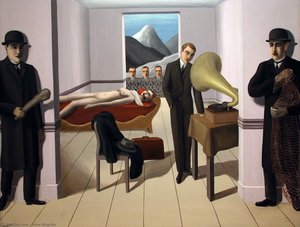
To encounter René Magritte’s The Menaced Assassin (1927) is to step into a world of unsettling calm, where logic dissolves and hidden anxieties take form. This painting isn't merely an image; it’s a meticulously crafted enigma that has captivated viewers for generations.
As one of the defining works of Surrealism , it embodies the movement’s core principles – challenging conventional perceptions of reality and exploring the subconscious mind. The scene unfolds with photographic precision: a nude woman reclining on a red chaise lounge, seemingly oblivious to the looming presence of a monumental golden gramophone horn and the watchful eyes of shadowy figures.
Magritte's masterful technique—the smooth blending of tones and precise realism applied to unreal scenarios—creates a disorienting effect. The restrained color palette amplifies the somber mood, inviting contemplation on themes of vulnerability, observation, and hidden menace. This painting isn’t about providing answers; it’s about raising questions.
At , we believe art should be more than just decorative; it should provoke thought and inspire dialogue. The Menaced Assassin does precisely that – offering a timeless reflection on the complexities of human perception and the ever-present possibility of unseen forces. Its presence in a refined space adds an air of intellectual curiosity and sophisticated intrigue, elevating any collection with its enduring legacy.
Ciphers and Constellations, in Love with a Woman - Joan Miró
 Ciphers and Constellations, in Love with a Woman - Joan Miró
To gaze upon Joan Miró’s Ciphers and Constellations, in Love with a Woman (1941) is to enter a realm of cosmic dance and subconscious longing. Part of his celebrated “Constellations” series, this gouache and watercolor on paper transcends mere representation, inviting us into a world where symbols float freely and dreams take form.
Created during a period of personal and global upheaval, these paintings weren’t literal depictions of the night sky but rather visual metaphors for fate, connection, and the hidden forces that shape our lives. Miró's masterful use of fluid lines and vibrant colors – bold blacks contrasted with creamy off-whites and passionate reds – evokes an ethereal quality, a sense of weightlessness and boundless possibility.
Recurring motifs like eyes suggest awareness and desire, drawing us deeper into the composition’s enigmatic world. Scattered star-like forms reinforce the “constellation” theme, hinting at cosmic influences and predetermined paths. This work embodies the core tenets of Surrealism – exploring the subconscious through abstract shapes and dreamlike associations.
At , we believe art should resonate with our deepest emotions. Ciphers and Constellations does precisely that, offering a timeless reflection on love, destiny, and the search for meaning. Its whimsical yet sophisticated aesthetic makes it a versatile addition to any space, sparking conversation and inviting contemplation – a testament to Miró’s enduring legacy.
The Son of Man - René Magritte
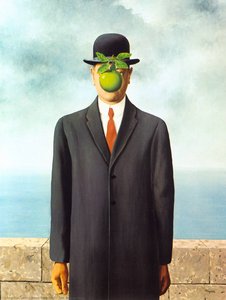 The Son of Man - René Magritte
To encounter René Magritte’s The Son of Man (1964) is to meet a silent enigma, an instantly recognizable image that continues to provoke thought and inspire fascination decades after its creation. This compelling painting presents a formally dressed man, yet obscures his face with a vibrant green apple – a visual paradox that encapsulates the core tenets of Surrealism .
More than just a striking composition, this work is rich in symbolism. The floating apple isn’t merely an obstruction; it represents hidden realities, forbidden knowledge, or perhaps the conformity that masks individuality. Magritte himself stated the image explores how “everything we see hides another thing,” prompting viewers to question what lies beneath the surface.
His meticulous technique—the smooth surfaces and precise lines—creates a sense of clarity that heightens the unsettling nature of the image. Rooted in representational skill, the composition deliberately disrupts conventional expectations, placing ordinary objects into extraordinary contexts. This quiet intensity and intellectual rigor set Magritte apart within the Surrealist movement.
At , we believe art should be more than decorative; it should spark conversation and inspire introspection. The Son of Man does precisely that – offering a timeless reflection on identity, perception, and the mysteries of existence. Its presence in a refined space adds an air of sophisticated intrigue, elevating any collection with its enduring legacy.
Joan Miró- Catalan Landscape (The Hunter) - Joan Miró
To gaze upon Joan Miró’s Catalan Landscape (The Hunter) (1924) is to be transported to a dreamlike interpretation of his homeland – a vibrant tapestry woven with symbolic forms and playful abstraction. More than just a landscape, it's an emotional response to Catalonia, embodying the artist’s unique contribution to Surrealism .
Emerging during a pivotal moment in art history, this piece exemplifies the burgeoning movement’s exploration of the subconscious. Miró sought to liberate art from rational constraints, embracing automatism and intuitive creation. However, unlike purely abstract works, “Catalan Landscape” retains a connection to recognizable forms – hinting at natural elements like land, sky, flora, and fauna.
His masterful use of thin washes of color layered with precise lines creates an all-over pattern that invites the eye to wander, discovering new details with each viewing. The warm palette—earthy ochres, terracotta, and olive greens punctuated by bursts of red, blue, and pink—evokes a sense of inviting atmosphere despite the artwork’s inherent mystery.
At , we believe art should resonate with our deepest emotions. Catalan Landscape (The Hunter) does precisely that – offering a timeless reflection on nature, memory, and the power of imagination. Its whimsical yet sophisticated aesthetic makes it a versatile addition to any space, adding an air of refined intrigue and artistic sensibility.
Premonition of Civil War - Salvador Dalí
 Premonition of Civil War - Salvador Dalí
To encounter Salvador Dalí’s Premonition of Civil War (1936) is to confront a haunting vision of impending conflict and the psychological trauma it inflicts. This powerful work isn't merely a historical document; it’s a visceral exploration of human suffering rendered with Dalí’s signature surrealist flair.
As one of the defining works of Surrealism , this piece exemplifies his mastery of meticulous detail within a dreamlike, distorted reality. The dramatically contorted figure – dissolving into anguish – represents the fragmentation of self under immense pressure, a symbol of existential crisis and the fragility of the human condition.
Dalí’s precise brushwork creates a startling contrast between the smoothness of the form and the implied weight of despair it carries. The barren landscape and stark rectangular block symbolize an oppressive force against which humanity struggles. This painting reflects a growing sense of unease on the cusp of the Spanish Civil War, born from a profound sensitivity to escalating tensions.
At , we believe art should provoke thought and inspire dialogue. Premonition of Civil War does precisely that – offering a timeless reflection on the human cost of conflict. Its presence in a refined space adds an air of intellectual curiosity and serves as a poignant reminder of our shared vulnerability.
Self portrait with Thorn Necklace and Hummingbird - Frida Kahlo
 Self portrait with Thorn Necklace and Hummingbird - Frida Kahlo
To gaze upon Frida Kahlo’s Self Portrait with Thorn Necklace and Hummingbird (1940) is to encounter a window into her soul – a profound exploration of pain, resilience, and the intricate relationship between humanity and nature. More than a likeness, it's a testament to her enduring legacy as one of Mexico’s most important artists.
Kahlo presents herself frontally, meeting the viewer’s gaze with unwavering intensity. This directness is arresting, inviting intimate contemplation. Flanking her are carefully chosen animal companions – a playful monkey and a watchful black cat – each contributing to the painting’s layered narrative. The composition is deliberately symmetrical, lending formality that belies the turbulent emotions simmering beneath.
This work exemplifies Kahlo’s unique style—a compelling fusion of Mexican folk art traditions and surrealist tendencies. While she resisted categorization as a Surrealist, the dreamlike quality and symbolic weight align with the movement's core principles. Executed with meticulous detail in oil on canvas, her technique showcases precise brushwork and masterful command of color.
Every element carries symbolic weight. The thorn necklace alludes to both physical and emotional suffering—a poignant echo of Kahlo’s lifelong battle with chronic pain. Suspended from it is a hummingbird, traditionally symbolizing joy, yet here appearing almost lifeless. These symbols are deliberately open to interpretation, encouraging viewers to project their own meanings onto the canvas.
The Elephants, 1948 - Salvador Dalí
 The Elephants, 1948 - Salvador Dalí
Unveiled to a world captivated by the mysteries of the unconscious, Salvador Dalí’s The Elephants (1948) stands as a quintessential example of Surrealist artistry. This iconic work transcends mere representation to become a powerful exploration of desire, strength, and the inherent instability of existence.
Emerging in the aftermath of World War II, this painting exemplifies Dalí’s meticulous technique used to depict illogical scenes and bizarre juxtapositions. The strikingly different elephantine figures—rendered with unsettling delicacy—subvert traditional associations of power, suggesting even the most formidable forces are vulnerable. Their impossibly long legs evoke fragility, while the obelisks they bear symbolize ambition or the weight of history.
Executed with Dalí’s signature precision in oil paint, this work showcases his mastery of realistic rendering despite its fantastical subject matter. The smooth blending of colors and subtle gradations create a dreamlike atmosphere within a vast, barren landscape under a fiery red sky.
The Elephants is more than an image; it’s a meditation on the human condition—a poignant reminder of loneliness, insignificance, and our complex relationship to power.
Conclusion
As the light fades on these ten extraordinary visions, we find ourselves not merely concluding a journey through art history, but returning from an encounter with the very essence of human imagination. These Surrealist masterpieces—from Dalí’s melting clocks to Kahlo’s unflinching self-portraits—are not relics of a bygone era, but living presences that continue to ripple through our world.
They remind us that reality is often far more fluid and subjective than we perceive, inviting us to question the boundaries between dream and waking life. They speak to the power of symbolism, the weight of emotion, and the enduring search for meaning in a chaotic universe. And perhaps most profoundly, they demonstrate the courage it takes to confront our deepest selves—our fears, our desires, and our vulnerabilities.
Today, these artworks transcend museum walls, finding new life within the intimate spaces of our homes. A touch of Magritte’s enigmatic landscapes can transform a living room into a realm of quiet contemplation, while Kahlo’s vibrant colors infuse a bedroom with strength and resilience. They are echoes of eternal dialogues—between artist and viewer, between past and present, between the conscious and unconscious mind.
We invite you to continue exploring this captivating movement and discover the Surrealist masterpiece that resonates most deeply within your own heart. Begin your journey anew with our full collection , and allow these extraordinary visions to inspire a world of wonder and possibility.