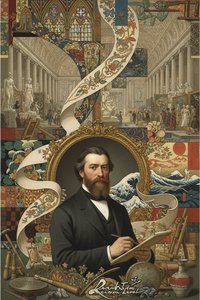
Achille Devéria: A Painter of Intimacy and Artistic Reverie
Achille Jacques Jean Marie Devéria (1800-1857) stands as a singular figure in French Romantic painting, distinguished not merely by his artistic skill but also by the profound psychological depth he imbued into his canvases. Born in Paris amidst the burgeoning intellectual fervor of the era, Devéria’s life was marked by both personal tragedy and remarkable creative output—a duality that profoundly shaped his oeuvre. While biographical details remain somewhat sparse, scholarly research illuminates a man deeply attuned to the currents of artistic discourse and passionately committed to capturing fleeting moments of human emotion.
- Early Life & Artistic Training:
- Career Highlights: Portraits & Illustrations
- Technique & Style: The Essence of Sfumato
- Influences & Connections: Romantic Sensibility & Literary Circles
- Legacy & Significance: A Voice of Quiet Observation
Devéria’s artistic journey began in Paris, where he received instruction from Jean-Auguste Dominique Ingres, arguably the most influential painter of his time. Ingres championed Devéria's talent for capturing subtle nuances of expression and encouraged him to explore the expressive possibilities inherent in sfumato—a technique pioneered by Leonardo da Vinci that Devéria skillfully adopted, creating hazy, atmospheric effects that prioritized mood and emotion over precise detail. This stylistic preference aligns perfectly with Devéria’s fascination for portraying intimate scenes and capturing the psychological complexities of his subjects.
His professional life unfolded primarily as a portrait artist and illustrator, securing commissions from prominent figures within Parisian literary circles—most notably Gustave Flaubert and Alexandre Dumas fils. Notably, Devéria produced several striking portraits of writers, including Flaubert’s depiction of Hugo, which exemplifies his ability to convey inner states through visual representation. These collaborations cemented Devéria's reputation as a keen observer of human character and demonstrated his understanding of the artistic sensibilities prevalent in the Romantic period.
Devéria’s paintings are characterized by their understated elegance and remarkable sensitivity to light and color. Unlike many of his contemporaries who favored grand narratives and dramatic compositions, Devéria opted for quiet contemplation—often depicting solitary figures bathed in soft luminescence. This deliberate restraint serves not to diminish the emotional impact of his works but rather to heighten it, inviting viewers into a realm of psychological introspection. His meticulous attention to detail—particularly in rendering textures and capturing subtle gradations of tone—underscores his mastery of sfumato and contributes to the ethereal quality of his paintings.
Devéria’s artistic sensibilities were deeply rooted in Romantic idealism, influenced by thinkers like Rousseau and Byron. He embraced the movement's emphasis on emotion, imagination, and individualism, channeling these ideals into his art. His work reflects a profound appreciation for beauty—both natural and human—and conveys a sense of melancholy that resonates with the spirit of the era. Devéria’s contribution to French Romantic painting lies not in flamboyant spectacle but in a quiet yet powerful exploration of inner life—a legacy that continues to inspire artists today.
Despite his considerable success, Devéria tragically succumbed to tuberculosis at the young age of 57, leaving behind a relatively small body of work—approximately eighty paintings and drawings—yet these pieces remain invaluable treasures of Romantic art history. His enduring influence can be seen in subsequent generations of painters who sought to emulate his masterful sfumato technique and his ability to convey profound psychological truths through understated visual expression. Devéria’s legacy resides in his unwavering commitment to capturing the essence of human experience with grace, subtlety, and an exquisite understanding of artistic vision.