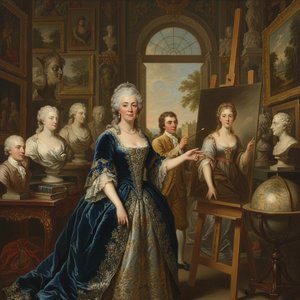
Agustín Esteve y Marqués (1753 - 1830): A Portraitist Shaped by Goya
Agustín Esteve y Marqués, born in Valencia in 1753, stands as a pivotal figure within the artistic landscape of Spain’s Enlightenment and Romantic eras. His career unfolded against the backdrop of burgeoning neoclassical ideals yet was profoundly molded by the revolutionary spirit emanating from Francisco Goya, resulting in an oeuvre characterized by both meticulous realism and theatrical grandeur.
- Early Life & Education: Esteve's formative years were spent honing his artistic skills at the Academia de Bellas Artes de San Carlos in Valencia. This institution instilled in him a disciplined approach to art, grounding him in classical principles while simultaneously exposing him to emerging stylistic trends.
- Influence of Mengs and Murillo: Esteve’s apprenticeship under Anton Raphael Mengs proved instrumental in shaping his artistic vision. Mengs championed the revival of Greco-Roman aesthetics, emphasizing clarity, balance, and idealized forms—influences that would permeate Esteve's early works. Simultaneously, he absorbed lessons from Bartolomé Esteban Murillo, whose serene depictions of religious subjects fostered a sensitivity to tonal harmony and subtle emotional expression.
- The Encounter with Goya: The meeting between Esteve and Francisco Goya marked a transformative juncture in his artistic trajectory. Recognizing Goya’s groundbreaking experimentation with color and brushwork—a deliberate departure from academic conventions—Esteve embraced these innovations, adopting a looser style that mirrored Goya's own expressive approach.
- Royal Patronage & Artistic Achievements: Esteve quickly gained renown as a portraitist to the Spanish Crown, securing commissions from influential families and elevating his social standing. His meticulous attention to detail and masterful rendering of facial expressions cemented his reputation for capturing psychological nuance—a hallmark of Goya’s oeuvre. Notably, he created an unforgettable portrait of Countess María Josefa Piscatori Díaz de Lavandero (ca.1800), a masterpiece that exemplifies Esteve's stylistic prowess.
- Legacy & Rediscovery: Despite the obscurity surrounding Esteve’s artistic output during his lifetime—often attributed erroneously to Goya—recent scholarship has begun to reassess his significance as an artist and interpreter of the era. His works now command considerable attention, revealing a sophisticated aesthetic sensibility that deserves recognition alongside Goya's monumental contribution to Spanish art history.
Esteve’s artistic legacy resides not merely in the sheer number of portraits he produced but also in his ability to distill the essence of human character—a skill honed by observing and mastering the techniques championed by both Mengs and Goya.