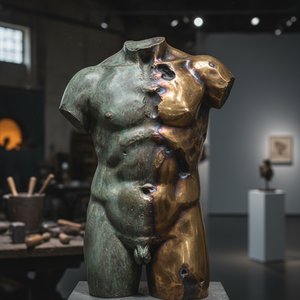
Ben Fortunado Marcune: Bridging Precision and Emotion
Born in the vibrant heart of New York City in 1935, Ben Fortunado Marcune’s artistic journey is a fascinating tapestry woven from diverse threads – from the structured world of engineering to the passionate expression of sculpture and painting. Initially raised in Brooklyn before relocating to Florida and eventually California, Marcune's formative years instilled within him a unique perspective: an appreciation for both meticulous design and profound human emotion. This duality would become the defining characteristic of his work, informing his approach to every piece he created.
Marcune’s early life was marked by intellectual curiosity and a drive to understand how things worked. He pursued higher education at UCLA and Caltech in the 1950s, earning a master's degree in human factors engineering – a field focused on optimizing human-machine interaction. This academic foundation provided him with an invaluable understanding of design principles, spatial relationships, and the psychology behind effective communication. Following his service as a medic in the United States Army during the Korean War, he transitioned into the fields of biomedical and industrial design, demonstrating a remarkable adaptability and a keen eye for innovation. Notably, Marcune secured several patents for surgical and orthopedic devices, showcasing his technical prowess and commitment to improving human well-being.
However, Marcune’s artistic inclinations weren't confined solely to the realm of engineering. A surprising detour led him to the world of dance, where he served as a lead dancer for the Philadelphia Civic Ballet in the 1970s. This experience profoundly impacted his understanding of movement, form, and the expressive power of the human body – elements that would later find their way into his sculptural work. Seeking further artistic development, Marcune attended the Pennsylvania Academy of Fine Arts in 1976, graduating with a focus on traditional techniques and a renewed dedication to visual art.
The Shift to Sculpture and Public Art
A pivotal moment in Marcune’s career arrived in the late 1980s when he consciously shifted his focus from engineering and design towards the fine arts. This transition marked a profound transformation, allowing him to fully explore his creative potential and develop a distinctive artistic voice. He began experimenting with various mediums, ultimately gravitating toward bronze sculpture as his primary medium of expression.
Marcune’s commitment to public art quickly became evident. Beginning in the 1990s, he embarked on a series of ambitious projects that have permanently shaped the landscape of Pennsylvania. His sculptures are not merely decorative; they serve as powerful reminders of historical events, cultural values, and the human spirit. Notable examples include the Korean-Vietnam Memorial at Lehigh Carbon Community College, a poignant tribute to those who served in conflict; the Worker’s Memorial in the Bethlehem Rose Garden, honoring the contributions of laborers; and “Jesus as Teacher” on the campus of DeSales University, a contemplative piece that invites reflection on faith and compassion. These works demonstrate Marcune's ability to create impactful public art that engages communities and fosters dialogue.
A Portraitist and Landscape Painter
Beyond his monumental bronze sculptures, Marcune has also established himself as a skilled portrait painter and landscape artist. Commissions from prestigious institutions such as Quakertown National Bank, St. Luke’s Hospital, Moravian College, DeSales University, and Lafayette College attest to the quality of his work and the esteem in which he is held by the art community. His oil landscapes are featured in both public and private collections, including those of Lehigh Valley Hospital, St. Luke’s Hospital, DeSales University, and UGI.
Marcune's artistic style is characterized by a remarkable blend of realism and emotional depth. He meticulously renders anatomical details with the precision honed during his engineering years, yet imbues his figures and landscapes with a palpable sense of humanity and feeling. His work reflects a deep understanding of human form, light, and shadow, creating images that are both visually stunning and emotionally resonant.
Legacy and Continuing Work
Today, Ben Fortunado Marcune continues to thrive as an artist, maintaining three working studios in Northampton and Bucks County, Pennsylvania. His legacy is firmly established through his impressive collection of public sculptures and paintings, which serve as enduring testaments to his artistic vision and technical skill. Marcune’s work stands as a powerful example of how diverse experiences – from the precision of engineering to the passion of dance – can converge to create truly exceptional art.
His dedication to his craft is evident in his ongoing projects, ensuring that his artistic voice will continue to resonate with audiences for generations to come. Marcune’s story is a testament to the transformative power of creativity and the enduring beauty of bridging seemingly disparate disciplines.