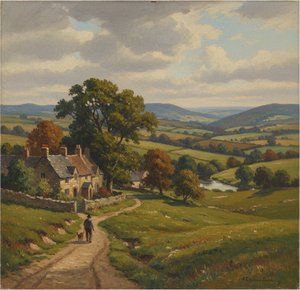
Campbell Archibald Mellon: A Norfolk Master of Light and Seaside Life
Campbell Archibald Mellon (1876-1955) emerged from a life of salesmanship to become one of the most beloved watercolorists of his era, particularly renowned for his evocative depictions of Norfolk’s coastline. Born in Berkshire, England, he initially pursued a career as a travelling salesman before finding his true calling and establishing himself in the charming seaside town of Gorleston-on-Sea. Mellon's artistic journey was marked by a profound connection to the natural world, specifically the ever-changing beauty of the Norfolk coast, which would ultimately define his signature style and lasting legacy. His work isn’t merely representations of landscapes; they are imbued with a palpable sense of atmosphere, capturing not just what he saw but also how it *felt* – the bracing sea air, the warmth of the sun on sand, and the quiet joy of coastal life.
Early Life and Artistic Beginnings
Mellon’s early years were characterized by a pragmatic approach to life, a stark contrast to the artistic pursuits he would later embrace. After serving in World War I, he relocated to Nottingham, where he worked as a salesman – a profession that provided a necessary income while simultaneously fueling his nascent desire for creative expression. Crucially, Mellon’s artistic development was significantly shaped by his mentorship under Sir John Arnesby Brown R.A., a prominent landscape painter whose influence is readily apparent in Mellon's later work. This relationship wasn’t simply about technical instruction; it fostered a deep appreciation for composition, color harmony, and the ability to capture fleeting moments of light and atmosphere – qualities that would become hallmarks of Mellon’s distinctive style. He also studied with Carl Brenner, a nephew of Benjamin Williams Leader, further broadening his artistic horizons.
The Norfolk Years: A Coastal Obsession
In 1928, Mellon made the pivotal decision to move to Norfolk, drawn by its dramatic coastline and the opportunity to immerse himself in the landscape he so admired. He settled in a house overlooking Gorleston-on-Sea, establishing a home that would become inextricably linked with his artistic output. It was here, amidst the shifting sands and crashing waves, that Mellon truly blossomed as an artist. His subjects – bustling beach scenes, solitary figures strolling along the shore, and dramatic skies reflecting over the sea – became increasingly vibrant and alive. He developed a unique technique of layering colors to create luminous effects, particularly when capturing the sun’s rays dancing on the water or illuminating the faces of his fellow holidaymakers. Mellon's style evolved from darker, more muted tones in his early work to brighter, warmer palettes as he mastered the art of translating light and atmosphere onto paper.
Style and Technique: Impressionism Meets Regional Character
Mellon’s artistic style is often described as a blend of Impressionism and regional character. He embraced the Impressionists' focus on capturing fleeting moments, using broken brushstrokes and vibrant colors to convey light and atmosphere. However, unlike many of his contemporaries, Mellon didn’t simply replicate what he saw; he imbued his paintings with a distinctly British sensibility, reflecting the unique charm and spirit of Norfolk life. His compositions are often dynamic, filled with movement and energy, capturing the hustle and bustle of beach days or the quiet serenity of a coastal sunset. He was particularly adept at portraying people – fishermen mending their nets, children building sandcastles, families enjoying picnics on the shore – imbuing them with warmth and personality. Mellon’s meticulous attention to detail, combined with his expressive use of color and brushwork, created paintings that are both visually stunning and emotionally resonant.
Legacy and Recognition
Campbell Archibald Mellon was a respected figure in the British art world, earning membership in several prestigious organizations, including the Royal Institute of Painters in Watercolour (ROI) and the Royal Society of British Artists (RBA). His work has been exhibited at numerous galleries throughout England, and his paintings are now held in public collections across the country. He was elected to the ROI and RBA in 1938, solidifying his place as a significant contributor to the landscape art tradition. Mellon’s legacy extends beyond his individual achievements; he played a key role in establishing the Great Yarmouth and District Society of Artists, fostering a vibrant artistic community in Norfolk. Today, his paintings continue to be admired for their beauty, capturing the timeless charm of the Norfolk coast and offering viewers a glimpse into a bygone era of seaside holidays and simple pleasures. His work serves as a reminder of the power of art to evoke emotion and transport us to another time and place.