A Visionary of Abstraction: The World of Charles Houghton Howard
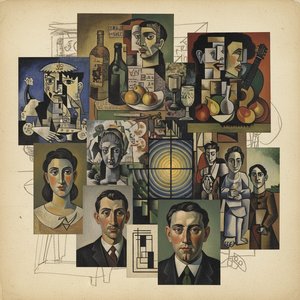
Charles Houghton Howard, born in 1942, is a contemporary artist whose work embodies a compelling synthesis of abstract expressionism, Cubism, and Constructivism. While biographical details remain somewhat elusive – Howard prefers to let his art speak for itself – the impact of his canvases resonates powerfully within the modern art landscape. He has cultivated a distinctive visual language characterized by dynamic geometric forms, bold color palettes, and an underlying sense of intellectual rigor. His paintings aren’t merely compositions; they are explorations of spatial relationships, perceptual challenges, and the emotive power inherent in pure abstraction.Early Influences and Artistic Development
Howard's artistic journey wasn’t one of immediate recognition but rather a gradual refinement of vision. Though details about his formal training are scarce, it is evident that he deeply engaged with the pioneers of abstract art. The fragmented perspectives of Cubism, particularly the works of Picasso and Braque, laid an early foundation for his deconstruction of form. However, Howard moved beyond mere imitation, embracing the Constructivist principles of geometric precision and a rejection of representational imagery. He sought to create paintings that existed as self-contained realities, independent of external references. This pursuit led him to explore the interplay of color and shape, meticulously balancing contrasting hues and interlocking planes to generate visual tension and harmony. His work is not simply about *what* is depicted but rather *how* it is perceived – a testament to his deep understanding of Gestalt principles and perceptual psychology.Key Characteristics and Techniques
Howard’s paintings are immediately recognizable for their striking use of color. He rarely employs muted tones, instead favoring vibrant reds, blues, yellows, and greens that clash and complement in equal measure. These colors aren't applied randomly; they function as structural elements, defining spatial boundaries and creating a sense of depth within the canvas. His technique is equally deliberate. While he doesn’t adhere to a single method, his work often features carefully layered brushstrokes and precise geometric shapes achieved through masking or meticulous drafting. The surfaces are typically smooth, devoid of excessive impasto, further emphasizing the clarity of form and color. This emphasis on precision distinguishes him from more gestural abstract expressionists, highlighting his commitment to a controlled and intellectual approach to painting.Major Achievements and Recognition
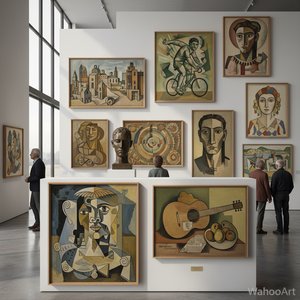
While Howard maintains a relatively low profile, his work has garnered significant attention within art circles. His painting “Prescience,” for example, is a prime illustration of his mature style – a complex composition that won a prestigious award in a national juried exhibition. The piece exemplifies his ability to create a dynamic interplay between geometric forms and vibrant colors, inviting viewers to engage with the artwork on multiple levels. “Prescience” isn’t simply visually arresting; it is intellectually stimulating, prompting contemplation of spatial relationships and perceptual illusions. His work has been featured in several group exhibitions and private collections, steadily building a reputation among discerning art enthusiasts.Historical Significance and Legacy
Charles Houghton Howard occupies a unique position within contemporary abstraction. He doesn’t neatly fit into any pre-defined category, instead forging his own path by synthesizing diverse influences into a cohesive visual language. His work represents a continuation of the modernist project – an ongoing exploration of form, color, and perception. In an era often dominated by conceptual art and digital media, Howard's commitment to traditional painting techniques is particularly noteworthy. He demonstrates that abstraction remains a vital and relevant mode of expression, capable of evoking profound emotional responses and intellectual engagement. His legacy lies not in revolutionizing the medium but rather in refining it – pushing the boundaries of abstract form while maintaining a deep respect for its historical roots.- Dynamic geometric compositions
- Bold and contrasting color palettes
- Precise painting techniques
- Intellectual exploration of perception