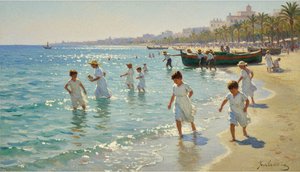
A Cádiz Luminary: The Life and Art of Felipe Abarzúa
Felipe Abarzúa y Rodriguez de Arias, born in the vibrant port city of Cádiz, Spain, in 1871, stands as a compelling figure within the transition of Spanish painting towards modernity. While often overshadowed by his more internationally renowned contemporary, Joaquín Sorolla, Abarzúa carved out a significant niche for himself as one of the foremost artists from Cádiz during the first half of the 20th century. His life unfolded against a backdrop of societal shifts and artistic ferment, influencing a body of work that beautifully blends genre scenes, portraiture, landscapes, and still lifes with an increasingly impressionistic sensibility. Abarzúa wasn’t merely replicating reality; he was capturing fleeting moments of light and atmosphere, imbuing his canvases with a palpable sense of life and emotion.
Early Influences and Artistic Development
Abarzúa's artistic journey began within the established traditions of Spanish academic painting. However, the burgeoning Impressionist movement sweeping across Europe would prove to be a pivotal force in shaping his style. He became a dedicated follower of Sorolla, absorbing the master’s techniques for rendering light and capturing the essence of Mediterranean life. This influence is readily apparent in Abarzúa's early works, characterized by loose brushstrokes, vibrant color palettes, and a focus on outdoor scenes. Yet, he wasn’t simply an imitator. He skillfully adapted Sorolla’s principles to his own unique vision, focusing particularly on the everyday lives of people in Cádiz – fishermen mending nets, families strolling along the beaches, gypsies engaged in their traditional customs. These genre paintings are not merely depictions of daily life; they are celebrations of a specific culture and environment, rendered with warmth, sensitivity, and an acute eye for detail.
Themes and Techniques: Capturing the Soul of Cádiz
Abarzúa’s artistic output was remarkably diverse, encompassing portraits that reveal not just physical likeness but also the inner character of his subjects; landscapes that evoke the sun-drenched beauty of the Andalusian coastline; and still lifes brimming with the abundance of local produce. However, a unifying thread runs through all his work: a deep connection to Cádiz and its people. His paintings are imbued with the atmosphere of the city – the salty air, the bright sunlight, the vibrant colors of the markets. Technically, Abarzúa’s mastery lay in his ability to capture light and movement. He employed loose brushwork and broken color techniques, creating a shimmering effect that brings his canvases to life. His palette was typically warm and luminous, reflecting the Mediterranean sun. He excelled at portraying the interplay of light and shadow, giving his paintings a sense of depth and realism.
Recognition and Legacy
Throughout his career, Abarzúa enjoyed considerable recognition within Spain, particularly in Cádiz where he was celebrated as a leading artistic voice. While he may not have achieved the same international fame as Sorolla, his work remains highly valued by collectors and art enthusiasts alike. He is often acknowledged as the best artist from Cádiz during the first half of the 20th century, representing a crucial link between traditional Spanish painting and the emerging modern movements. His paintings offer a valuable glimpse into the life and culture of Andalusia during a period of significant change, preserving a sense of time and place with remarkable sensitivity and skill. Abarzúa’s legacy lies not only in his beautiful canvases but also in his ability to capture the soul of Cádiz – its light, its color, and its people – for generations to come.