Francesco di Bosio Zaganelli: A Cotignola Master of Religious Iconography
Francesco di Bosio Zaganelli (c. 1475 – 1532) emerged from the artistic crucible of Cotignola, Italy—a town renowned for its patronage of Renaissance art and humanist scholarship—as a painter deeply rooted in the traditions of Florentine Mannerism yet imbued with an individual stylistic vision. While biographical details remain scarce, Zaganelli’s legacy resides primarily in his captivating religious artworks, particularly those executed during the formative years of the sixteenth century. His oeuvre speaks volumes about the artistic sensibilities of his time and reflects a profound engagement with theological themes.
- Early Life & Training:
- Notable Commissions & Artistic Style:
- Influences & Patronage:
- Major Achievements & Legacy:
Early Life & Training
Precise information regarding Zaganelli’s birthdate and familial background is elusive, contributing to the ongoing debate among scholars about his formative years. However, it is generally accepted that he was born in Cotignola around 1475—a location strategically positioned within the Duchy of Ferrara, a bastion of Renaissance culture under Alfonso I d'Este. Zaganelli’s artistic training likely commenced under the tutelage of Andrea del Sarto, arguably the most influential painter of his era and a pivotal figure in establishing Florentine Mannerism. This association exposed him to the stylistic innovations championed by Sarto—characterized by elongated figures, subtle drapery folds, and an emphasis on psychological realism—influencing Zaganelli’s artistic approach considerably.
Notable Commissions & Artistic Style
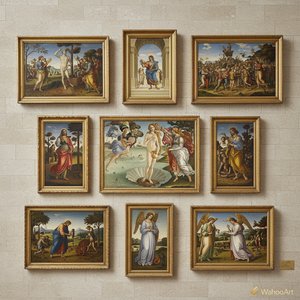
Zaganelli gained prominence through his involvement in significant ecclesiastical commissions throughout Ferrara and its environs. He produced a remarkable series of altarpieces and devotional panels, demonstrating exceptional technical skill and compositional sophistication. His paintings are distinguished by their meticulous attention to detail—particularly evident in the rendering of fabrics and facial expressions—reflecting the Mannerist preoccupation with capturing fleeting emotions and conveying spiritual contemplation. The artist’s palette favored muted tones—often incorporating earthy hues—creating a harmonious visual experience that prioritized solemn beauty over flamboyant ornamentation.
Influences & Patronage
Zaganelli benefited from the generous patronage of Alfonso I d'Este, who recognized his artistic talent and fostered an environment conducive to creative experimentation. Beyond Este’s influence, Zaganelli absorbed stylistic cues from artists such as Piero della Francesca and Giovanni Battista Baldinelli—whose works championed geometric precision and idealized beauty. These influences underscored Zaganelli’s commitment to upholding classical ideals while simultaneously adapting them to the evolving artistic landscape of his time.
Major Achievements & Legacy
Among Zaganelli's most celebrated achievements is ‘The Dead Christ with Angels,’ a monumental panel depicting Jesus Christ’s deposition from the cross—a work that exemplifies the expressive power and emotional depth characteristic of Mannerist painting. Similarly, his depiction of Saint Lucy—executed around 1500—captures the saint’s serene countenance and embodies the humanist fascination with portraying human dignity amidst suffering. Furthermore, Zaganelli's contribution to ‘Saint Catherine of Alexandria,’ attributed to him, showcases a masterful blend of classical elegance and psychological nuance. Although his output remains relatively modest compared to contemporaries like Michelangelo or Raphael, Zaganelli’s enduring artistic legacy testifies to his unwavering dedication to elevating religious iconography through meticulous craftsmanship and profound artistic vision—solidifying his place as a pivotal figure in the Ferrara Renaissance.