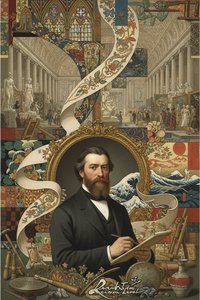
Francisco García Padrós: A Pioneer of Iberian Symbolism
Francisco García Padrós (1867-?) remains an enigmatic figure in Spanish art history, a testament to the challenges faced by documenting artists whose lives and output were not extensively recorded. Born in Madrid, Spain, his artistic journey unfolded during a period marked by significant cultural shifts—the waning influence of Romanticism and the burgeoning embrace of Symbolism—a movement that profoundly shaped his distinctive visual language. Despite scarce biographical details, García Padrós’s legacy rests primarily on his singular masterpiece: ‘Map- Price lists of Caminos de Hierro de España and Portugal,’ completed in 1867. This ambitious project exemplifies not only technical prowess but also a deep engagement with the intellectual currents of his time.
The Birth of Symbolism and Artistic Vision
The late nineteenth century witnessed a dramatic transformation within European artistic circles, fueled by thinkers like Nietzsche and Wagner who questioned traditional moral frameworks and championed subjective experience. Symbolist artists rejected realism’s objective portrayal of reality in favor of exploring inner states—dreams, emotions, myths—and conveying spiritual truths through evocative imagery. García Padrós absorbed these ideas, channeling them into his artwork with remarkable sensitivity. His approach prioritized atmosphere and mood over precise representation, prioritizing the suggestion of meaning rather than literal depiction. This stylistic choice aligns perfectly with the Symbolist ethos, demonstrating a profound understanding of its core principles.
‘Map- Price lists of Caminos de Hierro de España and Portugal’: A Monumental Achievement
‘Map- Price lists of Caminos de Hierro de España and Portugal’ stands as García Padrós's crowning achievement—a monumental watercolor that transcends mere topographical accuracy. Measuring approximately 180 x 240 cm, the painting depicts a panoramic view of Spain and Portugal, overlaid with intricate price lists detailing railway routes and infrastructure developments. This seemingly disparate combination speaks volumes about García Padrós’s artistic vision. He skillfully integrates geometric precision—the mapping itself—with lyrical brushwork—capturing the hazy beauty of the landscape—creating a visual paradox that invites contemplation. The meticulous detail evident in every stroke underscores his mastery of watercolor technique, demonstrating an unwavering commitment to capturing nuance and subtlety.
Influences and Artistic Development
While biographical information remains elusive, García Padrós’s artistic style reveals connections to prominent Symbolist painters like Edvard Munch and Gustav Klimt. Like these artists, he employed muted color palettes—primarily blues and greens—to evoke emotion and create a sense of melancholy. Furthermore, his use of decorative patterns and textures reflects Klimt's opulent aesthetic, demonstrating an awareness of broader artistic trends. Although García Padrós’s oeuvre is limited, ‘Map- Price lists of Caminos de Hierro de España and Portugal’ firmly establishes him as a pivotal figure in Iberian Symbolism—a testament to his ability to synthesize intellectual ideas with artistic execution.
Legacy and Museums Collections
Today, García Padrós's work resides primarily within the colección andrés blaisten and the pérez simón collection, offering scholars invaluable insight into the artistic landscape of Spain during its transformative period. These collections showcase a wealth of Latin American artworks, including paintings by Diego Velázquez and other masters—a reminder of the enduring power of art to transcend time and inspire ongoing research. Exploring these museums provides an opportunity to appreciate García Padrós’s contribution to Spanish art history and to contemplate the complexities of documenting artistic creativity in the absence of comprehensive biographical records.