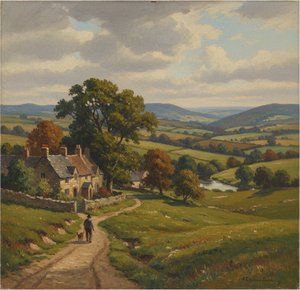
The Enduring Legacy of Frank Moore Studio: Capturing American Interiors
Frank Moore Studio, based in Cleveland, Ohio, represents a fascinating and often overlooked chapter in the history of American decorative art and reproduction painting. While not a single artist but rather a prolific workshop, the studio’s impact on the aesthetic landscape of the early to mid-20th century is undeniable. The story of Frank Moore Studio isn't one of individual genius celebrated through unique brushstrokes, but of skilled craftsmanship dedicated to bringing European Old Master paintings into American homes during a period when international travel was less accessible and original artworks were largely beyond the reach of most collectors.
A Response to Demand: The Rise of Reproduction
The studio emerged as part of a broader trend in the late 19th and early 20th centuries – the growing desire for cultural enrichment among a burgeoning middle class. Before widespread photography and digital reproduction, owning a piece of art meant commissioning an original work or acquiring it at significant expense. Frank Moore Studio filled a crucial niche by offering meticulously hand-painted reproductions of celebrated European paintings. These weren’t simple copies; they were re-interpretations created with considerable skill, often tailored to the specific tastes and dimensions requested by clients. The studio's success hinged on its ability to provide affordable access to artistic heritage, effectively democratizing art ownership. The demand stemmed from a yearning for sophistication and status, as well as a genuine appreciation for the beauty and historical significance of the works being replicated.
Techniques and Styles: Mastering the Old Masters
Frank Moore Studio didn’t specialize in a single style; its strength lay in versatility. Artists employed by the studio were adept at mimicking a wide range of techniques, from the delicate glazing of Renaissance masters like Raphael and Titian to the bolder brushwork of Baroque painters such as Rembrandt and Rubens.
The process was labor-intensive, involving careful study of original compositions, often relying on photographs or engravings as source material. While details about individual artists within the studio remain scarce, it’s clear they possessed a strong understanding of pigment mixing, composition, and perspective. The studio frequently focused on interior scenes, still lifes, and portraits – subjects that resonated with American domestic sensibilities.
The emphasis was not necessarily on innovation but on faithful reproduction, albeit with subtle variations reflecting the hand of the artist and the preferences of the client.
Historical Significance: A Reflection of American Taste
Frank Moore Studio’s work provides a unique window into the tastes of early 20th-century America. The paintings they reproduced weren't chosen arbitrarily; they represented a collective ideal of beauty, refinement, and cultural aspiration. The studio’s clientele included private collectors, hotels, and public institutions, indicating a broad appeal across different social strata. While often dismissed as mere copies, these reproductions played a significant role in shaping the visual environment of American homes and fostering an appreciation for European art history.
- They allowed a wider audience to engage with masterpieces that would otherwise have been inaccessible.
- The studio’s success demonstrates the growing importance of decorative arts in American society.
- Frank Moore Studio's paintings offer valuable insights into the aesthetic preferences and cultural values of the period.
Today, works attributed to Frank Moore Studio are increasingly recognized as fascinating artifacts of a bygone era. They represent not just skillful craftsmanship but also a compelling story about art, commerce, and the American pursuit of beauty and culture. The studio’s enduring legacy lies in its ability to bring the Old Masters into the lives of ordinary Americans, leaving an indelible mark on the nation's artistic landscape.