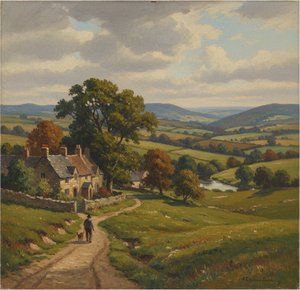
Franklin H. Eshelman: A Pioneer of American Landscape Painting
Franklin H. Eshelman (1874-1959) stands as a quietly significant figure in the history of American art, particularly within the realm of early 20th-century landscape painting. Born in Lancaster, Pennsylvania, and raised amidst the rolling hills of Bourbon County, his formative years were deeply intertwined with the rural beauty that would become the enduring subject of his work. Eshelman’s career unfolded not through formal training or academic acclaim, but rather through a dedicated life spent observing and meticulously rendering the landscapes he knew intimately – primarily the fertile valleys and open fields of southeastern Pennsylvania.
Eshelman's artistic journey began modestly, initially as an itinerant artist working portraits and commissions in local communities. This early experience honed his observational skills and instilled a deep appreciation for capturing the nuances of light and shadow on natural subjects. However, it was during the late 1890s and early 1900s that he truly established himself as a landscape painter. Influenced by the burgeoning Impressionist movement – particularly the work of artists like Frederic Church and Albert Bierstadt – Eshelman sought to translate his direct observations into paintings imbued with a sense of atmosphere and color. He wasn’t interested in grand, dramatic vistas; instead, he favored smaller-scale scenes depicting familiar farms, fields, and streams—the everyday beauty of rural life.
His technique was characterized by a deliberate restraint and a commitment to realism. Eshelman meticulously built up his paintings through numerous thin layers of oil paint, creating a textured surface that subtly reflected the light and shadows of the landscape. He employed a muted palette – predominantly greens, browns, and blues – to evoke a sense of tranquility and authenticity. Unlike some of his contemporaries who embraced bold brushstrokes and vibrant colors, Eshelman’s approach was more understated, prioritizing accuracy and detail over expressive gesture. His paintings often feature elements like grazing livestock, weathered barns, and winding streams, creating scenes that feel both timeless and deeply rooted in the local environment.
Key Works and Recurring Themes
Among Eshelman's most celebrated works is “Schwartz’s Old Mill” (1913), a serene depiction of a classic Pennsylvania mill nestled within a pastoral landscape. This painting exemplifies his signature style – a careful rendering of light, color, and detail that captures the essence of rural life. Other notable pieces include various scenes depicting farms, fields, and streams, each imbued with a quiet sense of peace and harmony. These works weren’t intended for grand exhibitions or public acclaim; rather, they were created largely for private collectors and individuals who appreciated his ability to capture the beauty of the Pennsylvania countryside.
Recurring themes in Eshelman's work include the cyclical rhythms of nature—the changing seasons, the movement of water, and the daily routines of rural life. He frequently depicted scenes that evoked a sense of nostalgia for a simpler time, reflecting a deep connection to his roots and a reverence for the land. His paintings are not merely representations of landscapes; they are imbued with a quiet spirituality, suggesting a profound understanding of the relationship between humanity and nature.
A Life Beyond Painting: An Unexpected Connection
Interestingly, Eshelman’s life extended beyond his artistic pursuits. Records indicate he was involved in the automobile industry for a significant period, working as an engineer and later as a manager at various automotive companies, including the defunct Studebaker Corporation. This dual career—a dedicated artist alongside a professional in manufacturing—offers a fascinating glimpse into the complexities of his life and perhaps reflects a pragmatic approach to survival and success. Family records reveal that he emigrated from Europe with his family and settled in Pennsylvania, eventually marrying Sarah Plotts.
Further research reveals connections between Eshelman’s artistic endeavors and his ancestry. Genealogical investigations have traced his lineage back to German immigrants who arrived in the United States during the 19th century, specifically settling in Lancaster County, Pennsylvania. This connection to a rich immigrant heritage likely informed his appreciation for the land and his commitment to preserving its beauty through his art.
Legacy and Historical Significance
While Franklin H. Eshelman may not be as widely recognized as some of his contemporaries, his work holds significant historical value. He represents a vital link in the chain of American landscape painting—a generation of artists who sought to capture the beauty of their native land with honesty and restraint. His paintings offer a valuable window into the rural life of early 20th-century America, providing insights into the values, customs, and aesthetics of a bygone era.
Eshelman’s legacy is perhaps best understood through his quiet dedication to his craft and his unwavering commitment to portraying the beauty of the Pennsylvania countryside. His paintings serve as a testament to the power of observation, the importance of connection to nature, and the enduring appeal of simple, honest art.