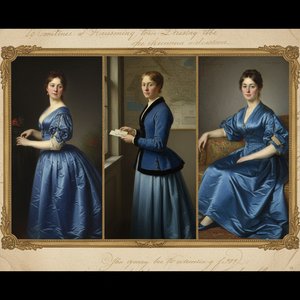
Franz Wilhelm Voigt: A Portraitist of German Modernity
Franz Wilhelm Voigt (1867–1949) stands as a significant figure in German art history, particularly recognized for his masterful portraits that captured the spirit of the early 20th century and cemented his place within the Expressionist movement. Born in Germany during a period of rapid social and artistic transformation, Voigt’s career unfolded against the backdrop of burgeoning industrialization and intellectual ferment—influences that profoundly shaped his artistic vision.
- Early Life & Artistic Training:
- Career Highlights: Portraits of Notable Figures
- Style & Technique: Nuanced Realism with Emotional Depth
- Connections to Expressionist Movement & Blue Rider Circle
- Legacy & Significance in German Art History
Early Life & Artistic Training:
Voigt’s formative years were spent in Düsseldorf, where he received a comprehensive artistic education at the Kunstakademie Düsseldorf. He studied under Wilhelm Trübschenitsch and Anton Körner, absorbing the principles of academic painting while simultaneously encountering the burgeoning avant-garde currents circulating within German art circles. This dual influence proved crucial to his subsequent stylistic development—a synthesis of classical precision with expressive emotion that would characterize his oeuvre. His early works demonstrated a dedication to meticulous observation and anatomical accuracy, reflecting the traditions of Düsseldorf’s artistic heritage.
Career Highlights: Portraits of Notable Figures:
Voigt gained considerable renown as a portrait artist, attracting commissions from prominent intellectuals and figures across Germany. Among his most celebrated achievements is undoubtedly his portrait of Paul Ehrlich (1920), considered by many to be one of the finest depictions of the renowned bacteriologist. This painting exemplifies Voigt’s ability to convey not merely physical likeness but also psychological insight—capturing Ehrlich's contemplative gaze and conveying a sense of intellectual seriousness. He produced numerous other portraits, documenting the faces of German artists, scientists, and politicians, contributing significantly to the visual record of the Weimar Republic era.
Style & Technique: Nuanced Realism with Emotional Depth:
Voigt’s artistic style distinguished itself through a remarkable blend of realism and expressive emotion. While adhering to meticulous anatomical detail—a hallmark of Düsseldorf’s academic tradition—he skillfully employed subtle tonal variations and nuanced brushwork to imbue his subjects with palpable feeling. Unlike the overtly dramatic gestures often associated with Expressionist painting, Voigt's portraits achieved emotional resonance through understated observation and psychological subtlety. He prioritized capturing the inner life of his sitters, conveying their moods and anxieties with remarkable sensitivity—a testament to his profound understanding of human psychology.
Connections to Expressionist Movement & Blue Rider Circle:
Voigt’s artistic sensibilities aligned closely with the broader trends shaping German art during the early 20th century. Although he never formally joined the Expressionist movement, his stylistic innovations—particularly his emphasis on psychological depth and tonal modulation—were undeniably influenced by its ethos. Furthermore, Voigt maintained connections with artists associated with the Blue Rider Circle, including Wassily Kandinsky and Franz Marc, fostering dialogues about artistic experimentation and spiritual exploration. These collaborations underscored the shared conviction that art should transcend mere representation to engage directly with human experience.
Legacy & Significance in German Art History:
Franz Wilhelm Voigt’s contribution to German art history extends beyond his individual portraits; he embodies a pivotal moment in artistic transition—the bridging of academic tradition and expressive innovation. His work serves as an enduring reminder that profound artistic achievement can arise from reconciling meticulous technique with heartfelt emotion. Voigt's legacy continues to inspire artists today, demonstrating the power of observation combined with psychological awareness to create images that resonate deeply within the viewer’s consciousness. He remains a respected figure in Düsseldorf’s art scene and his portraits continue to be studied as exemplary representations of German artistic culture during the formative years of the 20th century.