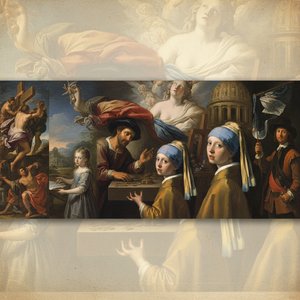
Michelangelo Merisi da Caravaggio: A Revolutionary of Light and Shadow
Michelangelo Merisi, more famously known as Caravaggio, remains one of the most intensely debated and profoundly influential figures in art history. Born in Milan in 1571, his life was a whirlwind of dramatic events – marked by both extraordinary artistic talent and a volatile temperament that ultimately led to exile and premature death in 1610. His brief but explosive career irrevocably altered the course of painting, establishing a new visual language characterized by intense realism, dramatic lighting, and an unprecedented engagement with contemporary life. Caravaggio’s legacy continues to resonate today, inspiring artists and captivating audiences alike.
Early Years and Artistic Training
Caravaggio's early life remains somewhat shrouded in mystery. He was born into a family of modest means in Milan, the son of Rosso Merisi, a court painter for Vincenzo I Gonzaga, Duke of Marsica. This provided him with an initial introduction to the world of art, though he received no formal training. He spent his youth in various Italian cities – Cremona, Bologna, and Venice – honing his skills as a draughtsman and preparing himself for a career in painting. It was in 1592 that he moved to Rome, the vibrant heart of the artistic world, seeking opportunities and hoping to establish himself. Initially struggling to find commissions, he began by specializing in still lifes—scenes of fruits and flowers – a common practice at the time, selling his works on the streets to make ends meet. This early work, though modest, demonstrated an innate ability to capture the textures and colors of natural objects with remarkable accuracy.
The Breakthrough: Dramatic Realism and Theatrical Lighting
Caravaggio’s breakthrough came in 1596 with a commission from Cardinal Francesco Maria del Monte, a prominent patron known for his discerning eye and support of emerging artists. Through the cardinal's connections, Caravaggio secured his first major public commissions – the *Calling of Saint Matthew* and *The Martyrdom of Saint Matthew*, paintings that would cement his reputation almost overnight. These works were revolutionary in their approach to religious painting. Rather than depicting saints as idealized figures removed from earthly concerns, Caravaggio presented them as ordinary people caught in dramatic moments. He employed a technique known as “tenebrism,” characterized by stark contrasts between light and shadow – plunging figures into darkness while highlighting key elements with intense illumination. This created a powerful sense of immediacy and drama, drawing the viewer directly into the scene. As Keith Christiansen notes in *Caravaggio (Michelangelo Merisi) (1571–1610) and His Followers*, Caravaggio “pushed the figures up against the picture plane and used light to enhance the dramatic impact and give the figures a quality of immediacy.”
Controversy, Violence, and Exile
Caravaggio’s innovative style was not without its detractors. His depictions of ordinary people, often with unflattering features and dressed in contemporary clothing, challenged traditional artistic conventions. He was also known for his volatile temper and a penchant for brawling – incidents that included slashing the cloak of an adversary, throwing a plate of artichokes at a waiter, and engaging in violent altercations with police officers. In 1606, his life took a tragic turn when he became embroiled in a dispute with a young man, resulting in a fatal stabbing. Rather than face justice, Caravaggio fled Rome, seeking refuge in Naples, Malta, and Sicily. His travels were punctuated by further incidents of violence and legal troubles, culminating in his expulsion from Malta after another brawl.
Later Years and Legacy
Despite his turbulent life, Caravaggio continued to paint throughout his exile, producing a series of works that demonstrate the evolution of his style. In Naples, he experimented with color and composition, while in Sicily, he focused on dramatic scenes of martyrdom and sacrifice. His final years were marked by a severe disfigurement resulting from a bar fight – an injury that ultimately contributed to his declining health. Caravaggio died in Porto Ercole, Italy, in 1610 at the age of 39.
Despite his short life, Caravaggio’s impact on art was immense. His innovations in lighting, composition, and subject matter profoundly influenced generations of painters who followed, including Rembrandt, Velázquez, and Gentileschi. His use of tenebrism continues to be studied and emulated today, and his paintings remain among the most celebrated and emotionally resonant works in Western art history. As The National Gallery notes, “Caravaggio’s paintings were controversial, popular, and hugely influential on succeeding generations of painters all over Europe.” His legacy endures as a testament to the power of artistic vision and the enduring fascination with the dramatic interplay between light and shadow.