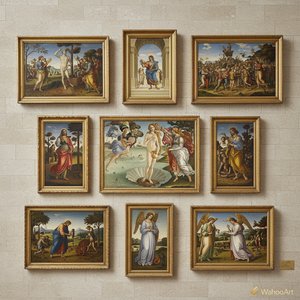
Giovanni Jacopo Caraglio (1500–1565): The Florentine Master of Mannerist Printmaking
Giovanni Jacopo Caraglio, born around 1500 in Verona or Parma—the exact birthplace remains debated—was a pivotal figure in the burgeoning Renaissance printmaking scene and a celebrated goldsmith whose legacy continues to resonate today. His artistic journey spanned from the vibrant studios of Rome to the opulent courts of Poland, marking him as an innovator who skillfully blended technical mastery with stylistic sensitivity.
Early Training and Roman Patronage
Caraglio’s formative years were spent honing his skills in goldsmithing—a craft deeply ingrained in Veronese tradition—before gravitating towards engraving under the tutelage of Marcantonio Raimondi, a prominent artist and printmaker whose workshop served as a crucible for artistic experimentation. Raimondi's influence instilled in Caraglio a profound understanding of disegno (drawing) and established him within a circle that embraced groundbreaking techniques. This association quickly propelled him into collaboration with Rosso Fiorentino, arguably the foremost Mannerist painter of his time, resulting in iconic print suites depicting mythological narratives and heroic themes—most notably *The Labours of Hercules* and *Pagan Divinities in Niches*. These prints weren’t merely reproductions; they were interpretations infused with Rosso's distinctive stylistic vision, demonstrating Caraglio’s ability to elevate the print medium beyond mere copying. The patronage of Giulio Romano further solidified his position as a leading artist, commissioning elaborate engravings for monumental architectural projects and showcasing his versatility across various artistic disciplines.
Venetian Innovation and Artistic Evolution
Following the tumultuous Sack of Rome in 1527, Caraglio sought refuge in Venice—a city renowned for its artistic dynamism and burgeoning printmaking industry—where he continued to refine his craft and explore new stylistic avenues. Here, he engaged with artists like Titian and Michelangelo, absorbing their innovative approaches to color and composition. His Venetian prints exemplify a shift towards Mannerist aesthetics characterized by elongated figures, stylized drapery, and dramatic contrasts of light and shadow—a stylistic hallmark that distinguished him from earlier generations of engravers. Notably, Caraglio’s collaboration with Pietro Aretino—a diplomat and humanist known for his flamboyant style—brought him into contact with the influential court of Bona Sforza in Poland, where he served as goldsmith and medallist, crafting exquisite commemorative objects reflecting the grandeur of Polish royal patronage.
A Legacy Defined by Mannerist Style and Reproductive Printmaking
Caraglio’s oeuvre comprises approximately 70 engravings primarily focused on reproducing masterpieces created by Italian masters—Raphael, Titian, Michelangelo, and others. Unlike many engravers of his era who merely replicated existing drawings, Caraglio undertook a transformative process: he meticulously studied the original artworks and translated their expressive qualities into printmaking form. This pioneering approach established him as one of the earliest practitioners of reproductive printmaking—a technique that fundamentally altered the dissemination of art and profoundly impacted artistic practice throughout Europe. His prints are celebrated for their exceptional detail, nuanced tonal gradations, and masterful execution, cementing his reputation as a virtuoso engraver who championed Mannerist ideals and elevated the print medium to new heights of artistic sophistication. Giovanni Jacopo Caraglio’s enduring influence can be seen in subsequent generations of printmakers—a testament to his groundbreaking contribution to Renaissance art history.