Vincent van Gogh: A Life Painted in Color and Emotion
Vincent Willem van Gogh, a name synonymous with passionate brushstrokes and intensely colored landscapes, remains one of the most recognizable figures in art history. Born in 1853 in Groot-Zundert, Netherlands, his life was tragically short – just 37 years – yet during that brief period, he produced over 2,100 artworks, a testament to an extraordinary creative force battling internal turmoil. His work, initially dismissed and largely unappreciated during his lifetime, now commands staggering prices and continues to resonate deeply with audiences worldwide, offering a glimpse into the soul of a man grappling with mental illness while simultaneously striving for profound artistic expression.
Van Gogh’s early life offered little indication of the turbulent path he would take. He was raised in a middle-class family, demonstrating an aptitude for drawing from a young age. Initially, he pursued a career as an art dealer, traveling throughout Europe and working for Goupil & Cie, a prominent firm. However, this profession proved unsatisfying, and he experienced periods of depression and disillusionment. A pivotal moment arrived in 1886 when he moved to Paris, immersing himself in the vibrant Impressionist and Post-Impressionist circles. Artists like Monet, Renoir, and Degas profoundly influenced his approach to color and light, though Van Gogh quickly developed a distinct style that diverged from these movements.
His time in Paris marked a significant shift. He began experimenting with brighter colors, bolder brushstrokes, and a more expressive use of line – techniques he would later refine during his years in Arles and Saint-Rémy. The influence of Japanese prints, which were gaining popularity at the time, is also evident in his work, particularly in the flattened perspectives and bold compositions. He sought to capture not just what he *saw*, but how he *felt* – a deeply personal and emotional response to the world around him. This desire to convey inner experience would become a hallmark of his artistic vision.
The Arles Years: Seeking Community and Artistic Fulfillment
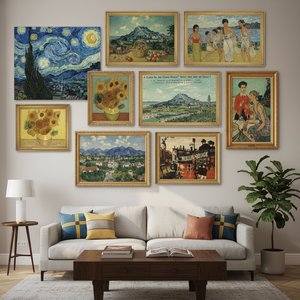
In 1888, Van Gogh moved to Arles in southern France, hoping to establish an artist’s colony alongside Paul Gauguin. This period proved both exhilarating and fraught with challenges. He painted a prolific number of works during this time – including the iconic *Sunflowers* series, *The Bedroom*, and numerous landscapes depicting the Provençal countryside. These paintings are characterized by their vibrant colors, dynamic brushwork, and an almost palpable sense of energy. However, his relationship with Gauguin deteriorated rapidly, culminating in a violent argument that left Van Gogh self-mutilated – he severed part of his ear.
Following this traumatic event, Van Gogh voluntarily admitted himself to the Saint-Paul-de-Mausole asylum in Saint-Rémy. Despite his mental instability, he continued to paint relentlessly, producing some of his most celebrated works during this period, including *The Starry Night*, a swirling depiction of the night sky above Saint-Rémy, and *Wheatfield with Crows*, a powerfully evocative image filled with anxiety and foreboding. These paintings are not merely representations of landscapes; they are expressions of Van Gogh’s inner state – his struggles, his hopes, and his profound connection to nature.
Late Work and the Descent into Darkness
In 1890, Van Gogh moved to Auvers-sur-Oise, a village near Paris, where he was cared for by Dr. Paul Gachet. Despite this relative stability, his mental health continued to deteriorate. He painted feverishly during this final period, producing works such as *The Potato Eaters*, a poignant depiction of peasant life, and several self-portraits that reveal increasing signs of distress. It is believed that he shot himself on July 27, 1890, dying two days later at the age of 37.
Ironically, it was his brother Theo, who tirelessly supported Vincent throughout his life, and who organized the exhibition of his work after his death. Only a handful of Van Gogh’s paintings were sold during his lifetime, but his legacy has grown exponentially in the decades since. His innovative use of color, expressive brushwork, and deeply personal subject matter have profoundly influenced generations of artists – from Expressionists like Edvard Munch to contemporary painters.
Legacy and Influence
Vincent van Gogh’s impact on art is immeasurable. He demonstrated that painting could be a vehicle for intense emotional expression, moving beyond mere representation to convey the artist's inner world. His bold use of color, particularly his vibrant yellows and blues, revolutionized the way artists approached landscape and still life painting. His work paved the way for Expressionism and continues to inspire artists today.
Beyond his artistic achievements, Van Gogh’s story is one of profound human struggle and resilience. His letters to Theo offer a rare and intimate glimpse into his thoughts, feelings, and creative process. They reveal a man grappling with mental illness, seeking connection, and striving for meaning in a world that often seemed incomprehensible. Vincent van Gogh's art endures not just as beautiful images, but as a testament to the power of human creativity and the enduring quest for self-expression.