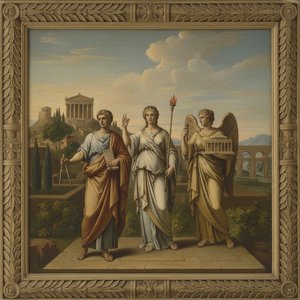
Jan Anthonie Coxcie (1650–1720): Flemish Baroque Painter of Myth and Majesty
Jan Anthonie Coxcie, born around 1660 in Mechelen, Belgium, was a pivotal figure in the flourishing Flemish Baroque artistic landscape. His lineage traced back to Michiel Coxie, one of the foremost Renaissance painters who championed the ideals of Raphael—a connection that profoundly shaped his artistic vision and established him within a tradition of grandeur and meticulous detail. Growing up amidst this artistic heritage instilled in him an unwavering dedication to mastering technique and conveying profound emotion through visual representation.
Early Life and Artistic Training
Coxcie’s formative years were spent honing his skills under the tutelage of his father, Jan Coxie—a celebrated landscape painter—and Charles Emmanuel Biset, director of the Antwerp Academy. Biset's influence extended beyond mere instruction; he fostered a deep appreciation for classical ideals and encouraged Coxcie to explore the expressive potential of disegno, the Italian term for drawing and sketching. This rigorous training equipped him with the foundational knowledge necessary to excel in both portraiture and history painting—genres that would define his artistic career.
A Career Marked by Patronage and Artistic Innovation
Coxcie’s professional life unfolded across several European capitals: Mechelen, Amsterdam, Berlin, Mainz, and Milan. Initially establishing himself in Mechelen around 1691, he swiftly gained recognition for his portrait commissions—most notably a monumental depiction of Charles II of Spain commissioned by the city itself. This undertaking showcased Coxcie’s ability to capture regal dignity and convey complex psychological states with remarkable accuracy. His subsequent engagements in Amsterdam and Berlin cemented his reputation as a versatile artist capable of adapting to diverse artistic contexts while maintaining stylistic consistency. The patronage of Frederick I of Prussia afforded him unparalleled opportunities to decorate royal residences—a testament to his skill and prestige.
Notable Works and Artistic Style
Coxcie’s oeuvre comprises an impressive array of paintings, reflecting the breadth of his artistic interests. Among his most celebrated achievements are the frescoes adorning Charlottenburg Palace—particularly those depicting Aurora, Apollo, Mercury, Saturn, and the Four Continents—which embody the spirit of Prussia's Golden Age. These monumental canvases exemplify Coxcie’s masterful command of color, composition, and illusionistic technique—drawing heavily from the influence of Rubens and Van Dyck. His meticulous attention to detail and his ability to imbue his subjects with palpable emotion solidified his position as a leading exponent of Baroque artistry. Furthermore, he produced copies after masterpieces by Rubens and Van Dyck demonstrating his understanding of artistic conventions and stylistic nuances.
Legacy and Historical Significance
Coxcie’s contribution to Flemish Baroque art is undeniable—he stands alongside other luminaries of the era as a champion of classical ideals and a conduit for conveying profound narratives through visual imagery. His work continues to inspire admiration for its elegance, psychological depth, and technical virtuosity. The Minorite Church in Eger, Hungary, houses one of his most enduring masterpieces—a breathtaking fresco cycle that exemplifies the grandeur and spiritual fervor characteristic of Baroque art. Coxcie’s legacy extends beyond individual artworks; he represents a pivotal moment in European artistic history—a period marked by innovation, patronage, and an unwavering commitment to elevating visual representation as a vehicle for conveying moral and intellectual ideals.