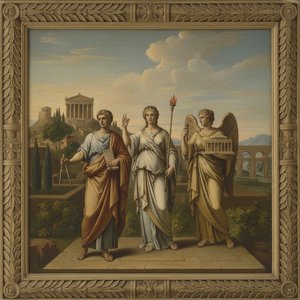
Jean-Jacques François Le Barbier: A Painter of Myth and Majesty
Jean-Jacques François Le Barbier (1738 – 1826) stands as a fascinating figure in the artistic landscape of late eighteenth-century France, blending meticulous craftsmanship with allegorical storytelling. Born in Rouen, he emerged from humble beginnings to become an official painter of Louis XVI, marking him as a prominent voice within the royal court’s patronage system—a pivotal moment shaping the trajectory of French art and culture. His legacy extends beyond mere portraiture; Le Barbier's artistic vision embraced grand narratives rooted in classical mythology and humanist ideals, leaving an indelible mark on decorative arts and influencing subsequent generations of artists.
Early Life and Artistic Training
Little is known about Le Barbier’s formative years, though he received his initial training under Jean-Baptiste Simeon Chardin, a celebrated Neoclassical painter renowned for his serene depictions of human emotion and understated elegance. This influence undoubtedly instilled in Le Barbier a dedication to realism tempered by intellectual contemplation—a characteristic that would permeate his oeuvre throughout his career. He honed his skills further at the Académie Royale de dessin in Paris, immersing himself in the prevailing artistic currents of the era and absorbing the lessons imparted by luminaries like François Boucher and Jean-Honoré Fragonard.
The Declaration of Rights and Artistic Patronage
Le Barbier’s ascent to prominence coincided with the tumultuous period preceding the French Revolution. Recognizing his talent and ambition, Louis XVI appointed him as an official painter, affording him access to royal commissions and propelling him into the orbit of influential artistic circles. This patronage proved invaluable, allowing Le Barbier to undertake ambitious projects that reflected the intellectual ferment of the time. Notably, he contributed significantly to Jacques-Louis David’s monumental depiction of ‘The Declaration of the Rights of Man and of the Citizen,’ a pivotal artwork embodying Enlightenment principles and symbolizing the burgeoning spirit of republican liberty. His involvement in this iconic piece cemented his reputation as a champion of humanist ideals and artistic innovation.
Decorative Arts and Mythological Allegory
Beyond painting, Le Barbier excelled as an illustrator and designer of tapestries—a skill that showcased his mastery of color and composition while aligning with the decorative ambitions of the monarchy. He spearheaded the creation of ‘The Four Continents,’ a breathtaking suite of tapestries commissioned by Louis XVI to commemorate the grandeur of France’s imperial dominion. Each tapestry depicted a stylized representation of its respective continent, infused with mythological symbolism—Africa embodied Venus, Asia represented Jupiter, Turkey showcased Apollo, and America honored Hercules—demonstrating Le Barbier's ability to transform classical narratives into visually arresting artworks. His meticulous attention to detail and masterful use of color elevated these tapestries to masterpieces of Neoclassical decorative art.
Notable Works: Beyond the Grand Narrative
Le Barbier’s artistic output encompassed a diverse range of subjects, reflecting his versatility as an artist. Among his most enduring creations is ‘A Female Turkish Bath or Hammam,’ a captivating scene capturing the sensual beauty and ritualistic traditions of Ottoman culture—a testament to Le Barbier's fascination with exotic landscapes and humanist observation. Furthermore, “La Chasse aux Papillons,” an allegory exploring themes of Beauty attempting to restrain Inconstancy, exemplifies his penchant for conveying complex ideas through symbolic imagery. These artworks stand as enduring symbols of artistic excellence and intellectual curiosity, securing Le Barbier’s place within the canon of French art history.
Legacy and Influence
Jean-Jacques François Le Barbier's contribution to French art extended far beyond his individual achievements. His unwavering commitment to Neoclassical principles—characterized by clarity, restraint, and idealized beauty—influenced countless artists who followed him. He championed a humanist aesthetic that prioritized intellectual contemplation alongside technical virtuosity, shaping the artistic sensibilities of an era grappling with profound social and political transformations. Today, Le Barbier’s paintings continue to inspire admiration for their elegance and symbolic depth, ensuring his enduring legacy as a painter of myth and majesty—a true embodiment of the Enlightenment spirit.