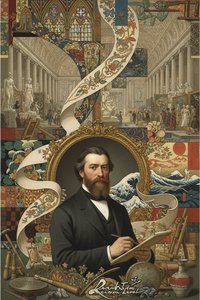
Jean Paul Étienne Balze: A Rediscovery of Raphael’s Legacy
Jean Paul Étienne Balze (1815 – 1884) stands as a pivotal figure in the revival of Raphael scholarship during the mid-nineteenth century, largely thanks to his meticulous reproductions of Michelangelo Buonarroti's frescoes in the Sistine Chapel and, more notably, his extraordinary series of copies after Raphael’s frescoes in the Vatican Loggias. While overshadowed by contemporaries like Ingres and Millet, Balze’s dedication to preserving and disseminating Raphael’s artistic vision cemented his place within French art history.
Born in Rome—the son of Joseph Balze, Grand Chamberlain to Charles IV—Balze’s upbringing amidst the intellectual fervor of the papal exile profoundly shaped his artistic sensibilities. His brother Raymond Balze shared similar ambitions as an artist, fostering a collaborative spirit that would characterize their careers. Early exposure to Ingres' influence proved formative; Ingres himself commissioned several works from Balze after 1814, recognizing Balze’s talent for capturing the grandeur and subtlety of classical art.
Balze’s formal artistic training commenced at the École des Beaux-Arts in Paris during the 1830s where he honed his skills as a copyist under Ingres' tutelage. This apprenticeship was particularly significant as Ingres spearheaded the Vatican Loggia Project, assigning Balze and Raymond to meticulously reproduce Raphael’s monumental frescoes—a task that demanded unparalleled precision and artistic understanding. The resulting fifty-two copies were unveiled in 1840 at the École des Beaux-Arts chapel, demonstrating Balze's commitment to upholding artistic standards of excellence.
Further bolstering his reputation was Ingres’ insistence on utilizing Balze and Raymond for a new initiative: placing these reproductions within the Palazzo delle Stampe—the Louvre’s decorative galleries—a decision that acknowledged their contribution to enriching Parisian cultural life. The project culminated in 1854-55 with the collaboration of Charles Chauvin and Camille Auguste Gastine, who skillfully integrated Balze's copies into the palazzo’s architectural framework. This undertaking underscored Balze’s role not merely as a painter but as an active participant in shaping artistic discourse and aesthetic experience.
Beyond these monumental reproductions, Balze pursued diverse artistic endeavors, including faience productions and involvement in the decorative scheme of the Hôtel de la Banque de France. Notably, he undertook the restoration of frescoes in Abbot's Chapel Chaalis Abbey alongside Raymond Balze between 1875 and 1881—a testament to his enduring passion for preserving artistic heritage. Jean Paul Étienne Balze passed away peacefully in Paris on March 24th, 1884, leaving behind a legacy of unwavering dedication to Raphael’s art and its dissemination throughout France.