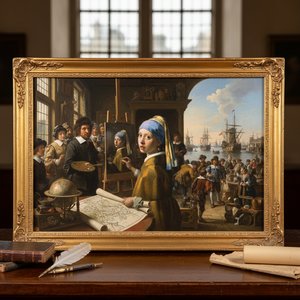
Johannes Mytens: A Master of Dutch Portraiture
Johannes Mytens (c. 1614 – 1670) stands as a prominent figure within the illustrious Dutch Golden Age, celebrated primarily for his exquisite portrait paintings that captured the essence of aristocratic families and individuals alike. Born in The Hague, he emerged from a lineage steeped in artistic tradition—his uncles Isaac Mijtens and Daniël Mijtens were also painters, fostering an environment ripe for creative development. This familial connection profoundly shaped Mytens’ artistic trajectory, influencing his training under luminaries like Anthony van Opstal and Nicolas van der Horst, establishing him firmly within the established artistic circles of his time.
- Early Training & Influences: Van Opstal's meticulous realism and van der Horst’s masterful use of light undoubtedly instilled in Mytens a foundational understanding of technique—a hallmark that would characterize his subsequent oeuvre.
- Guild Membership & Artistic Community: Joining the Hague Guild of Saint Luke in 1642 marked a pivotal moment, solidifying his professional standing and aligning him with fellow artists who championed artistic excellence and innovation. Notably, he spearheaded the formation of the confrerie pictura, demonstrating his commitment to fostering collaborative creativity within the artistic landscape.
Mytens’ artistic output spanned diverse genres, ranging from stately portraits showcasing the grandeur of Dutch royalty to intimate genre scenes depicting everyday life—often imbued with subtle symbolic representations reflecting prevailing social and moral values. His unparalleled skill in rendering clothing – particularly the opulent attire of affluent Dutch citizens – distinguishes him as a uniquely perceptive artist who meticulously documented the visual culture of his era. Scholarly research confirms that Mytens nurtured numerous talented students, including Nicolaes Lissant, Gerard de Nijst, Adriaen Stalpert van der Wiele, Pouwels van de Velde, Andries Thijsz. De Wit, and Urbanus Talibert van Yperen—a testament to his enduring legacy as a pedagogue and mentor.
Notable Works & Artistic Style
Mytens’ artistic style is characterized by a harmonious blend of realism and idealism, reflecting the Baroque aesthetic prevalent during his lifetime. He skillfully employed chiaroscuro – dramatic contrasts between light and shadow – to sculpt figures with remarkable depth and dimensionality, conveying emotion and psychological nuance. His compositions are meticulously balanced, prioritizing clarity and elegance while simultaneously incorporating symbolic elements that enrich the narrative content. Consider particularly ‘The van der Graeff Family,’ where he deftly portrays a wealthy English family against a richly textured backdrop—a masterpiece demonstrating his mastery of color palettes and spatial arrangement. Similarly, his depiction of Frederick Henry’s daughters exemplifies Baroque grace and sophistication.
- ‘The van der Graeff Family’: This monumental portrait showcases Mytens' ability to capture familial bonds and convey aristocratic status with breathtaking precision.
- Portrait of James, 4th Lord Cranstoun: A captivating depiction of Scottish nobility, demonstrating Mytens’ talent for portraying character and conveying emotion through nuanced facial expressions.
Legacy & Historical Significance
Johannes Mytens' contribution to Dutch art history extends beyond his individual paintings; he served as a crucial catalyst in shaping the artistic sensibilities of subsequent generations. His influence can be discerned in the works of his students, who carried forward his stylistic innovations and upheld his commitment to artistic integrity. Furthermore, Mytens’ meticulous documentation of social life—particularly through genre scenes—provides invaluable insights into the cultural milieu of 17th-century Holland. As a symbol of Dutch artistic excellence during its golden age, Mytens continues to inspire admiration and scholarly investigation today, securing his place as one of the most revered portrait painters of his era.
Further Exploration
For deeper understanding of Johannes Mytens’ life and work, explore resources such as: