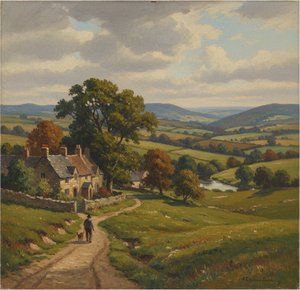
A Quiet Pastoral Vision: The Life and Art of Kate Ethel Cowderoy
Kate Ethel Cowderoy (1875-1972) remains a somewhat elusive figure in the landscape of early 20th-century British art, yet her charming paintings—often depicting idyllic scenes of rural life centered around goats and young girls—possess a delicate beauty that resonates with a quiet, enduring appeal. While not widely celebrated during her lifetime, Cowderoy’s work offers a fascinating glimpse into the artistic currents of the period, blending elements of Victorian sentimentality with a developing sense of modern observation. Born in 1875, details surrounding her early life are scarce; however, it is known she received formal training at the Herkomer School of Art, Bushey, Hertfordshire, a significant institution that fostered a community of artists dedicated to realistic representation and plein air painting. This education profoundly shaped her artistic trajectory, instilling in her a commitment to capturing the nuances of light and atmosphere.Early Influences and Artistic Development
The Herkomer School, founded by Sir Hubert von Herkomer, emphasized direct observation from life, particularly landscape and figure studies. Cowderoy’s early works reflect this influence, with meticulous attention paid to anatomical accuracy and naturalistic detail. Her paintings from this period frequently feature nude or semi-nude male models – a common subject for academic study – demonstrating her technical proficiency in rendering the human form. However, she soon gravitated towards more pastoral themes, particularly scenes involving goats and young girls. This shift may have been influenced by the broader artistic trends of the time, which saw a renewed interest in rural life as an antidote to the increasing industrialization of Britain. The Newlyn School of painters, with their focus on depicting the lives of Cornish fishing communities, also likely exerted some influence, though Cowderoy’s work possesses a distinctly gentler and more introspective quality. Her paintings are not concerned with social realism or dramatic narratives; rather, they evoke a sense of peaceful contemplation and harmonious connection between humanity and nature.Themes and Techniques: Goats, Girls, and the British Countryside
Cowderoy’s signature subject matter – goats and girls in rural settings – is imbued with a subtle symbolism that adds depth to her seemingly simple scenes. Goats, often associated with pastoral innocence and fertility, become emblems of natural vitality and untamed beauty. The young girls depicted in her paintings are rarely engaged in active play; instead, they appear lost in thought, gazing into the distance or tending to their animal companions. This introspective quality suggests a fascination with the inner lives of these subjects, exploring themes of childhood, femininity, and the passage of time. Technically, Cowderoy’s work is characterized by a delicate brushstroke and a muted palette, often employing soft greens, browns, and blues to create a harmonious atmosphere. She demonstrates a keen eye for light and shadow, capturing the subtle effects of sunlight filtering through trees or illuminating a young girl's face. Her paintings are not grand in scale; they are intimate studies that invite close observation and quiet reflection.Recognition and Legacy
Despite exhibiting her work at various galleries throughout her career, Cowderoy never achieved widespread recognition during her lifetime. Her paintings were appreciated for their technical skill and charming subject matter, but they did not fit neatly into any established artistic category. In recent years, however, there has been a growing appreciation for her work as part of a broader reassessment of women artists in the early 20th century. Her paintings offer a valuable insight into the lives and experiences of women during this period, challenging traditional notions of artistic subject matter and aesthetic conventions. Today, Cowderoy’s works are increasingly sought after by collectors who appreciate their delicate beauty and quiet emotional resonance. They serve as a reminder of the enduring power of art to capture the fleeting moments of everyday life and evoke a sense of peaceful contemplation in a rapidly changing world.- Key Characteristics: Pastoral scenes, goats, young girls, introspective mood, delicate brushwork.
- Influences: Herkomer School of Art, Newlyn School painters, Victorian sentimentality.
- Notable Works: “Seated Semi Nude Male Model at the Herkomer School”, “Study of a Male Model at the Herkomer School”, “Portrait of a Young Woman”.
- Historical Significance: Represents a quieter, less-celebrated strand of early 20th-century British art; offers insight into women’s artistic perspectives.