Konstantin Andreyevich Somov: A Life in Art
Early Life and Education
Konstantin Andreyevich Somov, a prominent figure in Russian art, was born on November 30, 1869, in Saint Petersburg, Russia. His upbringing within an artistic family profoundly shaped his future path. His father, Andrey Ivanovich Somov, served as a distinguished art historian and curator at the renowned Hermitage Museum. This environment instilled in young Konstantin a deep appreciation for 18th-century art and music from an early age.
Somov pursued formal artistic training at the Imperial Academy of Arts between 1888 and 1897, studying under the tutelage of the celebrated realist painter, Ilya Repin. However, Somov’s artistic inclinations soon diverged from the strictures of realism, leading him to explore more decorative and evocative styles.
Artistic Development and Influences
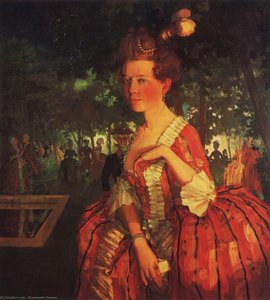
Somov's artistic development was significantly influenced by his fascination with the Rococo period. He admired the elegance, grace, and playful themes prevalent in the works of 18th-century French artists like Jean-Antoine Watteau and François Boucher. This influence is readily apparent in his paintings, characterized by delicate brushwork, pastel colors, and a focus on aristocratic subjects.
He experimented with various mediums, but became particularly adept at watercolors and gouache, which allowed him to achieve the luminous effects he desired. His association with the Mir iskusstva (World of Art) movement further solidified his position within the Russian art scene, fostering a spirit of innovation and aestheticism.
Key Characteristics and Style
- Rococo Revival: Somov consciously revived the Rococo style, imbuing it with a modern sensibility.
- Symbolism & Aestheticism: His works often possess symbolic undertones and prioritize aesthetic beauty over strict realism.
- Elegant Portraits: He excelled in creating refined portraits of Russian society, capturing their elegance and psychological depth.
- Pastel Palette: Somov’s paintings are known for their delicate pastel colors and subtle gradations of tone.
Notable Works and Achievements
Somov created a diverse body of work encompassing portraits, landscapes, and genre scenes. Some of his most celebrated pieces include:
- Open Door on a Garden: A quintessential example of his Art Nouveau style, showcasing his mastery of color and composition.
- Lady Taking Off a Mask: Demonstrates Somov’s exploration of Symbolist themes and psychological complexity.
- The Rainbow (1927): This painting achieved significant recognition when it was sold at Christie's for US$7.33 million, setting a record for a work at an auction of Russian art.
- Portrait of A. Somov, the Artist’s Father: A poignant and intimate portrayal of his father, reflecting his skill in portraiture.
Historical Significance and Legacy
Konstantin Somov played a crucial role in shaping the landscape of Russian art at the turn of the 20th century. His embrace of aestheticism and his revival of Rococo sensibilities challenged prevailing artistic norms and paved the way for new forms of expression.
He was a key member of Mir iskusstva, contributing to its mission of promoting artistic innovation and cultural renewal. Somov’s work continues to inspire artists and art enthusiasts alike, solidifying his legacy as a significant figure in Russian art history. His paintings are exhibited in museums worldwide, including the Yaroslavl Arts Museum in Russia, and remain part of numerous prestigious collections.
Later Life and Death
Somov continued to paint throughout his life, adapting to changing artistic trends while maintaining his distinctive style. He passed away on May 6, 1939, leaving behind a rich and enduring artistic legacy.