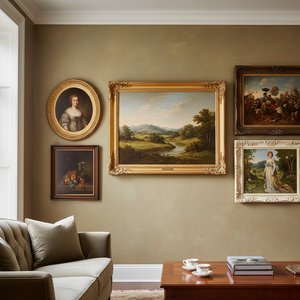
Luigi Giovanni Giussani: Bridging Neoclassicism and Romanticism
Luigi Giovanni Giussani (1771-1840) stands as a singular figure in Italian art history, an artist who defied easy categorization yet undeniably embodies the spirit of his era. Born in Bologna, Italy, Giussani’s life was marked by both artistic passion and profound intellectual engagement—a duality that profoundly shaped his oeuvre and cemented his legacy as a pivotal voice within the burgeoning Romantic movement.
- Early Life & Artistic Formation: Giussani's formative years were steeped in the artistic traditions of Bologna, where he absorbed influences from the Baroque masters – particularly Francesco Bartolomeo Rastrelli – whose grandeur and theatricality resonated deeply within his sensibility. However, it was his father’s role as an anarchist artist who instilled in him a critical perspective on societal norms and fueled his lifelong fascination with reconciling faith and reason.
- Career Highlights: Giussani's artistic career unfolded primarily during the 1800s, witnessing the rise of Romanticism alongside the enduring legacy of Neoclassicism. He achieved considerable renown for landscapes imbued with sublime beauty—particularly those depicting the Tuscan countryside—and portraits that captured the psychological depth and emotional nuance characteristic of the period.
- Technique & Style: Giussani’s artistic style is distinguished by a masterful command of chiaroscuro and sfumato, techniques borrowed directly from Leonardo da Vinci and perfected by Rembrandt. These methods allowed him to create canvases that pulsed with atmospheric luminescence and conveyed an unparalleled sense of realism—a hallmark of Romantic painting.
- Influences & Connections: Giussani’s artistic vision was undeniably shaped by the intellectual currents of his time, notably the rediscovery of classical antiquity and the philosophical debates surrounding Enlightenment ideals. He collaborated closely with fellow artists like Giovanni Domenico Tiepolo and Francesco Cairo—luminaries of Venetian Baroque—whose stylistic innovations served as inspiration for his own explorations.
- Legacy & Significance: Though Giussani’s output remains relatively modest compared to some contemporaries, his paintings continue to captivate viewers with their evocative beauty and psychological insight. He is remembered not merely as a skilled painter but as an artist who successfully synthesized disparate artistic traditions—Neoclassicism and Romanticism—creating a uniquely expressive aesthetic that reflects the complexities of the Italian Romantic landscape.
His work found its home in institutions like the Museo Civico Giovanni Fattori in Livorno, where his landscapes continue to inspire admiration for their masterful depiction of Tuscan scenery. Furthermore, Giussani’s artistic explorations align with broader trends within European art history—a testament to his enduring contribution to the visual arts and a poignant reminder of the transformative power of reconciling faith and reason through creative expression.
Further Exploration: