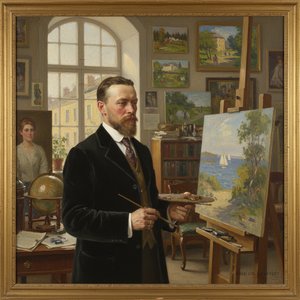
The Tender World of Albert Roelofs: A Belgian Master of Motherhood and Infancy
Albert Roelofs, born Otto Willem Albertus Roelofs in Schaerbeek, Belgium, on September 5th, 1877, was a painter whose legacy resides primarily within the quietly profound realm of domestic scenes. His life, tragically cut short by illness at the young age of forty-three in The Hague in December 1920, nevertheless yielded a remarkably consistent and deeply affecting body of work centered on motherhood, infancy, and the intimate bonds between families. Roelofs’s art isn't characterized by grand narratives or dramatic events; instead, he meticulously captured fleeting moments of tenderness, vulnerability, and quiet connection—a deliberate choice that speaks volumes about his artistic sensibility.
Roelofs’s early life offered little indication of the profound impact he would have on Belgian art. He received a formal artistic education at the Royal Academy of Fine Arts in Antwerp, where he studied under established masters. However, it was through independent study and a deep immersion in the works of artists like Jean-Auguste-Dominique Ingres and Gustave Moreau—both known for their meticulous attention to detail and their exploration of classical themes—that Roelofs began to develop his distinctive style. Moreau’s influence is particularly evident in Roelofs's use of soft, diffused light and his penchant for depicting figures within richly ornamented interiors, creating a sense of timelessness and serenity.
The core of Roelofs’s oeuvre revolves around depictions of mothers and children. These aren’t idealized portrayals; rather, they are imbued with an honest realism that acknowledges the challenges and joys of family life. His subjects—often middle-class families—are presented in intimate settings: nurseries bathed in golden light, kitchens filled with domestic activity, or quiet moments shared between mother and child. He rarely employed dramatic poses or elaborate compositions. Instead, he favored simple, direct arrangements, focusing on capturing the subtle expressions of love, concern, and affection that pass between family members. His paintings are notable for their remarkable technical skill—the delicate rendering of fabrics, the precise observation of anatomy, and the masterful manipulation of light and shadow all contribute to a sense of palpable realism.
Key Characteristics and Artistic Style
Roelofs’s artistic style is often described as “Belgian Impressionism,” though he resisted easy categorization. He shared with the Impressionists an interest in capturing fleeting moments and the effects of light, but unlike his contemporaries, Roelofs retained a strong grounding in academic tradition. His paintings are characterized by:
* **Soft Focus:** A deliberate blurring of details creates a dreamlike atmosphere, emphasizing mood and emotion over sharp realism.
* **Warm Palette:** Roelofs favored muted earth tones—ochres, browns, and creams—which contribute to the overall sense of warmth and intimacy.
* **Detailed Observation:** Despite the soft focus, Roelofs’s paintings are remarkably detailed, particularly in his rendering of fabrics, textures, and facial features.
* **Psychological Insight:** Roelofs possessed a remarkable ability to capture the inner lives of his subjects, conveying their emotions through subtle gestures and expressions.
Notable Works and Recognition
While Roelofs’s output was relatively modest—he produced approximately 150 paintings during his career—several works stand out as particularly significant examples of his art. “The Cradle” (1897), a tender depiction of a mother gently rocking her sleeping child, is arguably his most famous painting and exemplifies the core themes of his oeuvre. Other notable works include "Nursing," "A Mother's Embrace," and numerous portraits of children within domestic settings. Despite his considerable talent, Roelofs received limited recognition during his lifetime. He primarily sold his paintings through galleries and private commissions, and he never achieved widespread fame or commercial success. However, his work was appreciated by a small but devoted circle of collectors and critics who recognized the unique beauty and emotional depth of his art.
Legacy and Historical Significance
Today, Albert Roelofs is increasingly recognized as one of the most important Belgian painters of the late 19th and early 20th centuries. His paintings offer a poignant glimpse into the domestic life of a bygone era—a time when family values were deeply cherished and the bonds between mother and child were held in high regard. His work’s quiet intimacy and emotional resonance continue to resonate with viewers today, reminding us of the enduring power of love, tenderness, and connection. His paintings are now housed primarily at the Royal Albert Memorial Museum in Bloemfontein, South Africa, a testament to his lasting artistic contribution. The museum serves as a vital center for the preservation and display of his work, ensuring that future generations will have the opportunity to appreciate the beauty and significance of this Belgian master’s oeuvre.