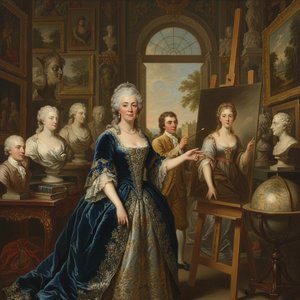
Ramón Bayeu y Subías: A Neoclassical Voice from Zaragoza
Born in Zaragoza, Spain, on December 2nd, 1744, Ramón Bayeu y Subías emerged as a significant figure within the vibrant artistic landscape of the late 18th century. His life was inextricably linked to his family’s legacy of artistic talent; he was the brother of Francisco Bayeu, a renowned painter in his own right, and Manuel Bayeu, also pursuing a career in art. This familial connection fostered an environment of shared learning and collaboration, profoundly shaping Ramón's artistic development. Unlike many artists of his time who sought formal training abroad, Ramón’s initial education was largely provided by his brother Francisco, establishing a strong foundation in painting techniques.
Early influences were rooted in the traditions of Spanish Baroque art, but Ramón quickly embraced the burgeoning Neoclassical movement sweeping across Europe. This shift is particularly evident in his later work, characterized by a deliberate return to classical forms, idealized beauty, and a restrained palette. His decision to travel to Italy after winning a contest at the Real Academia de Bellas Artes de San Fernando in Madrid in 1766 marked a pivotal moment. The Italian experience proved transformative, exposing him to the masterpieces of antiquity and fostering a deeper appreciation for classical principles. He spent several years immersed in the artistic fervor of Rome and Florence, absorbing the techniques and philosophies that would inform his future creations.
The Tapestry Cartoons: A Collaborative Legacy
Ramón Bayeu’s most enduring contribution to art history lies in his prolific work as a “cartonista” – a designer for tapestries. Beginning in 1773, he dedicated himself to creating elaborate designs for the Real Fábrica de Tapices (Royal Tapestry Factory) in Madrid, producing an impressive thirty-five cartoons over the course of nearly two decades. These intricate drawings served as templates for weavers, transforming his artistic vision into magnificent textile masterpieces. His collaborations with his brother-in-law, Francisco Goya, were particularly noteworthy, resulting in a harmonious blend of styles and techniques that elevated the quality and aesthetic impact of the tapestries.
The subject matter of these cartoons spanned a wide range of themes – historical narratives, mythological scenes, portraits, and allegorical representations. Ramón’s meticulous attention to detail, combined with his skillful rendering of drapery and figures, ensured that each cartoon was a work of art in its own right. The tapestries themselves, woven from these designs, became highly sought-after decorations for royal palaces and noble residences throughout Spain and beyond. Notably, many of these tapestries were later reproduced as engravings, ensuring the widespread dissemination of Ramón’s artistic vision.
Beyond Tapestries: Frescoes and Engravings
While his work in tapestry design remains his most celebrated achievement, Ramón Bayeu was also a versatile artist who excelled in other mediums. He executed several frescoes within the Basilica of Our Lady of the Pillar in Zaragoza, demonstrating his mastery of color and composition on a grand scale. He also produced engravings, meticulously reproducing famous paintings such as Guercino’s “Liberation of St. Peter,” now housed in the Museo del Prado. These engravings served not only as artistic tributes but also as valuable historical documents, providing insights into the techniques and styles of master painters.
Furthermore, Ramón's involvement extended to commissions for private clients, including frescoes in Valladolid Monastery and Valdemoro Church, and portraits that adorned the homes of prominent figures. His versatility showcased a deep understanding of artistic principles and a willingness to adapt his skills to diverse projects.
A Tragic End and Lasting Influence
Ramón Bayeu y Subías’s life was tragically cut short on March 1st, 1793, in Aranjuez, where he was working on a commission for the King. His untimely death at the age of 48 was likely due to lead poisoning, contracted during his earlier years as a freelance painter. Despite this unfortunate circumstance, Ramón’s artistic legacy endures. His tapestries and engravings continue to be admired for their elegance, sophistication, and technical brilliance. He remains a significant figure in Spanish Neoclassicism, representing a bridge between the Baroque traditions of his family and the emerging ideals of the Enlightenment era.
His work exemplifies the importance of familial artistic networks and the enduring power of classical inspiration. Ramón Bayeu y Subías’s contributions to Spanish art are a testament to his talent, dedication, and the vibrant cultural atmosphere of 18th-century Spain.