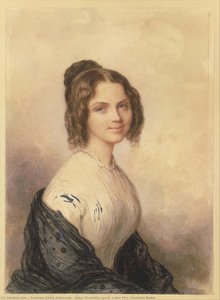
Savinien Edme Dubourjal: A Parisian Watercolorist Capturing American Politics
Savinien Edme Dubourjal (1795-1853) was a French watercolorist and miniaturist painter who quietly established himself as one of the foremost portrait artists of his era, particularly adept at capturing the nuances of political figures. Born in Paris amidst the burgeoning artistic fervor of the Romantic movement, Dubourjal’s career unfolded largely outside the spotlight of academic salons, focusing instead on commissions from wealthy patrons and prominent statesmen—a path that allowed him to cultivate a distinctive style rooted in meticulous observation and subtle tonal gradations.
Early Life and Artistic Training
Little is known about Dubourjal's formative years beyond his birthdate and place. He apprenticed under Jean-Baptiste Camille Bouchardy, a respected watercolorist who championed the expressive qualities of the medium—a crucial influence on Dubourjal’s artistic sensibilities. Bouchardy instilled in him not merely technical proficiency but also an understanding of how to convey emotion through color and texture, principles that would become hallmarks of Dubourjal's oeuvre. This training fostered a dedication to realism tempered by sensitivity, shaping his approach to portraiture and miniature painting alike.
The Art of Watercolor: Technique and Aesthetic Considerations
Watercolor possessed a particular allure for Dubourjal—its ability to achieve luminous effects and capture fleeting impressions resonated deeply with his artistic vision. Unlike oil paint, watercolor demanded patience and precision; layers upon layers of translucent washes built up gradually, creating depth and atmosphere without sacrificing detail. Dubourjal’s technique involved careful blending and scumbling—manipulating the pigment surface to create soft edges and subtle tonal variations—resulting in portraits that possessed an ethereal quality, reflecting both the sitter's personality and the artist's masterful control over color. He favored muted palettes dominated by blues, greens, and browns, colors he skillfully employed to convey dignity and seriousness.
Notable Commissions and Artistic Achievements
Dubourjal gained considerable renown for his portrait commissions, notably including Henry Clay and John C. Calhoun—two titans of American politics during the tumultuous years leading up to the Civil War. These portraits are celebrated not only for their accuracy but also for their psychological insight; Dubourjal succeeded in capturing the gravitas and intellectual fervor of his subjects, conveying their convictions with understated eloquence. His miniature paintings were equally admired for their exquisite craftsmanship and artistic merit—often depicting aristocratic families or religious figures—demonstrating a versatility that distinguished him from many of his contemporaries.
Legacy and Historical Significance
Though Dubourjal remained largely unrecognized during his lifetime, his work has endured as an exemplar of nineteenth-century watercolor portraiture. His meticulous attention to detail, combined with his masterful use of color and tonal modulation, established him as a pioneer in conveying psychological complexity within the confines of a small format. Furthermore, his portraits serve as invaluable documents of American political life during a pivotal period—testaments to Dubourjal’s artistic skill and his ability to capture the spirit of an era. His legacy continues to inspire artists today who strive for subtlety and nuance in their depictions of human subjects.