The Maestro of Edo’s Artistic Zenith
Utagawa Kunisada, born Sumida Shōgorō IX in the vibrant district of Honjo, Japan, stands as arguably the most celebrated ukiyo-e artist of the 19th century. His prolific output and unparalleled commercial success cemented his position as a titan amongst his contemporaries—Hiroshige, Hokusai, and Kuniyoshi—establishing him as the undisputed champion of color woodblock printing during the Edo period. While European collectors initially regarded these masters as inferior to classical ukiyo-e artists, a resurgence of appreciation in the mid-20th century has rightfully elevated Kunisada’s stature, recognizing him as one of the foremost figures in Japanese artistic history.
Kunisada's formative years were marked by familial stability stemming from his father’s modest ferry service business, a circumstance that afforded him a degree of financial security uncommon for artists of his time. His father, an amateur poet, instilled in Kunisada a deep passion for literature and artistic expression. Recognizing his innate talent, the legendary Toyokuni I, the dominant figure of the Utagawa school and a renowned Kabuki designer, took Kunisada under his wing as an apprentice. This apprenticeship imparted invaluable knowledge of theatrical art and printmaking techniques, solidifying Kunisada’s connection to the Utagawa lineage. The studio name kuni-sada, derived from Toyokuni I's surname, symbolized this heritage and foreshadowed Kunisada’s own enduring legacy as a leader in the field.
A Mastery of Color and Character
As his career blossomed, Kunisada became a master of capturing the ephemeral beauty of the "floating world." His work is characterized by an extraordinary ability to breathe life into his subjects through vibrant colors and meticulous detail. He achieved unparalleled success in several distinct genres:
- Yakusha-e: His iconic portraits of Kabuki actors, which captured the dramatic intensity and stylized movements of the stage with psychological depth.
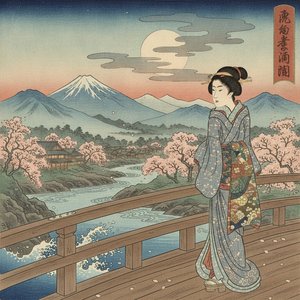
- Bijin-ga: His exquisite depictions of beautiful women, where he utilized flowing lines and intricate patterns to convey elegance and grace.
- Musha-e: His dynamic prints of legendary warriors and historical scenes, showcasing his command over action and composition.
The technical brilliance of Kunisada lay in his ability to push the boundaries of woodblock printing. He utilized a rich palette that became synonymous with the aesthetic of late Edo Japan. His compositions were not merely decorative; they were narrative powerhouses that reflected the social pulse of the era, from the high drama of the theater to the quiet elegance of the tea house.
Legacy and Historical Significance
The historical significance of Utagawa Kunisada cannot be overstated. He was not just a painter but a cultural chronicler who documented the zenith of Edo's urban culture. His work bridged the gap between traditional craftsmanship and the burgeoning commercial art market, making high-quality art accessible to a wide audience. Though his fame faced a period of relative obscurity in the West during the early modern era, contemporary scholarship has reclaimed him as a central pillar of Japanese art.
Today, we look back at Kunisada not merely as a successor to Toyokuni I, but as an artist who redefined the possibilities of the ukiyo-e medium. His influence can be seen in the evolution of graphic design and the continued reverence for Japanese printmaking worldwide. To study Kunisada is to witness the very heartbeat of 19th-century Japan, captured in ink, pigment, and wood.