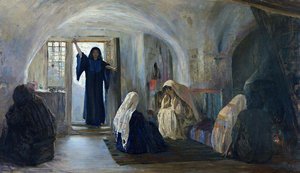
Vasily Dmitrievich Polenov: The Knight of Beauty
Vasily Dmitrievich Polenov (1844 – 1927) stands as a cornerstone of Russian landscape painting and a prominent figure within the Peredvizhniki movement—a group of realist artists who championed artistic freedom and social responsibility. Born in Saint Petersburg, Russia, Polenov’s life was marked by intellectual curiosity and unwavering dedication to his craft, shaping him into an artist whose vision profoundly impacted the cultural landscape of his time. He embodied what many contemporaries termed “the knight of beauty,” seamlessly blending European artistic traditions with the soulful spirit of Russian folklore and Orthodox Christianity.
His formative years were steeped in scholarly pursuits; Polenov excelled at mathematics and physics before embarking on a path toward art, studying at Saint Petersburg Imperial Academy of Arts alongside luminaries like Ilya Repin and Ivan Kramskoi. These influential mentors instilled in him a commitment to portraying the natural world with uncompromising honesty and capturing its emotional resonance—a principle that would define his artistic output throughout his career. The Peredvizhniki movement itself served as a crucible for Polenov’s artistic development, fostering an environment where artists dared to challenge academic conventions and explore themes of social justice and spiritual contemplation.
Polenov's artistic style evolved over time, initially influenced by Impressionism but gradually gravitating toward Symbolism. However, he steadfastly adhered to realism, prioritizing meticulous observation and accurate depiction of landscapes—particularly those imbued with religious significance. He famously stated that “art should promote happiness and joy,” reflecting his humanist conviction that art possessed the power to uplift humanity and inspire moral reflection. This belief permeated his canvases, resulting in works characterized by luminous color palettes, textured surfaces, and evocative compositions designed to convey profound emotional depth.
Among Polenov’s most celebrated paintings include ‘Oka River,’ a monumental landscape depicting the Volga River delta—a scene steeped in Russian folklore and imbued with symbolic representations of the Virgin Mary and Saint George. The painting's masterful use of color and light captures the ethereal beauty of the region while simultaneously conveying a sense of spiritual reverence. Similarly, ‘Dalisque’ showcases Polenov’s ability to distill complex emotions into simple visual forms—a testament to his artistic prowess and psychological insight. His depictions of monastic life, as seen in ‘Ushered in a tearful joy,’ are imbued with tenderness and compassion, reflecting his deep empathy for the human condition.
Furthermore, “At the foot of the mountain” exemplifies Polenov’s Impressionistic technique—characterized by loose brushstrokes and vibrant hues—to portray the serene majesty of the Ural Mountains. These paintings solidified Polenov's reputation as a master of landscape art and cemented his place within Russian cultural history. His legacy extends beyond individual artworks; he championed artistic education and actively encouraged young artists to embrace realism and explore themes that resonated with moral values. Vasily Dmitrievich Polenov’s enduring influence continues to inspire artists today, ensuring that “the knight of beauty” remains a symbol of artistic integrity and humanist compassion.