x


 Comprar impresión Comprar imagen en alta resolución
 Enviar
 Detalles
 Añadir a favoritos
 Descargar
 Similares
 Radiografía
 Presentación de diapositivas
Óleo sobre lienzo pintado a mano en el tamaño y marco de su elección, realizado por encargo por nuestros artistas.





























Elija entre nuestros tamaños predefinidos que respetan las proporciones originales de la obra.

Puede ingresar sus propias dimensiones para adaptarse a un marco o espacio específico. Si el tamaño seleccionado no coincide con las proporciones de la imagen original, recortaremos la obra o extenderemos la pintura con elementos adicionales pintados a mano. Se le enviará una maqueta digital para su aprobación antes de comenzar la producción.
Tenga en cuenta que la vista previa en pantalla no refleja el recorte o la extensión reales. Solo la maqueta mostrará con precisión la composición final.
Si bien existen tamaños personalizados, recomendamos seleccionar una dimensión de la lista predefinida para preservar las proporciones originales.
Entrega mundial () en 3-4 semanas en lugar de las 5 semanas estándar. (18 julio). Sin compromisos con la calidad.


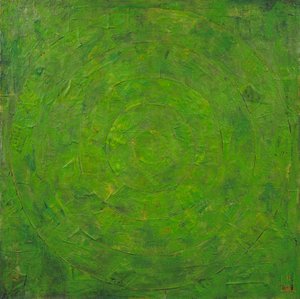
El Objetivo Verde
Tamaño de la reproducción
Jasper Johns's *Green Target*, created in 1955, is not merely a painting; it’s a pivotal statement within the evolving landscape of postwar American art. Emerging from the shadow of Abstract Expressionism, this work boldly reintroduces representation – but with a subversive twist. The image itself is deceptively simple: a vibrant green circle dominates the canvas, punctuated by a contrasting yellow center, evoking the familiar form of a target. Yet, to perceive it as merely decorative would be a profound misreading. Johns doesn’t offer us a target *to* aim at; he presents us with the very idea of a target, stripped bare and laid open for contemplation.
Johns' choice of subject matter is crucial. The target, inherently linked to notions of precision, skill, and even conflict, becomes an ambiguous symbol in his hands. Is it a celebration of American prowess? A commentary on the Cold War anxieties simmering beneath the surface of 1950s society? Or something far more personal? Johns deliberately avoids providing definitive answers, instead inviting viewers to project their own interpretations onto the work. This ambiguity is further amplified by his innovative technique. *Green Target* isn’t painted in a traditional sense; it's constructed using encaustic – heated beeswax mixed with pigment – layered over newspaper and cloth adhered to canvas. This process imbues the surface with a rich, tactile quality, revealing fragments of text and texture beneath the vibrant green. The layering itself becomes symbolic, suggesting hidden depths and the accumulation of history within a seemingly straightforward image.
The historical context surrounding *Green Target* is essential to understanding its significance. Abstract Expressionism, with its emphasis on spontaneous gesture and subjective emotion, had reigned supreme in the New York art world for over a decade. Johns' work represented a radical departure from this dominant aesthetic. While not fully embracing the overt consumerism that would define Pop Art, *Green Target* shares with it a fascination with everyday objects and imagery. It’s a bridge between these two movements, questioning the very nature of artistic expression and challenging the boundaries between “high” art and popular culture. The painting's reception was initially met with bewilderment and resistance from critics accustomed to the emotional intensity of Abstract Expressionism. However, Leo Castelli, a visionary gallerist, recognized Johns’ genius and championed his work, paving the way for a new generation of artists.
The impact of *Green Target* extends beyond its historical importance. The painting possesses an undeniable emotional resonance, stemming from its inherent contradictions. The bright, cheerful colors are juxtaposed with the unsettling implications of the target symbol. The meticulous craftsmanship contrasts with the seemingly casual application of encaustic and collage materials. This tension creates a sense of unease, prompting viewers to question their own perceptions and assumptions. *Green Target* is not a painting that offers easy answers; it’s a work that demands engagement, inviting us to delve beneath the surface and confront the complexities of modern life. Its enduring appeal lies in its ability to simultaneously fascinate, challenge, and provoke – qualities that solidify Jasper Johns as one of the most influential artists of the 20th century.
Johns’ *Green Target* stands as a testament to the transformative power of artistic experimentation. Castelli's astute observation that Johns’ gallery began with his debut exhibition underscores the significance of patronage in fostering groundbreaking art movements.
The painting’s enduring legacy resides not only in its formal innovations but also in its capacity to provoke contemplation about identity, representation, and the role of art within society.
Nacido en Augusta, Georgia, en 1930, Jasper Johns es un artista estadounidense altamente influyente, reconocido por sus obras innovadoras y provocativas que redefinieron el arte moderno. Su carrera abarca décadas, marcada por una constante exploración de la forma, el simbolismo y la propia naturaleza de la representación.
Johns experimentó una infancia desafiante tras el divorcio de sus padres. Asistió a varias escuelas antes de estudiar en la Universidad de Carolina del Sur durante tres semestres en 1948-1949. Luego se mudó a la ciudad de Nueva York en 1949, donde estudió brevemente en la Parsons School of Design y más tarde sirvió en el Ejército de los EE. UU. durante la Guerra de Corea. Este período tuvo un impacto significativo en su desarrollo artístico.
Inicialmente influenciado por el Expresionismo Abstracto, Johns pronto comenzó a desviarse de su enfoque puramente no representacional. Buscó un nuevo lenguaje visual que incorporara imágenes reconocibles, desafiando las normas estéticas prevalecientes de la época. Las influencias clave incluyeron:
El estilo artístico de Johns se caracteriza por su audacia, simplicidad, ironía y una ambigüedad deliberada. A menudo empleó técnicas como el encausto (pigmento mezclado con cera caliente) y el collage, creando superficies texturizadas que añadieron capas de significado a sus obras.
Jasper Johns desempeñó un papel crucial en la transición del Expresionismo Abstracto al Pop Art. Su uso de imágenes reconocibles desafió la noción de que el arte no tenía que ser puramente abstracto o emocionalmente expresivo. Allanó el camino para una nueva generación de artistas que adoptaron la cultura popular y los objetos cotidianos como tema.
Su influencia se puede ver en el trabajo de:
Las obras de Johns se conservan en importantes colecciones de museos de todo el mundo, incluyendo:
Jasper Johns sigue activo hoy en día. Su exploración continua de los límites artísticos y su impacto perdurable en el arte contemporáneo consolidan su posición como uno de los artistas más importantes del siglo XX y XXI.

1930 - , Estados Unidos de América

Descubre la armonía espacial y el poder del color en el arte abstracto. Guías expertas para interioristas y coleccionistas. Encuentra obras únicas que transformarán tus espacios.

Guía experta para coleccionistas de arte abstracto contemporáneo. Descubra las tendencias actuales, valore obras clave y aprenda a construir una colección significativa con Most-Famous-Paintings.

Explore Roy Lichtenstein's revolutionary Pop Art! Discover the story behind Ben-Day dots, iconic works like 'Whaam!', and investment insights for collectors. Expert analysis & high-quality reproductions at Most-Famous-Paintings.
Descubre las 25 obras maestras de Wassily Kandinsky, pionero del arte abstracto. Explora su expresionismo, composiciones únicas y la historia detrás de cada cuadro. Reproducciones de alta calidad para decorar tu hogar con arte moderno en Most-Famous-Paintings.com.

Descubre la evolución de la abstracción contemporánea y el legado de sus maestros. Análisis experto, técnicas innovadoras e inspiración para coleccionistas exigentes. ¡Encuentra tu obra abstracta ideal!


Manténgase al día con las últimas noticias de arte, ofertas exclusivas e ideas de decoración.
Cuéntanos sobre tu proyecto y nuestros expertos en arte te ofrecerán 3 sugerencias de obras personalizadas.
Permítenos seleccionar 3 opciones solo para ti – ¡Gratis!


 Compartir


 Ver más







 La opción de vidrio solo está disponible en tamaños inferiores a 110 cm.