The Dual Legacy of a Commander: Francisco Javier Venegas de Saavedra
In the grand tapestry of the nineteenth century, few figures embody the dramatic intersection of martial duty and artistic devotion as profoundly as Francisco Javier Venegas de Saavedra. Born in 1754 within the historic confines of Zafra, Badajoz, his life was defined by a rare duality. While history books often remember him as the 1st Marquess of Reunión and New Spain—a formidable Spanish general who navigated the treacherous waters of the Napoleonic invasions and served as the Viceroy of New Spain—the soul of the man found its most enduring expression not on the battlefield, but upon the canvas. His life was a continuous dialogue between the rigid discipline of military command and the fluid, spiritual grace of religious painting.
Venegas’s early years were marked by a scholarly inclination; he initially pursued literary studies, a pursuit that likely nurtured the sensitivity required for his later artistic endeavors. However, the call of the infantry proved irresistible. As he ascended through the ranks to lieutenant colonel, his experiences in the Spanish War of and the Battle of Uclés instilled in him a profound understanding of human struggle, sacrifice, and the sublime. This visceral connection to the weight of existence would later infuse his artwork with a unique gravity, allowing him to depict sacred figures not merely as distant icons, but as beings touched by the same mortal intensity he witnessed in the heat of conflict.
A Vision of Devotion: Artistry and Sacred Themes
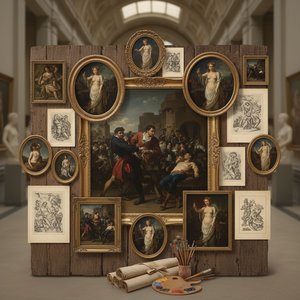
The artistry of Venegas de Saavedra is characterized by a deep-seated reverence for the divine, finding its most poignant manifestations in his depictions of Saint Vincent and San Francisco. His work transcends simple portraiture, moving into the realm of spiritual narrative. In these paintings, one can observe a masterful command of light and shadow, a technique that serves to elevate the subject matter from the earthly plane to the celestial. The way light clings to the folds of a saint's habit or illuminates a face in prayer suggests an artist deeply influenced by the emotional depth of the Romantic era, yet anchored by the classical traditions of Spanish religious art.
His paintings are more than mere decorations; they are meditations on faith. Through his brush, the figures of the saints become vessels for exploring themes of martyrdom, humility, and divine intervention. There is a certain majesty in his compositions that mirrors his own noble status, yet this grandeur is always tempered by a profound sense of piety. The textures of his work—the heavy drapery, the soft glow of skin, and the atmospheric backgrounds—work in harmony to create an immersive experience for the viewer, inviting a moment of quiet contemplation amidst the turbulent history of his era.
Historical Significance and Enduring Spirit
The historical significance of Francisco Javier Venegas de Saavedra lies in his ability to bridge two seemingly irreconcilable worlds. As a statesman and general, he was a central figure in the geopolitical shifts that reshaped the Spanish Empire and the Americas during the Mexican War of Independence. Yet, as an artist, he contributed to the cultural and spiritual lexicon of Spain, leaving behind works that continue to resonate with their evocative power. His life serves as a reminder that the intellect and the spirit are not mutually exclusive; the same strategic mind that organized divisions of infantry could also compose the delicate nuances of a religious icon.
Ultimately, the legacy of Venegas de Saavedra is found in the enduring beauty of his creations. While the political boundaries he once defended have long since changed, his paintings remain as timeless testaments to a life lived with immense purpose. To study his work is to encounter a man who understood that while glory may be found in conquest, true immortality is captured in the quiet, luminous moments of faith and the eternal pursuit of beauty.