A Legacy of Light and Line: The Life of Jean Humbert de Superville
In the vibrant intellectual landscape of the eighteenth century, few painters captured the quiet dignity of the Enlightenment era as gracefully as Jean Humbert de Superville. Born in Amsterdam in 1734 to a family of diverse European roots—his father, Pierre, was a Genevan merchant and his mother, Emilie, descended from a distinguished line of French Huguenot theologians—Humbert’s very existence was a bridge between cultures. This cosmopolitan heritage provided the foundation for an artistic journey that would traverse the great art capitals of Europe, from the rigorous training grounds of Paris to the prestigious guild halls of The Hague. His early years were shaped by the pursuit of excellence, studying under masters such as Jean Fournier and likely absorbing the Neoclassical nuances of Joseph-Marie Vien, a lineage that instilled in him a profound respect for classical form and anatomical precision.
As his career matured, Humbert de Superville emerged not merely as a craftsman, but as a chronicler of the Dutch social fabric. Moving to The Hague in the early 1760s, he became deeply embedded in the local artistic community, eventually rising to the esteemed position of head of the painters' guild, Confrerie Pictura. His talent for portraiture allowed him to navigate the upper echelural of Dutch society, securing commissions from powerful figures such as the politician Hendrik Fagel and the celebrated writer Isabelle de Charrière. These were not merely likenesses; they were psychological studies. Through a masterful application of glazing techniques—a refined inheritance from the Dutch Golden Age—he achieved a luminous quality in skin tones that seemed to radiate an inner vitality, capturing the fleeting nuances of expression that define the human soul.
Technique and the Art of Observation
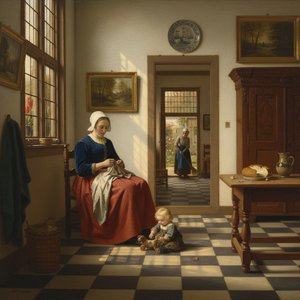
The brilliance of Humbert de Superville’s work lies in his ability to balance meticulous realism with an understated elegance. He possessed a rare gift for rendering the tactile reality of his subjects, from the heavy sheen of silk drapery to the intricate textures of lace and fine accessories, yet he never allowed ornamentation to overshadow the sitter's character. His palette was intentionally restrained, favoring muted, harmonious tones that created a sense of atmospheric depth and timelessness. This subtle approach ensured that his compositions remained clear and focused, directing the viewer’s eye toward the emotional truth of the subject.
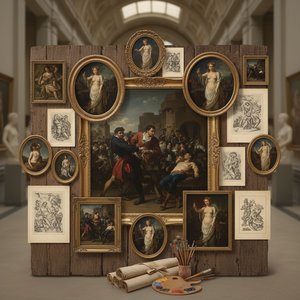
Beyond the intimate scale of portraiture, Humbert de Superville also ventured into the realms of historical and mythological subjects, demonstrating a versatility that spoke to his deep classical education. His contributions to public art were equally significant; he was tasked with designing the ornate decorations for the facade of The Hague's town hall during the momentous wedding of Stadtholder William V to Wilhelmina of Prussia in 1767. This ability to move between the private intimacy of a portrait and the grand scale of civic decoration underscores his importance as an artist who could command both the quietest room and the most public stage.
Historical Significance and Enduring Influence
Though the passage of time often obscures the names of those who worked in the shadows of more flamboyant eras, the historical significance of Jean Humbert de Superville remains anchored in his role as a definitive portraitist of his age. His work serves as a vital visual record of the Dutch elite during a period of profound transition. Through his brush, we encounter the faces of the men and women who steered the commerce, politics, and literature of the Netherlands.
His legacy is also found in the lineage of talent he helped foster and the family he left behind. His son, Jean Emile Humbert, would go on to achieve fame as a military engineer and archaeologist, while his brother David Pierre Giottino Humbert de Superville became a notable scholar and artist in his own right. Today, when we look upon works such as his Portrait of Adriaan du Bois, now preserved in the Rijksmuseum, we see more than just paint on canvas; we see the enduring spirit of an artist who mastered the art of seeing, capturing the very essence of an era through light, shadow, and a profound respect for the human countenance.