x

Käsinmaalattu öljyväri kankaalle haluamassasi koossa ja kehyksissä, taiteilijoidemme valmistamana tilauksesta. ( Osta printti Osta kuva)





























Valitse valmiista mitoistamme sellaiset, jotka vastaavat teoksen alkuperäisiä mittasuhteita.

Voit syöttää omat mitat sopimaan tiettyyn kehykseen tai tilaan. Jos valitsemasi koko ei vastaa alkuperäisen kuvan mittasuhteita, rajaamme taideteoksen tai jatkamme maalausta käsin maalatuilla elementeillä. Digitaalinen esikatselu lähetetään hyväksyttäväksi ennen tuotannon aloittamista.
Huomioithan, että näytöllä oleva esikatselu ei vastaa todellista rajausta tai jatkamista. Vain digitaalinen mallikuva näyttää lopullisen sommittelun tarkasti.
Vaikka mittatilaustyöt ovat mahdollisia, suosittelemme valitsemaan mitan ennalta määritetystä listasta alkuperäisten mittasuhteiden säilyttämiseksi.
Maailmanlaajuinen toimitus () 3–4 viikossa tavallisen 5 viikon sijaan. (18 elokuu). Laadusta ei tingitä.


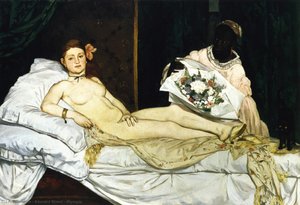
Olympia
Replikaatin koko
Édouard Manet's Olympia (1863) isn't merely a painting; it’s an audacious declaration, a seismic shift in the landscape of 19th-century art. Initially met with outrage and derision by Parisian society, this seemingly simple depiction of a nude woman has become one of the most iconic and endlessly debated works in Western art history. The canvas immediately confronts the viewer with a stark realism, devoid of the idealized beauty favored by academic painters of the time. Olympia, a courtesan, lies on her bed, attended by her black servant, Laure, who presents her with flowers – an act laden with complex social and economic implications. Manet deliberately avoids romanticizing the scene; there’s no idyllic pastoral setting, no mythological narrative to soften the blow of Olympia's nakedness. Instead, he offers a brutally honest portrayal of modern life, one that challenged the prevailing artistic conventions and sparked a furious debate about taste, morality, and representation.
Beyond the immediate depiction of a nude woman, Olympia is saturated with symbolic meaning. The inclusion of Laure, a black servant, was particularly controversial. It challenged the racial stereotypes prevalent in French society at the time and implicitly addressed issues of colonialism and slavery. The flowers presented by Laure are not a gesture of romantic affection but rather a transaction – a payment for services rendered. The gaze of Olympia, direct and unflinching, confronts the viewer with an uncomfortable awareness of her power and agency. The inclusion of the clock in the background subtly references time and mortality, adding another layer to the painting’s complex narrative.
Olympia debuted at the 1863 Salon, Paris's most prestigious art exhibition. The reaction was immediate and overwhelmingly negative. Critics condemned Manet for his unflinching realism, his lack of classical training, and his perceived vulgarity. They accused him of copying Delacroix’s *Saturn* and of depicting a prostitute in a manner that was both shocking and morally reprehensible. However, despite the initial outrage, Olympia ultimately played a crucial role in paving the way for Impressionism and other modern art movements. Manet's refusal to conform to academic standards forced the art world to confront new possibilities in representation and subject matter. His work demonstrated that beauty could be found not just in idealized forms but also in the complexities of everyday life, forever changing the course of art history.


1832 - 1883 , Ranska
Tutustu Édouard Manetin 25 mestariteokseen! Uppoudu impressionismin maailmaan ja opi taiteilijan tarina sekä ikonisten maalausten merkitys. Löydä upeita seinätaideteoksia kotiisi Most-Famous-Paintingsilta. Tutki kokoelma verkossa!

Explore the life & art of Édouard Manet, a pivotal figure bridging Realism and Impressionism. Discover his revolutionary techniques, controversial masterpieces like 'Olympia,' and lasting impact on modern art history.
Tutustu 10 impressionistisen mestariteoksen maailmaan! Claude Monet’sta Renoiriin – taidehistorian ikonisimmat maalaukset tarinoineen. Löydä inspiraatiota kotiisi Most-Famous-Paintingsilta ja tutustu laajaan valikoimaamme korkealaatuisia taidereproduktioita. Tutki kokoelma verkossa!

Uppoudu impressionismin maailmaan! Tutustu 10 ikoniseen mestariteokseen Monet'sta Renoiriin. Taidetta kotiisi – löydä upeat taideprintit ja öljyvärimaalaukset Most-Famous-Paintingsilta. Explore the full collection online!

Journey through Impressionistic Realism with 10 iconic masterpieces by Monet, Renoir & Van Gogh. Explore art history, techniques & find museum-quality reproductions for your home at Most-Famous-Paintings.com. Discover all masterpieces online!


Pysy ajan tasalla uusimmista taideuutisista, eksklusiivisista tarjouksista ja sisustusideoista.
Kerro meille projektistasi, niin taideasiantuntijamme tarjoavat sinulle kolme henkilökohtaista taidesuositusta.
Anna meidän kuratoida 3 vaihtoehtoa juuri sinulle – Ilmaiseksi!


 Esikatselu
 Jaa
Jaa Jaa
Jaa
 Tarkemmat tiedot

 Lataa
Lataa
 Samanlaisia
 Röntgenkuva
 Diaesitys

 Näytä lisää







 Lasivaihtoehto on saatavilla vain alle 110 cm kokoisina teoksina