


x
Osta korkearesoluutioinen, parannettu digitaalikuva, joka on laadultaan huomattavasti parempi kuin verkkosivuston esikatselu.
Jokainen tiedosto valmistellaan huolellisesti omien asiantuntijoidemme toimesta käyttäen edistyneitä työkaluja ja ammattitaitoista manuaalista retusointia. Varmistamme, että jokaisessa kuvassa on poikkeuksellinen selkeys, tarkka värintoisto ja hienovaraiset yksityiskohdat.
Lopputiedosto toimitetaan sähköpostitse 72 tunnin kuluessa, ja se on optimoitu välittömään käyttöön ammattimaisissa, toimituksellisissa ja painoympäristöissä. Laatu on sama, johon huipputason suunnittelustudiot, kustantajat ja galleriat luottavat.
Lataa korkearesoluutioinen tiedosto henkilökohtaiseen näyttelyyn, tulostamiseen ja luoviin projekteihin. ( Osta printti Osta käsintehty maalaus)
Kun valitset Most-Famous-Paintings.com-palvelun, et saa vain kuvaa – saat ammattimaisesti parannetun digitaalisen taideteoksen, joka on luotu tarkkuudella ja jonka takaa tulee tyytyväisyystakuu. Tässä on kaikki, mitä tilauksesi sisältää, automaattisesti:

Korkearesoluutioinen digitaalinen kuvatiedostosi lähetetään sähköpostiisi 72 tunnin kuluessa tilauksesta – valmiina käytettäväksi välittömästi.

Taiteilijasi teos on optimoitu ammattimaisesti edistyneiden tekoälytyökalujen ja manuaalisen muokkauksen avulla, mikä takaa maksimaalisen yksityiskohtaisuuden, selkeyden ja väritarkkuuden.

Oletko vahingossa poistanut tai kadottanut tiedostosi? Ei hätää – lähetämme sen sinulle uudelleen milloin tahansa täysin maksutta.

Nauti taiteestasi välittömästi ilman tulleja, veroja tai toimitusmaksuja – digitaaliset lataukset ovat aina verovapaita.

Varmistamme, että digitaalinen kuvasi vastaa alkuperäisiä värejä mahdollisimman tarkasti käyttämällä ammattilaistason työkaluja ja värinhallintaa.

Jos et ole tyytyväinen digitaaliseen kuvaasi, muokkaamme sitä tai palautamme 100% takaisin 60 päivän kuluessa – ilman kysymyksiä.

Etkö ole tyytyväinen? Saat täyden hyvityksen 60 päivän kuluessa digitaalisen tiedostosi vastaanottamisesta – ilman kyselyitä.

Osta 3 kuvaa, säästä 10% - Osta 5, säästä 15% - Osta 10+, säästä 20%. Erinomainen valinta luoviin projekteihin, gallerioille ja toimistoille.
Born in Bovisa, Italy, in 1889, Piero Parravicini was more than just a violin maker; he was an educator and innovator who championed the revival of classical violin making. He honed his skills at Monzino, Milan, absorbing knowledge from Romeo Antoniazzi (1862-1925), whose own approach to instrument construction drew inspiration from Stradivari’s groundbreaking methods.
Parravicini's dedication extended beyond production; he established a workshop where he imparted his expertise to aspiring artisans. His instruments garnered recognition at prestigious competitions—the National Lute-Making Competition in Rome (1925 & 1929), the International Contemporary Lute-Making Competition in Cremona (1949), and the National Exhibition in Florence (1951)—demonstrating his commitment to upholding the highest standards of craftsmanship.
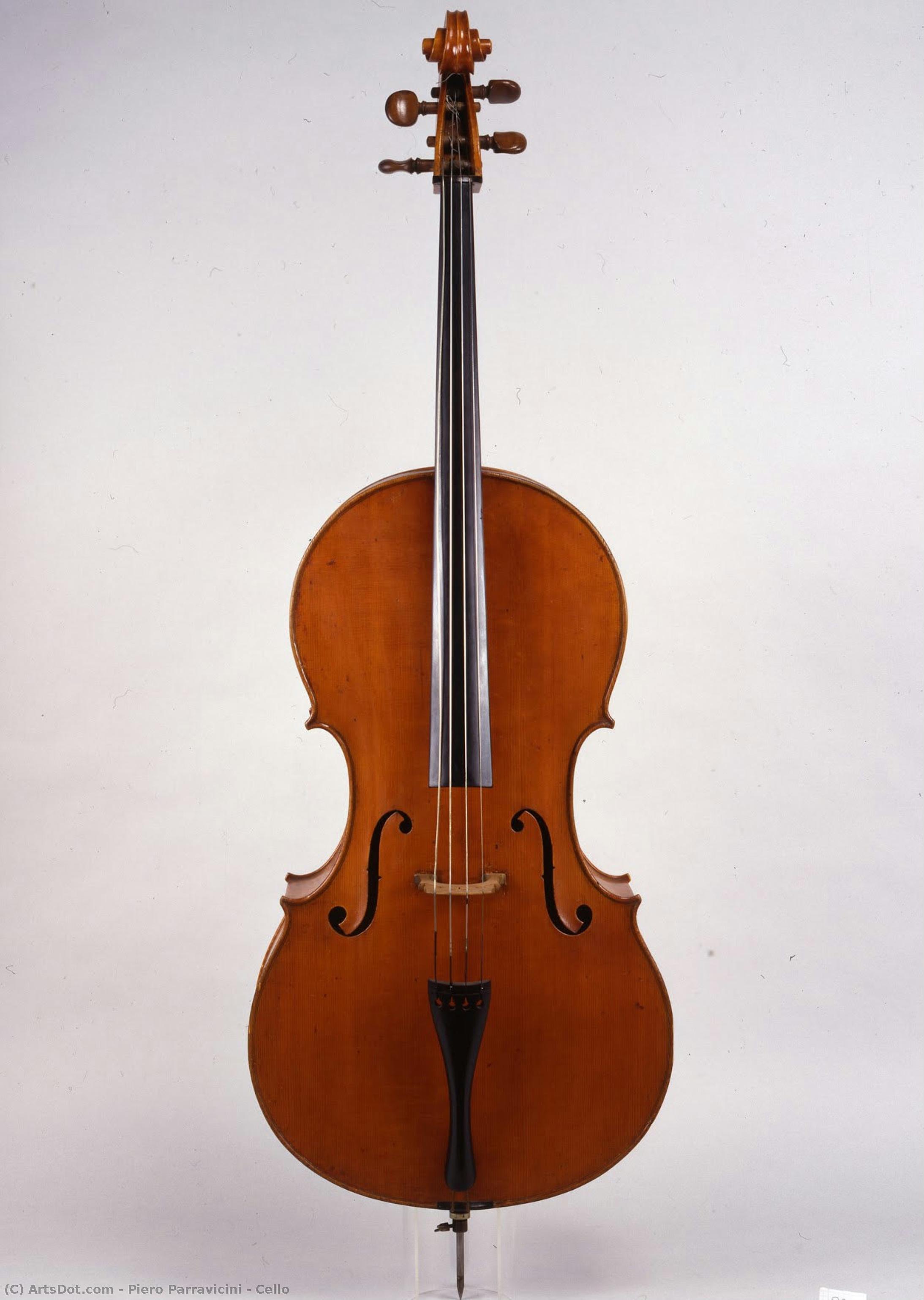
The cello's appearance speaks volumes about its maker’s vision. Its maple body exudes warmth and stability, while the spruce soundboard radiates luminosity—a characteristic achieved through meticulous polishing and varnish application. The white maple and black walnut purfling adds subtle textural contrast, enhancing both visual beauty and acoustic projection.
Beyond its physical form, the cello possesses a distinctive sonic character – a rich, resonant timbre capable of conveying profound emotion. This quality is attributable to Parravicini’s careful selection of materials and his meticulous attention to detail during construction—a testament to the enduring power of tradition in shaping artistic expression.
Like all great instruments, the cello transcends mere functionality; it embodies a deeper symbolic significance. Its elongated shape evokes contemplation and introspection – qualities that align perfectly with its expressive capabilities. When played skillfully, it can evoke feelings of melancholy, joy, and spiritual transcendence—connecting musicians and listeners alike to universal human experiences.
Piero Parravicini’s cello stands as a beacon of Italian violin making tradition – a symbol of unwavering dedication to craftsmanship and artistic excellence. Its enduring beauty and sonic power continue to inspire musicians and collectors worldwide, ensuring that the legacy of this remarkable instrument—and its maker—will endure for generations to come.

Vincent Willem van Gogh, a name synonymous with passionate brushstrokes and intensely colored landscapes, remains one of the most recognizable figures in art history. Born in 1853 in Groot-Zundert, Netherlands, his life was tragically short – just 37 years – yet during that time he produced over 860 paintings and around 1,100 drawings and sketches. His work, initially dismissed by critics, now commands staggering prices at auction and continues to resonate deeply with audiences worldwide. Van Gogh’s story is not simply one of artistic genius; it's a poignant tale of personal struggle, unwavering dedication, and the profound search for meaning through art.
Van Gogh’s early life offered little indication of his future as an artist. He worked as an art dealer in The Hague and London, experiencing firsthand the commercial realities of the art world – a reality that would later profoundly influence his perspective. He attempted various professions, including teaching and missionary work, but found himself increasingly drawn to the idea of capturing the beauty of the natural world on canvas. A significant turning point came at the age of 27 when he decided to dedicate himself entirely to painting, encouraged by his younger brother, Theo, who provided crucial financial support throughout Vincent’s career.
His artistic development unfolded primarily in France, particularly in Paris and Arles. Initially influenced by the Impressionists – artists like Monet and Renoir – Van Gogh quickly developed a distinctive style characterized by bold colors, thick impasto (the application of paint in layers), and swirling brushstrokes. He moved away from the fleeting effects of light favored by the Impressionists, instead focusing on conveying emotion and inner experience. The influence of Japanese prints, which he avidly collected, is also evident in his compositions – particularly in their use of flattened perspectives and bold outlines.
Van Gogh’s oeuvre encompasses a diverse range of subjects, including portraits, landscapes, still lifes, and self-portraits. Perhaps his most iconic works include *Sunflowers* (1888), a series of paintings celebrating the vibrant beauty of sunflowers; *Bedroom in Arles* (1888), offering an intimate glimpse into his personal space; *The Starry Night* (1889), a swirling, dreamlike depiction of the night sky above Saint-Rémy; and *Wheatfield with Crows* (1890), a powerfully evocative image filled with tension and foreboding. Each painting reveals a deepening exploration of color, texture, and emotional expression.
During his time in Arles, he sought to establish an artist’s colony alongside Paul Gauguin, hoping to create a community dedicated to artistic experimentation. However, the relationship proved turbulent, culminating in a severe mental breakdown following a confrontation with Gauguin. Following this episode, Van Gogh voluntarily admitted himself to the Saint-Paul-de-Mausole asylum in Saint-Rémy, where he continued to paint prolifically, producing some of his most emotionally charged works – including *Self-Portrait with Bandaged Ear* (1889). His final months were spent in Auvers-sur-Oise, under the care of Dr. Gachet, before his tragic death by suicide in 1890.
Van Gogh’s artistic journey was shaped by a confluence of influences. As mentioned earlier, he initially absorbed elements of Impressionism and Japanese printmaking. However, he also drew inspiration from the works of older masters, particularly Rembrandt for his use of light and shadow, and Millet for his depictions of rural life. Furthermore, Van Gogh’s personal experiences – his struggles with poverty, mental illness, and loneliness – profoundly informed his art. His paintings are not merely representations of external reality; they are expressions of his inner world, imbued with intense emotion and psychological depth.
It's important to note that Van Gogh’s work predates the formal establishment of Expressionism, yet he is widely considered a precursor to this movement. His emphasis on subjective experience, emotional intensity, and distorted forms paved the way for later artists who sought to convey inner turmoil through their art. His bold use of color and expressive brushwork anticipated many of the techniques employed by Expressionist painters like Edvard Munch and Ernst Ludwig Kirchner.
Despite his lifetime struggles and lack of recognition during his own time, Vincent van Gogh’s work has achieved unparalleled fame in the 20th and 21st centuries. His paintings are exhibited in major museums around the world, and his story continues to captivate audiences with its tragic beauty and profound emotional resonance. Van Gogh's influence on modern art is undeniable, and he remains a powerful symbol of artistic passion, perseverance, and the transformative power of creativity.
Today, Van Gogh’s legacy extends far beyond the realm of art history. He has become a cultural icon, representing the struggles of the outsider artist, the pursuit of beauty in the face of adversity, and the enduring human need for connection and meaning. His life and work serve as a testament to the power of art to illuminate the complexities of the human experience.

1889 - 1957


Pysy ajan tasalla uusimmista taideuutisista, eksklusiivisista tarjouksista ja sisustusideoista.
Kerro meille projektistasi, niin taideasiantuntijamme tarjoavat sinulle kolme henkilökohtaista taidesuositusta.
Anna meidän kuratoida 3 vaihtoehtoa juuri sinulle – Ilmaiseksi!


 Esikatselu
 Jaa
Jaa Jaa
Jaa
 Tarkemmat tiedot

 Lataa
Lataa
 Samanlaisia
 Röntgenkuva
 Diaesitys


 Näytä lisää


