


x

Huile sur toile peinte à la main, avec cadre et dimensions personnalisés, réalisée sur commande par nos artistes. ( Commander l'impression Télécharger l'image haute résolution)





























Choisissez parmi nos formats prédéfinis qui respectent les proportions originales de l’œuvre.

Vous pouvez saisir vos propres dimensions pour l'adapter à un cadre ou à un espace spécifique. Si la taille sélectionnée ne correspond pas aux proportions de l'image d'origine, nous recadrerons l'œuvre ou prolongerons la peinture avec des éléments peints à la main supplémentaires. Une maquette numérique vous sera envoyée pour approbation avant le début de la production.
Veuillez noter que l'aperçu à l'écran ne reflète pas le recadrage ou l'extension réels. Seule la maquette montrera fidèlement la composition finale.
Bien que des tailles personnalisées soient disponibles, nous vous recommandons de sélectionner une dimension dans la liste prédéfinie afin de préserver les proportions d'origine.
Livraison dans le monde entier () en 3 à 4 semaines au lieu des 5 semaines habituelles. (15 août). Aucun compromis sur la qualité.


Nude
Format de la reproduction
Alphonse Maria Mucha stands as one of the most recognizable figures of Art Nouveau, an artistic movement that flourished between 1890 and 1910 across Europe. Born in Brno, Czech Republic, in 1860, Mucha rejected the rigid academic traditions of his time, forging a path toward a uniquely expressive style rooted in observation and imagination.
His artistic journey began with studies at Prague’s Academy of Fine Arts, where he quickly recognized the limitations of conventional methods. Driven by an innate desire for innovation, he relocated to Paris in 1887, establishing himself amidst a vibrant intellectual milieu and immersing himself in the burgeoning Art Nouveau aesthetic.
Mucha's signature style is instantly identifiable: flowing lines reminiscent of plant stems and vines dominate his compositions, creating a mesmerizing sense of movement. Organic forms intertwine seamlessly with geometric shapes—particularly spirals—reflecting the influence of mathematicians like Ernst Haeckel and embodying the belief in harmony between nature and science that characterized the era.
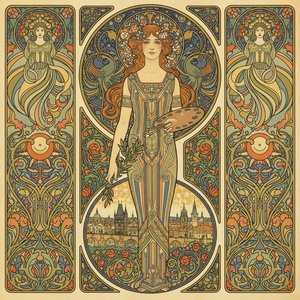
The painting “Nude,” often referred to as “La Femme Nue,” exemplifies Mucha’s masterful technique. Employing tempera on canvas, he achieved remarkable luminosity and textural depth through meticulous layering of pigments. The artist skillfully utilized glazing—applying thin translucent layers over opaque colors—to build up subtle gradations of tone and color, capturing the ethereal beauty of the female nude with unparalleled sensitivity.
Beyond its aesthetic merits, “Nude” is laden with symbolic significance. Mucha’s depictions of women frequently explore themes of femininity, purity, and spiritual awakening. The veiled face—a recurring motif in his oeuvre—represents modesty and contemplation, inviting viewers to engage in a dialogue about inner beauty and transcendence.
Historically situated within the broader context of Art Nouveau's fascination with mythology and folklore, “Nude” draws inspiration from classical ideals of feminine grace. It echoes the artistic explorations undertaken by Gustave Moreau and Piero Dorazio, artists who similarly sought to elevate art beyond mere decorative function into a vehicle for conveying profound emotional and intellectual ideas.
The painting’s impact extends far beyond its time, continuing to inspire contemporary artists and designers. Its elegant simplicity combined with evocative symbolism ensures that “Nude” remains a timeless masterpiece—a testament to Mucha's visionary artistry and the enduring allure of Art Nouveau’s enchanting vision of beauty.


1860 - 1939 , République tchèque
Explore the life & art of Alphonse Mucha, master of Art Nouveau! Discover his iconic posters, stunning illustrations, and the monumental Slav Epic. A comprehensive guide for collectors & enthusiasts.

Immerse yourself in the romantic allure of Art Nouveau. Explore the sinuous curves and floral elegance of the Belle Époque through our exquisite, hand-painted reproductions. Discover a timeless connection to nature’s beauty with our museum-quality collection.

Plongez dans l'univers fascinant de l'Art Nouveau ! Découvrez les 10 chefs-d’œuvre emblématiques de Klimt, Mucha et autres artistes majeurs. Inspirez votre décoration intérieure avec ces icônes du style floral et du symbolisme. Explorez la collection complète sur

Discover the enchanting world of Art Nouveau. Explore the organic beauty, flowing lines, and Belle Époque elegance that defined an era of unparalleled craftsmanship and natural inspiration.

Explore the captivating history of nude art! Discover iconic paintings & artists from classical to modern eras. Uncover symbolism, techniques & find museum-quality reproductions at Most-Famous-Paintings.


Restez informé(e) des dernières actualités artistiques, des offres exclusives et des idées de décoration.
Parlez-nous de votre projet et nos experts en art vous proposeront 3 suggestions d'œuvres personnalisées.
Laissez-nous sélectionner 3 œuvres rien que pour vous – Gratuit !


 Aperçu en situation
 Envoyer
 Partager
 Détails de l'œuvre

 Télécharger
 Articles similaires
 Radiographie
 Diaporama
 Lire la suite







 L'option verre n'est disponible que pour les dimensions inférieures à 110 cm.


