x

 Oil On CanvasWallArtExpressionism
 1913Modern
 51.0 x 57.0 cm
Impressions giclées ou sur toile de qualité musée, avec une production rapide et des finitions au choix. ( Commander la reproduction peinte à la main Télécharger l'image haute résolution)





























Choisissez parmi nos formats prédéfinis qui respectent les proportions originales de l’œuvre.

Vous pouvez saisir vos propres dimensions pour vous adapter à un cadre ou à un espace spécifique. Si la taille sélectionnée ne correspond pas aux proportions de l'image originale, nous recadrerons l'œuvre ou étendrons l'image avec une bordure en miroir ou une couleur unie. Une maquette numérique vous sera envoyée pour approbation avant le début de la production.
Veuillez noter que l'aperçu à l'écran ne reflète pas le recadrage ou l'extension réelle. Seule la maquette montrera avec précision la composition finale.
Bien que des tailles personnalisées soient disponibles, nous vous recommandons de choisir une dimension dans la liste prédéfinie afin de préserver les proportions originales.
Livraison dans le monde entier () en 2 semaines au lieu des 4/5 semaines habituelles. (18 août)


Promenade
Format de la reproduction
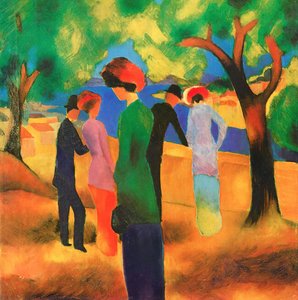
Captured in 1913, August Macke's "Promenade" offers a poignant glimpse into the burgeoning world of German Expressionism – a movement defined by its raw emotional intensity and rejection of traditional representational art. This intimate scene, measuring 51 x 57 cm, depicts a group of figures leisurely strolling along a shaded path beneath a canopy of trees, an idyllic tableau rendered with a distinctive boldness that speaks to the anxieties and aspirations of the early 20th century. The painting’s power resides not in photographic realism but in its ability to evoke a profound sense of mood and atmosphere – a feeling of quiet contemplation and fleeting joy within a rapidly changing world.
Macke's artistic trajectory was marked by a relentless pursuit of new forms, initially influenced by Impressionism and Post-Impressionism. However, “Promenade” firmly establishes him as a key figure within the Expressionist movement. The simplified forms, flattened perspective, and deliberate distortion of figures are hallmarks of this style. Notice how the rectangular shapes of the clothing contrast sharply with the organic curves of the trees, creating a visual tension that mirrors the emotional undercurrents of the scene. The use of color is particularly striking – vibrant greens and blues dominate, not to accurately depict nature but to amplify the painting’s emotive impact. Thick, impasto brushstrokes contribute significantly to this effect, adding a tactile quality and emphasizing the artist's deliberate manipulation of texture.
Executed in oil on canvas, “Promenade” reveals Macke’s masterful control of his medium. The visible brushwork is not merely a stylistic choice; it actively contributes to the painting’s expressive power. The layering of colors, particularly in the foliage and shadows, creates a sense of depth and volume while simultaneously conveying a feeling of movement and energy. The diffused lighting, ambiguous yet evocative, further enhances this effect, bathing the figures in a soft glow that suggests both serenity and an underlying melancholy. Macke’s technique demonstrates a commitment to capturing not just what he saw but how he *felt* about what he saw – a core tenet of Expressionist art.
Created in 1913, at the cusp of World War I, “Promenade” carries a subtle yet significant symbolic weight. The figures strolling along the path represent a momentary escape from the pressures and uncertainties of modern life – a brief respite within nature’s embrace. This theme resonates with the broader anxieties of the era, reflecting a desire for stability and tranquility amidst widespread social and political upheaval. Macke's work, like that of many Expressionist artists, can be interpreted as a response to the rapid industrialization, urbanization, and technological advancements transforming Europe at the time. The painting’s inherent beauty serves as a poignant reminder of the fragility of peace and the importance of cherishing simple pleasures.


1887 - 1914 , Allemagne

Explore the visceral power of German Expressionism. From Ernst Ludwig Kirchner to Die Brücke, discover how bold colors and distorted forms unmask raw human emotion in this expert art history guide for collectors and enthusiasts.


Restez informé(e) des dernières actualités artistiques, des offres exclusives et des idées de décoration.
Parlez-nous de votre projet et nos experts en art vous proposeront 3 suggestions d'œuvres personnalisées.
Laissez-nous sélectionner 3 œuvres rien que pour vous – Gratuit !


 Aperçu en situation
 Envoyer
 Partager
 Détails de l'œuvre

 Télécharger
 Articles similaires
 Radiographie
 Diaporama
 Lire la suite







 L'option verre n'est disponible que pour les dimensions inférieures à 110 cm.